To see Simbang Gabi institutionalized at the Archdiocese of Los Angeles is being on the right side of history, for me. It is part of our immigrant story in Los Angeles.
I thank the pioneering priests who introduced this cultural tradition, such that now, over 40% of the over 280 parishes in the Archdiocese of LA have Simbang Gabi; as in San Francisco, Florida and even Qatar and Pope Francis celebrated Simbang Gabi in Rome, according to Fr. Rodel G.Balagtas, who introduced it to @Immaculate Heart of Mary Church in East Hollywood. A very animated adult choir, 32 plus would travel from all parts of Los Angeles with flute, cello, violin, guitars and drums to sing the best Pinoy carols under the precise baton of @Pete Avendano, with the best homilists, some came from Chicago, Butuan, and Quezon. Each morning, volunteers would feed us hot soups, congee, hard boiled eggs sandwiches and rice cakes. Those were the golden years of celebrations of GRACE!
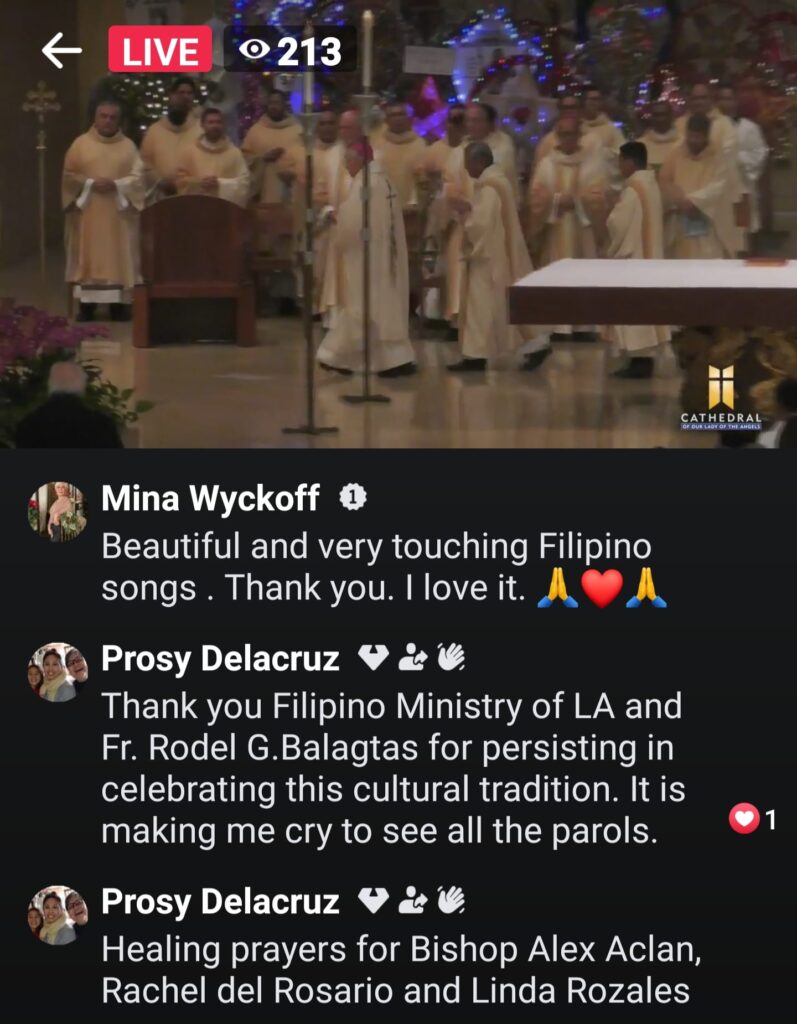
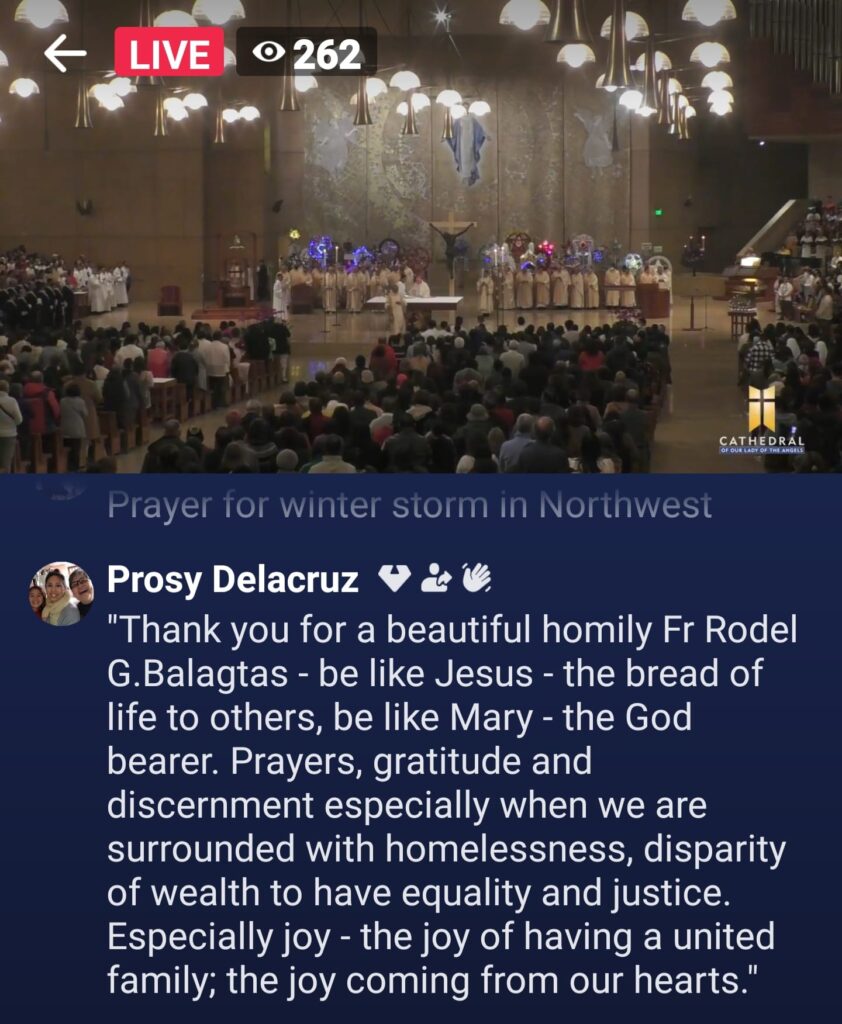
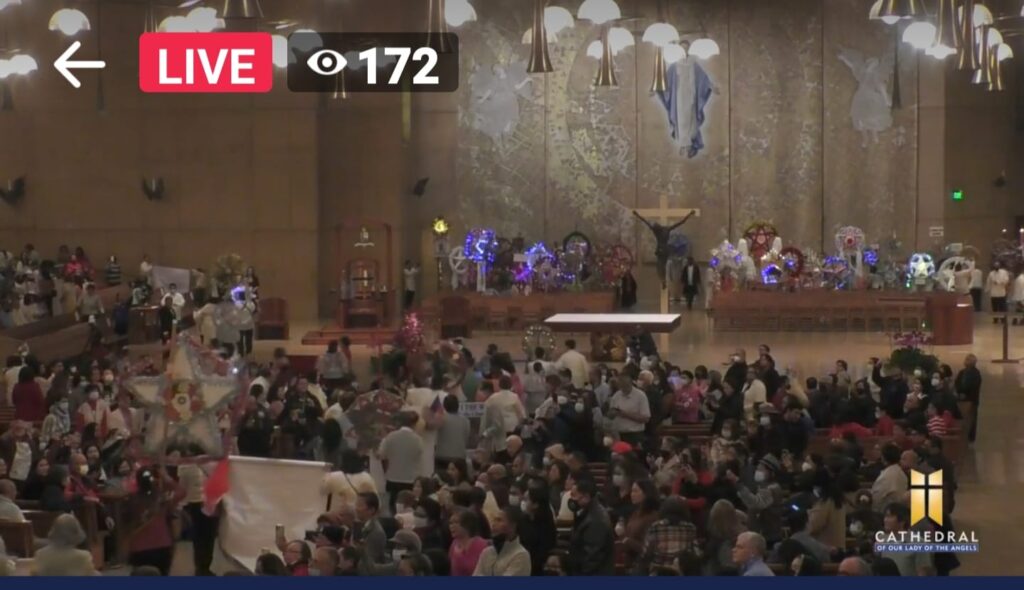
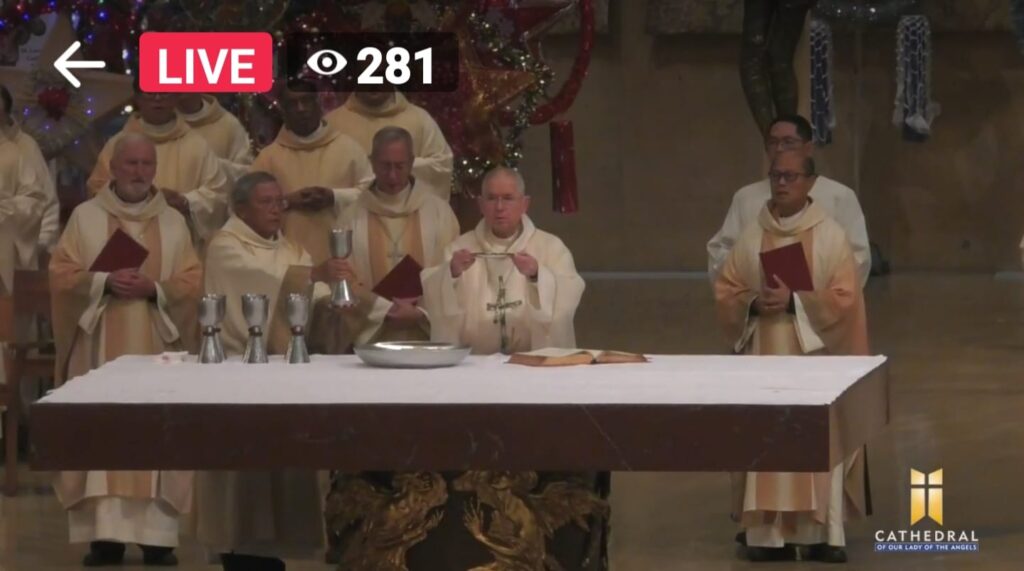
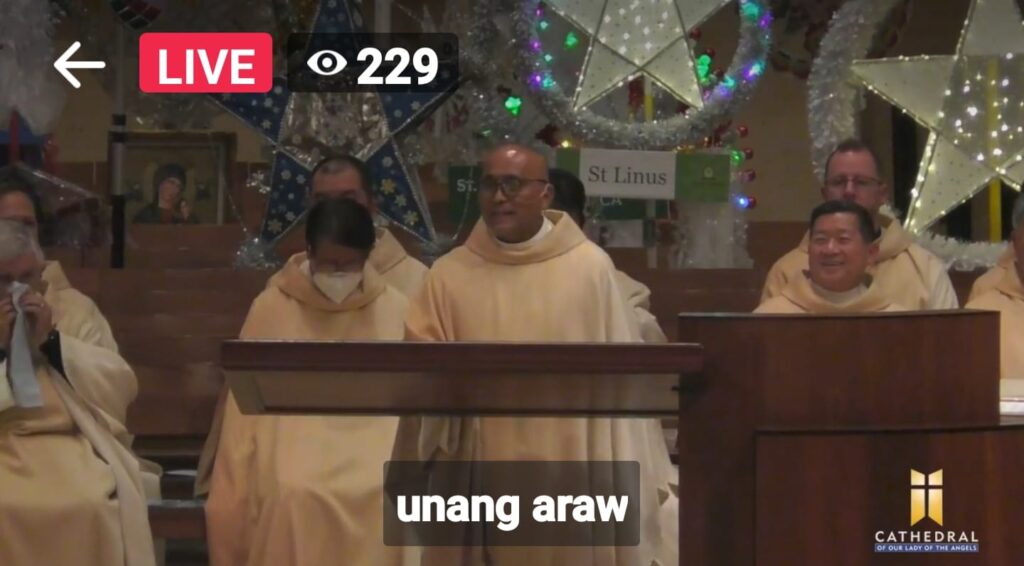
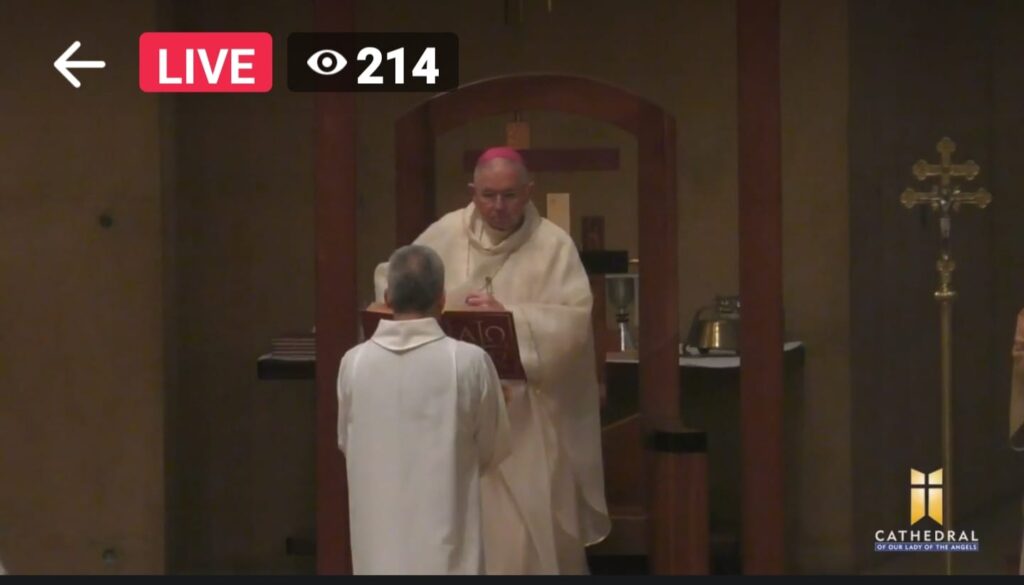
Thousands came – it was a full Cathedral. I was teary-eyed watching this livestreamed mass at the Cathedral of Angels in #dtla. With a sore throat, I opted to protect my health and my family, with a baby on the way from my first born.
Archdiocese of LA posted:”Thousands of Filipino Catholics from throughout Southern California will celebrate the beginning of the 20th annual Simbang Gabi, one of the oldest Filipino Christmas traditions, with a special Mass on Sunday, December 15 at 6:30 PM at the Cathedral of Our Lady of the Angels, 555 W. Temple St., in downtown Los Angeles.
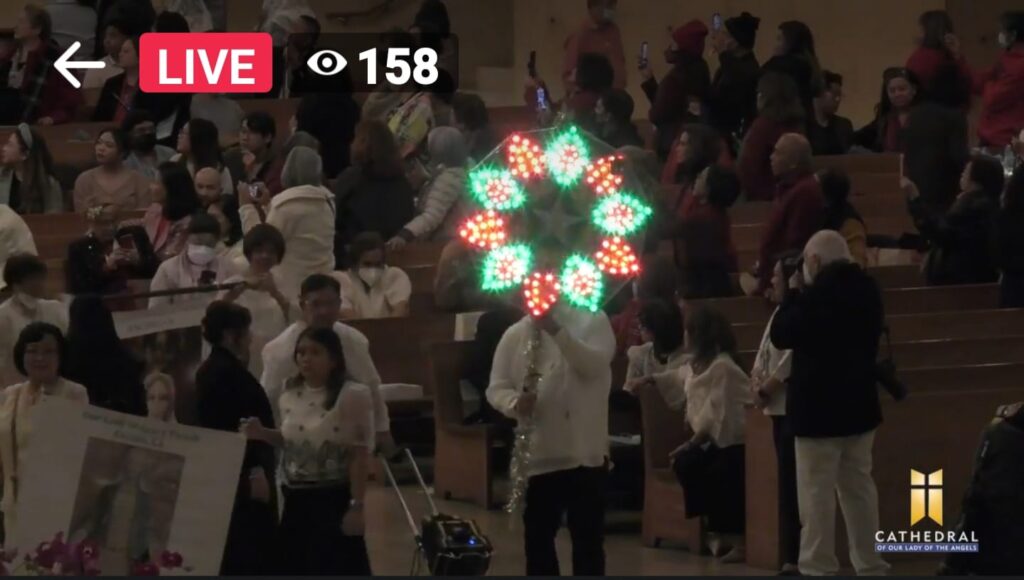
The Mass will be preceded by the “Parade of Parols,” or lanterns, of more than 120 parishes from the five pastoral regions in the tri-county Archdiocese (LA, Santa Barbara and Ventura)
The parols, a Philippine Christmas symbol, will be blessed at the end of the Mass. In the Philippines, the parol is used to light up people’s homes and is carried by parishioners attending Simbang Gabi Mass, or “Mass before dawn.” The procession will also include parols of religious Filipino-American organizations, civic and professional organizations, and government offices, usually led by the Philippine Consulate General.
The Filipino tradition of Simbang Gabi dates back nearly 500 years. It begins nine nights before Christmas Eve. An Advent Mass is celebrated before dawn each night in preparation for Christmas.”
Pinoy priests are not professional singers. Yet, they practiced with Pete Avendano and harmonized their voices well to sing two songs, their gift to the thousands of Filipino Americans and friends who came. What a beautiful worship mass, quite generous like Baby Jesus offered us by God.
“I see, above all, the pressing need to strengthen institutions, which are a vital reserve of moral energy and civic love. The hyperinflation of the individual goes along with the weakness of the state. Once people lose a sense of the common good, history shows that we are left with anarchy or authoritarianism or both together, a violent, unstable society.
We are there already; just consider the numbers of people who die each year from gun violence in the Americas. Since the outbreak of the crisis in the U.S., sales of guns have broken all records.” —Pope Francis, “Let Us Dream,” 2020.
“Where there shall be no darkness nor dazzling, but one equal light; no noise or silence, but one equal music.” —John Donne, 2004
In 2004, Harry Eyres of the Financial Times wrote about John Donne, a clergyman and a poet, who confronted the terror of death and saw beyond it a vision of peace, addressing the memorial of a dead woman. Donne spoke at a service consisting of words and music, “the two resources which are all that we humans can or need to bring to bear in the face of death,” outside of London.
What if we bring to our daily consciousness how we want to be remembered at our deaths? Will we be recalled for our fears? Or our strength? Or standing up to hate crimes?
In America, “it has been a year of living in fear for their lives, Pres. Joe Biden said, “they’ve been attacked, blamed, scapegoated and harassed. They’ve been verbally assaulted, physically assaulted and killed.” The 46th US President spoke of six women of Asian descent, who died from a mass shooting, constituting a pattern of violence against Asian Americans: Xiaojie Tan, 49; Daoyou Feng, 44; Delaina Ashley Yaun Gonzalez, 33; Paul Andre Michels, 54; Hyun J. Grant, 51; Soon C. Park, 74; Suncha Kim, 69 and Yong A. Yue, 63.
Eight died from this tragic crime. The gunman, interviewed by Cherokee Police, was reportedly acting out ‘his sexual addictions’, had a ‘bad day’ and was charged by the prosecutor for the multiple murders.
Harry Eyres wrote of the dead woman’s husband of 50 years who got up not once, but three times speaking on the “strength, dignity and fullness of the wife he had admired and loved, while the son spoke of “his mother’s reticence and obliqueness combined with warm care and good sense.”
What if these were our default behaviors towards all in America, especially women and girls?
Unconscious bias of institutions
Archbishop Socrates Villegas, the head of the Philippines’ Conference of Catholic Bishops teaches us “that the design of human beings is relationships…our destiny is relationships – all of us are connected. We are designed to love, to serve, to forgive, to not be separated. Computers have designs. In every human being, there’s a design to embrace, to live together, to touch. God condemned living alone, and created a woman to keep man, company.”
A day after the 46th U.S. President Joe Biden was inaugurated, the United States Catholic Conference of Bishops (USCCB) wrote a congratulatory note, signed by Archbishop Jose Gomez, which criticized the incoming president for his support of women’s reproductive rights as policies of “moral forces of evil.”
Imagine as a woman, reading this, would you not feel less than?
This is the institution which equated taking birth control pills, as abortifacient drugs, and based on that unscientific information, propagated by an unvetted Filipina physician, it became part of a New Mexico’s bishop’s homily advocating against Obamacare, the same affordable health care services, that millions of Americans currently depend on. Would we have reached a million deaths now if without Obamacare, given this pandemic?
It leads me to question – is this institution, USCCB truly pro-life?
Somehow the Universe pointed me to get my answer. I attended the mass officiated by Bishop Pablo Ambo David, digitally streamed from San Roque Cathedral in Caloocan, Philippines, viewed online by thousands.
“There will never be a time when the Church will consciously choose anti-life, or it ceases to be a Church…but through slavery, colonialism, misogyny, bigotry, slavery, we may claim we are pro-life, but espouse anti-life tendencies. In the past, Christians saw nothing wrong with slavery. People can’t be so evil that they can kill a defenseless child in a mother’s womb. It is blasphemy to regard any being as inherently evil because the creator is God and looked at His creations as very good, after the image and likeness of God.
Although we are inherently good, we are capable of committing evil. That’s why I cannot believe any woman as depraved, intrinsically evil to harm her child. It’s a woman’s instinct to not cause harm on her kid, without causing more harm to herself psychologically and spiritually.”
Why did I react? I know a handful in my circle that opted for abortion for their ectopic pregnancies, where the fetus attaches outside the uterus, and if left to mature, would cause blood poisoning to the mother, while others aborted for cancerous tumors.
I also know of moms who chose their infant, even if it meant the loss of their own lives.
When I was hemorrhaging nine days after giving birth to my youngest child, and I was declared code blue, compelling urgent blood transfusions, I made my husband promise to prioritize taking care of my children, before all else.
Speaking the language of the heart, instead of hate
When Lee Isaac Chung received the Golden Globe for Best Foreign Language Film for Minari, he said: “Minari is about a family trying to learn how to speak a language of its own. It goes deeper than any American language and any foreign language. It’s a language of the heart.”
Rumi, a poet, wrote, “It is better to speak the same language of the heart than speaking the same tongue.” In America, we have privileged the English language, yet the Census Bureau reports at least 350 languages are spoken in U.S. homes.
With these many languages, are we passing on a “minimization” of who we truly are? Or are we celebrating the multiplicity of heritages that our new generation is composed of? A friend’s grandchildren are Filipino, Chinese and American in ethnicities and are raised to embrace the richness of these cultures. In my own relations, one is Filipino, Chinese and American; while another is Filipino, Black and American and one is Filipino, Mexican, El Salvador and American in origins, all born in the United States of America.
Recently, the Antioch Police knelt on the neck of a 30-year-old Filipino American Navy Veteran, Angelo Quinto, for nearly five minutes, as previously reported in the Asian Journal. Had the Antioch Police restrained him as if their own family, would they have realized five minutes would kill him?
This was the same amount of time that four LAPD officers took to break the bones and the skull of Rodney King, after a high-speed chase for drunk driving. A bystander, who happened to have his new camcorder, also videotaped it. More than a dozen officers stood by and watched the beating. Even with that ocular proof, the officers were acquitted. The message was – “don’t trust what our lying eyes are seeing, as if it did not happen.”
The flames surrounded us, north, east and west. My children, then teenagers, got scared.
Rather than allowing their fears to grow, I asked my husband to take us near First AME Church. There, as we swept up the trash, the burnt debris, some still smoldering, hundreds of strangers gave smiles and some even gave hugs.
The federal government filed a civil complaint against LAPD officers, and a civil jury trial was held. The jury was headed by then foreperson Ester Soriano-Hewitt, the architect of the LA County’s Dispute Resolution Program. Two of these LAPD officers were found guilty and sentenced to prison terms. In a separate civil trial, filed by the federal government, two were acquitted and the LA City was held liable and awarded Rodney King $3,800,000 in damages.
But can monetary damage wipe out the trauma, the broken families, and generational theft of their futures with their loved ones?
Can we change our culture to dismantle racism, one family at a time?
Last year, during the pandemic, thousands marched in rallies in hundreds of cities in America and 20 countries abroad protesting the death of George Floyd, when Officer Derek Chauvin knelt on Floyd’s neck for 8 minutes and 46 seconds. That visible taking of someone’s life by a police officer, while his fellow officers stood by, was a betrayal of the public oaths they took. They have all been fired.
Chauvin faces a state trial for his actions and faces charges of second and third-degree murder. The Floyd family filed a federal civil rights lawsuit and the news recently reported that Minneapolis would settle for $27 million.
Recall the day when Joseph Ileto was mistaken for a Latino by a self-professed Aryan white supremacist, Buford Furrow? Furrow was an engineer who worked for several years for Northrop Gurman.
The tragedy was Ileto volunteered to work at the North Valley, when he worked in the eastside. He simply wanted to help another co-worker. He lived with his mother, sister and was the father figure to the family who had lost their father. Joseph often helped out with his co-workers.
Furrow opened fire first with 70 shots in the Valley Community Center, injuring three kids, a counselor and a worker. He drove miles from the center and when he saw Ileto had just delivered the mail, returning to his postal truck, he asked him to mail a letter. He then shot Ileto nine times. Furrow confessed he murdered Ileto, thinking he was Latino or Asian.
Ten years later, Furrow wrote a letter supposedly repenting, “I feel a life based on hate is no life at all.”
Ishmael, Joseph Ileto’s brother, has this to say: “It still hurts that our brother was taken from us and a letter won’t make up for that. It’s a positive thing that he’s saying he’s changed — it gives us some type of hope that people are able to rehabilitate themselves.
And that is a hopeful sign.” Even with two serial losses, a father and a brother, the Ileto family went to rallies nationwide to call for gun control and attended many high school trainings on hate crime prevention.
When we first heard this shooting on August 10, 1999 — we were shocked. We went to a Valley-based memorial, attended by mostly Jews, and we were one of the two Filipino families who attended. It led us to co-organize with the Asian American Legal Center and with Rachel Cometa Estuar’s “give it my all” leadership, as 25 community leaders, to mobilize over 40 groups and attended by over 400 folks. One of those leaders is the incoming Vice Chancellor Anna Gonzalez for Washington University in St. Louis.
Two memorials were held, one was a community vigil in the Japanese American Community Center and I invited my teenagers with their classmates to attend. It moved my teenage daughter to organize a hate crime prevention symposium at her high school and with the support of the teachers, the student body created an art project together.
Hundreds of square cloth fabrics carried the weight of traumatized high schoolers, later threaded together into a quilt, describing their bullying experiences and anguish at mistreatment at home. It became a wall mural, still hanging today by the principal’s office at Los Angeles Center for Enriched Studies.
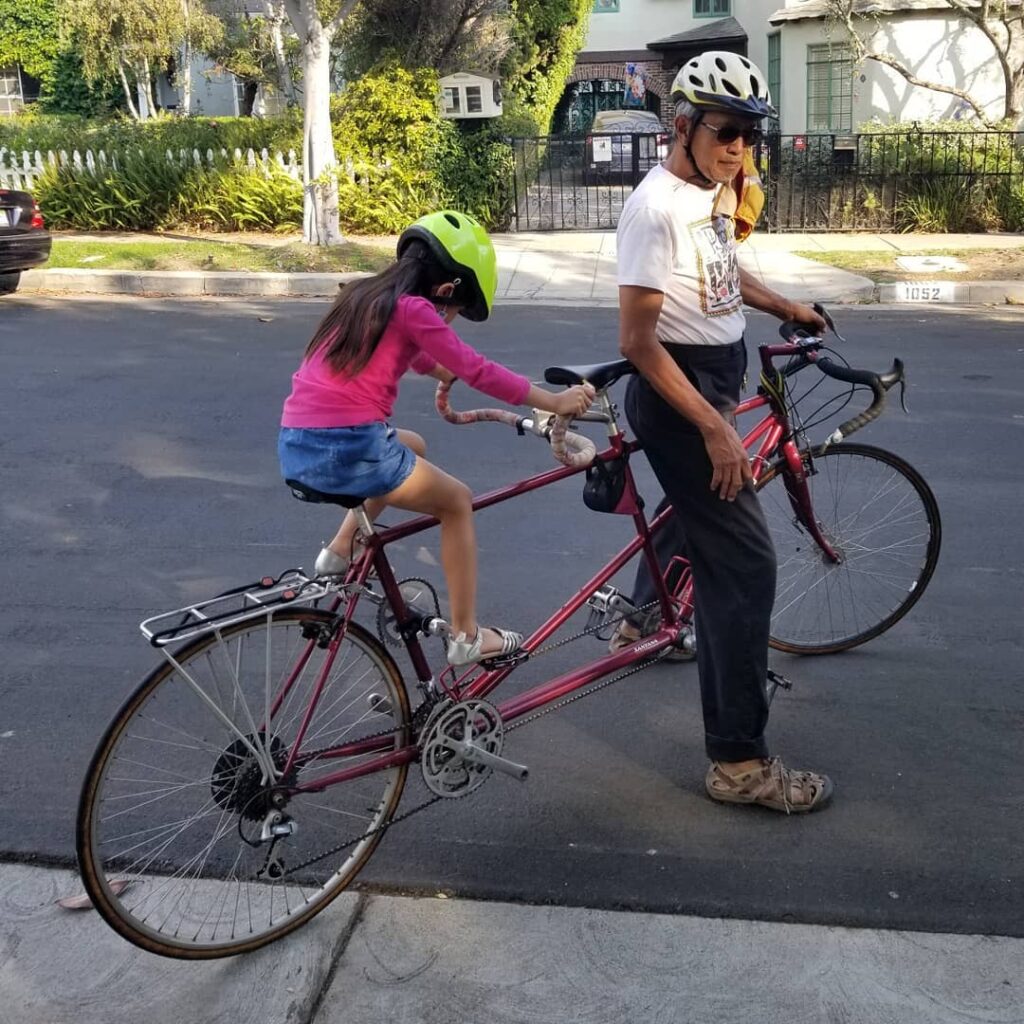
One day, my 6-year-old precocious granddaughter shared being punched in the tummy by her playmate. She was sleeping over in a relative’s house. Instead of an apology, her playmate rushed to her parents to reverse what happened.
I asked her to consider her playmate’s situation: What was causing her playmate to act that way. She knew right away and said, “Grandma she wants to be me when she can just be herself and be happy.”
I also told her she should not allow anyone physically hit or harm her, even if a friend or relative, and to let her parents know. She was in a sports camp when her personality briefly changed. She was irritable. When we talked about it, she said someone was hurting her.
Her diligent and conscientious father taught her a skill: go to him, look at his eyes and tell him, “Stop,” and walk away. She also reported it to the teacher.
That afternoon, her dad asked, “What happened at camp? Did you have a problem?”
“Papa, it worked. I did what you told me.”
Why did it work? She stopped the bully, by taking away the power to be over her. She claimed her agency.
One day, she said, “Don’t worry Grandma, I will not throw away my heart.”
“What happens if you throw away your heart,” I asked?
“When you throw away your heart, you become sassy and bossy. You hurt others, pinching them, hitting them in their tummy.” She was listening to raised voices on television and told me: “Grandma, it hurts my heart and ears to hear shouting. I am used to kind and gentle voices, like yours.” I became teary-eyed and hugged her.
Footnote: This piece is dedicated to my first-born, Corina, my favorite, beautiful daughter, the mother of my 6-year-old granddaughter, from whom I am getting heart-widening lessons. Corina organized the hate crime prevention symposium in her high school and organized Asian Americans in her college. Today, she takes a multicultural network of family and friends, intergenerational at times, climbing mountains.
She also plays her cello as part of a diverse philharmonic group, which has gone silent because of the pandemic. She works as a paralegal at a century-plus old law firm that teaches her daily what it is to climb a mountain while sustaining a personal code of ethics and healthy lawful operational practices.
* * *
The opinions, beliefs and viewpoints expressed by the author do not necessarily reflect the opinions, beliefs and viewpoints of the Asian Journal, its management, editorial board and staff.
* * *
Prosy Abarquez-Delacruz, J.D. writes a weekly column for Asian Journal, called “Rhizomes.” She has been writing for AJ Press for 13 years. She also contributes to Balikbayan Magazine. Her training and experiences are in science, food technology, law and community volunteerism for 4 decades. She holds a B.S. degree from the University of the Philippines, a law degree from Whittier College School of Law in California and a certificate on 21st Century Leadership from Harvard’s Kennedy School of Government. She has been a participant in NVM Writing Workshops taught by Prof. Peter Bacho for 4 years and Prof. Russell Leong. She has travelled to France, Holland, Belgium, Spain, Portugal, Japan, Costa Rica, Mexico and over 22 national parks in the US, in her pursuit of love for nature and the arts.
“I confess that when I hear some speeches by someone responsible for public order or a government, I am reminded of Hitler’s speeches in 1934 and 1936. They are typical actions of Nazism, which with its persecutions of Jews, gypsies, people of homosexual orientation, represent a negative model ‘par excellence’ of a throwaway culture and a culture of hate. That’s what they did then and today these things are resurfacing. [We] need to be vigilant, both in civil and religious society to avoid any possible compromise…with such degeneration.”
Pope Francis, Nov. 15, 2019, as reported by Lauren M. Johnson, et.al of CNN.
“The prayer of the heart opens the eyes of our soul to the truth of ourselves as well as to the truth of God. The prayer of the heart challenges us to hide absolutely nothing.”
Henri J.M. Nouwen, “The Way of the Heart,” 1981.
“Hate starts at every house,” Maura Brito said.
Instead of nursing her wounds of indignities, Maura purged them from her heart, by sharing her woes with friends. Her weapons against hate-inflicted wounds are love, forgiveness, prayers and conscientious service to others.
Maura, a Honduran, is a caregiver to Inga, a 93-year-old German survivor who persistently pointed out daily mistakes and deficiencies, like how this object does not belong to this space. “Can you not remember?”
During Inga’s teenage years, she lived in Germany, under Nazism, fed with daily radio broadcasts of hating others, other than Germans. Might that daily diet of hatred towards others affected her adult tendencies?
When Inga’s children would visit, Inga and Maura busily cook dishes for them to share and take home. On Maura’s birthday, Inga also made a special torte for her. But, Maura’s daily diet consisted of occasional thank you and heavy doses of daily pointing out mistakes.
One day, Inga’s son helped himself to groceries, taking them home without asking his mother. Maura was accused of taking them. She felt so angry and declared how she was raised to value honesty.
How was the truth finally revealed? Inga’s son fessed up to his dishonesty. Maura came close to quitting many times, but renews her positive spirit through prayers, forgiveness and projecting her wish to the Universe — that her quality caregiving be paid forward to her blind mom in Honduras.
The coronavirus pandemic transformed this negative default switch of Inga, realizing that 15 years of unilaterally pointing out mistakes, hyper scrutiny to most, she blurted out: “Please don’t leave me, Maura. I know you care about me.” Maura still takes care of Inga, wearing masks, and declined family invitations to preserve the health and safety of Inga, as herself. Of late, she asked friends to pray for Inga, to ease her suffering.
Grace starts at every house, spreading out to neighbors
98-year-old May struggled as a Holocaust Jewish survivor and waited for entry as a refugee in New York. She is quick to display gratitude and graciousness about the “thoughtful deeds” of anyone, including her caregivers, who are both Filipina immigrants. Michelle Dormitorio, May’s caregiver, commutes from Cerritos, a distance of 50 miles round trip.
During the pandemic, she changed her working hours including an overnight stay, to reduce her commute exposure to coronavirus, thereby protecting May’s health. Michelle did not go to family get togethers, to decrease her risk of acquiring the virus, a firewall she created to protect May.
When caregivers for the elderly were prioritized for vaccines, Michelle got hers. While May was in post-surgery and post-rehabilitation, Michelle stayed with her at the facility, making sure May was properly cared for: her meals, her medications, read to her and facilitated her grooming needs. One day when I visited her, her ice cream was lovingly served with strawberries cut to resemble a flower.
May, though a Holocaust survivor, normally expected in survivor studies to harbor bitterness and resentment, instead is generous, filled with love and overflowing appreciation. During neighbors’ visits, she would share how Michelle cares for her as family. May’s graciousness to others is legendary that her grandchildren’s visits last a week and neighbors do not miss a chance to celebrate her birthday. This year, even short hellos by her front window, flowers, and home-baked banana bread with her favorite chocolates were given. “C’mon come in,” she said with a smile, which we politely declined, to prevent viral transmission and a loving thank you card, penned by Michelle days after. (May handwrote all cards, until two years ago).
Grace and hatred grow legs in institutions
In the late 70s, Ralph, my Caucasian regional boss at a public state agency taught me financial literacy. As a new immigrant, I had no idea how to save. He encouraged me to save in the form of monthly deductions to treasury bonds. He told me that was a painless way of setting aside for my daughter’s college tuition. He consistently guided us with heartwarming stories.
During the national recession under the Reagan administration when the unemployment rate rose to 11%, we were restricted to using state-issued vehicles. It was a tight state budget, but it did not prevent us from creatively thinking of ways to be productive. We planned our inspections, one car was used and we got dropped off at different sites. We then took public buses to come back to the office. Our regional collective sacrifice was shared by Ralph, that when the recession lifted, and state vehicles were purchased, we were one of the very first regions to be issued state vehicles. We got a visit from the higher-ups who acknowledged our collective sacrifices to ensure the health mission was served, regardless of tight budgets.
We had a branch chief, with a quick temper, who cascaded blame downward. He often lied that he assumed his subordinates lied, too. It made for chaos, draining our energies, and staff suspicious of one another, thereby shielding him from being accountable to his staffers.
But even as he stayed indifferent to the point of cruelty and inflicting emotional harm — demanding we work more without proper staffing, fingerpointing and shaming folks in meetings — he was supportive of the industry.
He managed to influence a new agricultural practice of planting strawberries above ground, sitting on black ground cover, allowing for water and dirt to flow out, making the strawberries less susceptible to pathogen transmission. Portable toilets, hand washing stations were introduced. By holding industry meetings, he also initiated changes in state regulations for dietary supplements and other agricultural products susceptible to pathogens or disease-causing bacterial transmission.
One day, he was placed under a year’s suspension for abusing his public position and misusing state funds for the personal benefit of a staffer who was known to be favored with more state trips usually unavailable at her position of office secretary and ultimately got promoted to higher positions.
During his absence, his deputy, a Latino, assumed the chief’s role. It made for a lifting of some oppressive conditions — we were now being heard and our ideas actually considered.
I was motivated to work more, penned more reports, including one to a federal agency, which this Latino boss sent to this agency, as if penned by him. He did the ‘dishonesty’ openly by telling me he was going to Washington, D.C., invited to join a meeting based on the report I wrote. I felt a rush of goosebumps, almost an immediate rejection of what I just heard. He now works for that federal agency.
I persisted in speaking my truth, of health disparities, how we were egregiously understaffed, and that the next pandemic would leave us without proper responses. I was made a target of hyperscrutiny —my supervisor was no longer Ralph — but through some magic of internal reorganization, unbeknownst to the public, we got reorganized and a former colleague became my immediate supervisor. He asked me to fire an African American male supervisor who just got promoted. He told me to write him a derogatory performance evaluation, but I refused as it meant falsifying public records. Finally, to stop him, I said, he is free to write up the evaluation and sign it but I will not. I knew it would backfire if I complied with his instructions, which I asked him to put in writing. Refusing to write his instructions in writing, he stopped harassing me to do “the wrong thing.”
I hemorrhaged for three months, working in sustained hyper scrutiny, defending my staff, and my Kaiser physician wrote a note of excusing me from work for a week. A week that was too short, but long enough for my immediate supervisor to write me a negative evaluation that I abandoned my position and did not call in sick. Untrue, as I documented it with a doctor’s note, yet, he persisted in giving me a fabricated performance evaluation.
I got a lawyer who wrote that what they were doing, under the pretext of this, was actually unlawful acts of discrimination, and that got them angrier until I filed a grievance with the Office of Civil Rights. To resolve the grievance, I had mediation. I told them, “Gentlemen, how do you propose to make me whole, bringing me to ground zero when you have taken me 13 levels below ground zero with your acts of disparate treatment?” I was accompanied in mediation by Ester Soriano-Hewitt, the architect of the LA County Dispute Resolution Program. I asked to be left alone as a manager, to be respected to train my regional staff and a department-wide training on hate prevention and sensitivity training for all supervisors and upper management. No monies settlement.
I had an emotionally safe tenure in my last year prior to retirement. Like previous years, since 1992 to 2004, I used my role as middle manager to train and mentor all to be promotable, imparting skills to move up to higher levels of leadership, as well as the attitude of being inclusive of all — be women and Black, Asian, Latino, Caucasian, Middle Eastern individuals. This included resume writing and mock interview sessions privately held to upgrade their oral communication skills. Most have been promoted with the culture of “we are all learners, leaders, and teachers.” By practicing a culture of caring for one another, our regional staff thrived.
Karma has a way of completing the circle and extracting justice. I had another supervisor, another Caucasian male, as a result of “changing chairs,” internally. When I retired, he found himself being sued by an African American, let’s call her Mary for this article. Mary filed a federal discrimination lawsuit in the federal courts, alleging discrimination when she applied for a job with this state agency.
At that time, I led a regional hiring panel, which interviewed Mary, along with two Asian male supervisors. We asked merit-based hiring questions, took copious notes and made recommendations. Sacramento headquarters did the rest. Little did we know our notes would become public records in a Los Angeles federal trial court. I was already retired when I was called as a witness, testified under oath, and got cross-examined. I had a choice: tell the truth to defend the agency or not. I chose my conscience and to sleep with peace in my heart.
My husband questioned why I was going out of my way to defend the supervisor who harassed me to the point of incurring health and physical injuries when I could simply expose him. I told him that the truth is my life’s currency and reforms, not vengeance.
After that day’s trial, my former supervisor was teary-eyed and with two simple words, simply said, “Thank you.” At a Christmas party later that year, regional staffers invited the retired folks. I felt quite wholesome receiving their welcoming hugs.
Did hate persist in that agency? Of late, it took on another form: blatant physical harm to a Caucasian young female peace officer, who inflicted by a fellow male colleague, dared to speak the truth. This time, she received the support of witnesses who came forward as to what they witnessed. I hope in time, she prevails in getting justice and accountability, as hate simply persists, until love becomes the predominant culture.
Fr. Aris Martin reminded me that Mark 7:15, NIV: “Nothing outside a person can defile them by going into them. Rather, it is what comes out of a person that defiles them, continued on verse 21: ‘from within people, out of the hearts of people, come the evil thoughts, acts of sexual immorality, thefts, murders, acts of adultery.’”
Footnote: I am writing this to honor two civil rights leaders, decades-long friends, who have passed away years ago, teaching me the beauty of a life lived with inclusion and love: Ester Soriano-Hewitt and Raymond “Masai” Hewitt, whose death anniversaries are in March and April. Thank you for your sterling examples of morally aligned lives anchored in racial equality and inclusion. Raymond taught me about Martin Luther King while Ester taught me about democratic leadership skills and the farmworkers’ contributions to our civil rights. May you both rest in peace!
* * *
The opinions, beliefs and viewpoints expressed by the author do not necessarily reflect the opinions, beliefs and viewpoints of the Asian Journal, its management, editorial board and staff.
Terry Tempest Williams, as quoted by Parker J. Palmer, “The Politics of the Broken Hearted” (2005)
“This ‘one nation, indivisible’ is deeply divided along political, economic, racial, and religious lines. And despite our historic dream of being “a light unto the nations,” the gaps between our global neighbors and us continue to grow more deadly. The conflicts and contradictions of twenty-first century life are breaking the American heart and threatening to compromise our democratic values,” Parker Palmer wrote.
Writers are the guardians of democracy. When a country has good writers, public policies are uplifted, and so is democracy.
But a writer needs a pure heart or they write about the politics of the broken-hearted, recycling fears, negativities and they threaten the foundations of democracy in America. It quickly disintegrates into a hateful nation full of imaginary illusions that the end is near because the immigrants are coming.
America used to feel as if the safest country for immigrants, the so-called, city up in the hill serving as a beacon of hope. The early pioneer/citizens of America are the indigenous Native Americans.
Later, slave workers imported from Africa, the Irish, Italians, Greeks, Germans, British, Jews, Polish who fled Europe became immigrants to the U.S., and decades after, the immigrants from South America, Asia, and Africa.
America is a nation of immigrants, built by our immigrant ancestors as well. One might logically expect that our policies would be more embracing of immigrants, but not under 45th U.S. President Donald Trump. The hostility towards migrants has increased under his tenure. He even who would not denounce white supremacy groups, instead, told the Proud Boys, a domestic white supremacist group classified by the FBI, to “stand back and stand by,” further validating them.
We, the voters, need not stand back and stand by to evil and hatred A quick rundown of offensive happenings in 2018 to 2020 under this 45th U.S. President:
34 White House staffers and other contacts tested positive for the coronavirus after a White House event where over 200 folks attended with no masks and seated close to each other. The president and First Lady tested positive, as did Hope Hicks, Chris Christie, Kellyanne Conway, Stephen Miller, and heads of the military. Fourteen were first identified as positive, then, which then grew to 34 individuals.
Forced sterilizations of women under incarceration in 2020, who desire better futures for their children or risk starving to death, as crops no longer grow in their drought-stricken countries, a consequence of global warming.
Medical negligence of ICE agents in not providing care to sick children under detention.
Separating children from their families, some as young as infants and toddlers only to be given away to foster families, after the parents have been locked up. Trump was forced to sign an executive order in 2018 to stop the administration’s family separation policy.
Citizens resorted to fundraising and RAICES; a migrant support group in Texas got a deluge of donations of over $20 million.
Sexual abuse of women under incarceration and with no provisions for their personal hygiene.
Undocumented workers in the US paid $27 billion in federal taxes while in 2016, Pres. Trump paid $750 in federal taxes in 2016, the year he was elected, and paid zero in 10 out of 15 years.
218,097 Americans have died from Coronavirus and U.S. has 8,008,402 new confirmed cases as of October 16, 2020, per the Johns Hopkins University Coronavirus Resource Center.
Some might contend that Obama’s two terms between 2008-2016 were relatively organized and not chaotic. Yet, in 2008-2010, he too was attacked by immigrant advocacy groups. Newspapers then reported that Immigration and Customs Enforcement (ICE) deported 800,000 undocumented immigrants in those two years.
In the first half of 2011, ICE‘s goal under Pres. Barack Obama was 411,000 deportations, exceeding prior years’ deportation metrics.
It was as if America has lost its direction, its moral compass, and its soul.
It took Jose Antonio Vargas, Pulitzer-prize winning journalist, to re-ignite the dialogue on immigration issues, when he shared his riveting personal story that he is undocumented.
Vargas recently shared in his Instagram post that “Dear America: Notes of an Undocumented Citizen,” the book he wrote is now used as required reading in America’s high schools, changing the conversations about who is American and dispelling fear towards the undocumented.
“A Better Life” was a movie about a story of love between a gardener father who cuts trees in upscale LA neighborhoods and his teenage son who goes to an urban school in LA, challenged and terrorized by gangs in his school. Their lives were torn apart when the father was deported to Mexico.
During the film premiere, an octogenarian Hungarian dancer, M.W., stood up to compliment the producers. She said she identified with the characters and felt their fears, although she had nothing in common with them. Nonetheless, their fears felt like hers, during the Holocaust.
The same fears were depicted when I watched a documentary at the “Road to Freedom” exhibit in the Skirball Cultural Center. Rabbi Rachel Cowen described the civil rights movement as “a religion, a secular creed, a community, with values, its liturgy, its rituals, part of a larger narrative, with its high ideals that the world can improve, love would conquer, it would triumph.”
Dorothy Zellner spoke of her conviction, that when you see such inhumanity, there is a moral imperative to go: “thou shalt not stand idly by.”
Half of the white attorneys working in the South were Jews who felt a kinship with the injustice happening to the Black community. Rabbi Prinz shared “a sense of complete identification and solidarity born of their painful experience.” This mattered to him to take a stand: “will he allow these state troopers to kill in his name?”
Those were the dilemmas that they faced then, dilemmas that are ours now, confronted with the issue of immigration reform for 11 million undocumented individuals.
In 2011, I had a conversation with Fr. Alberto Carreon, 88, formerly the resident priest at Assumption Church, now residing at San Antonio de Padua Church. His special ministry then was to teach sobriety through faith. He was advocating for immigration reform, leading a 2,000 person strong rally in Nevada, and after, Senator Harry Reid’s staffers dialogued with him. His position was to revive the bracero program to give a legal path for permanent residency to those who want to work in the U.S. He believes that after three years of a consistent, law-abiding track record of employment, these workers have earned the right to apply for a green card.
Fr. Carreon cites the history of immigrants from Europe who fled to survive the holocaust unleashed by Nazi Germany. They were given their own paths to progress, facilitated by a change in their immigration status, legitimized by a humanitarian public policy. This public policy, he claimed, should also extend to those who fled their countries at the height of the civil war in El Salvador, and had some resettling in parts of Honduras and Mexico.
Note that the U.S. government propped up some of the dictators in these countries, causing citizens to leave, much like the exodus of Filipinos out of the Philippines, during the Marcos dictatorship.
By allowing those working in the harvest fields a path to legalization, backbreaking work that Americans shun, these immigrants can be legalized and fully contribute to this nation’s productivity and nation-building responsibilities.
Foreigners in innovation/manufacturing industries
A recent immigration panel organized by Coro Leadership estimated the U.S. economy could grow by a trillion, if immigration reform is enacted for the 11 million undocumented. In Silicon Valley, immigrants did most of the startups in technology. Slate cited that Andy Grove, Intel’s former chairman, and CEO, was born in Hungary in 1936 and immigrated to the United States in his 20s. Jerry Yang, the co-founder of Yahoo, was born in Taipei, Taiwan, and moved to San Jose, CA, with his family as a child. Sergey Brin, who co-founded Google, came to the United States from his native Russia when he was 6 years old.
These aren’t special cases: foreigners founded about one-quarter of American tech companies in part or entirely. The proportion in Silicon Valley is even higher—a recent survey by Vivek Wadhwa distinguished fellow at Carnegie Mellon’s School of Engineering at Silicon Valley and Fellow at Labor and Worklife Program at Harvard Law School showed that more than 52% of Silicon Valley startups were founded or co-founded by people born outside of the United States. According to Wadhwa’s research, immigrant-founded firms produced $52 billion in sales and employed 450,000 workers in 2005.
Since the mid-1980s, Silicon Hills has been set up in Western Austin, Texas led by Dell, followed by Hewlett Packard, Intel, Cisco, IBM, Apple, eBay, Oracle, and Facebook with established headquarters or offices in the area.
An updated report on the rate of immigrant entrepreneurship from 2006 to 2012 shows a decline of immigrant start-ups from 52.4% to 43.9%. While these innovation/manufacturing firms generated $63 billion in sales from 2006 to 2012, the immigration policies have resulted in an exodus of talents, and America’s loss has now become the world’s gains.
It became even more hostile, as foreign students are not allowed back into the United States if their classes are held online, a necessary learning pathway, given the highly contagious Coronavirus.
America is at a crossroads.
Should we consider opening our hearts to know the undocumented stories, and perhaps extend a hand to them? Or do we define who is American narrowly?
Or do we keep feeding the unconscious hatred in our hearts, nurtured by false news stories, enough to scare others to arm themselves with assault rifles, previously used in foreign wars by the military? How did these war weapons end up in the hands of right-wing groups and even some police agencies?
When we contemplate and reflect, we might find our hearts breaking open, purging the hatred and indifference to “others,” to allow “those different from us,” to come in.
Consider watching “Yellow Rose,” a film about an aspiring country singer and her undocumented family in Texas. Hollywood Reporter’s October issue described it as:
“Fifteen years in development, writer-director Diane Paragas’ ‘Yellow Rose’ arrives at a fraught point in the national immigration debate with its Texas-set story of an undocumented Filipina single mother and her teenage daughter struggling to remain in the U.S. ‘Miss Saigon’ Tony Award winner Lea Salonga’s name may be the most prominent in the cast, but rising star Eva Noblezada also earned a Tony nomination for her performance in the Broadway revival of the period musical, in the role originated by Salonga. Here Noblezada plays 17-year-old Rose Garcia, who lives at a tatty roadside motel on the outskirts of Austin, where her mother, Priscilla (Princess Punzalan), has worked cleaning rooms since the two arrived from the Philippines years earlier.”
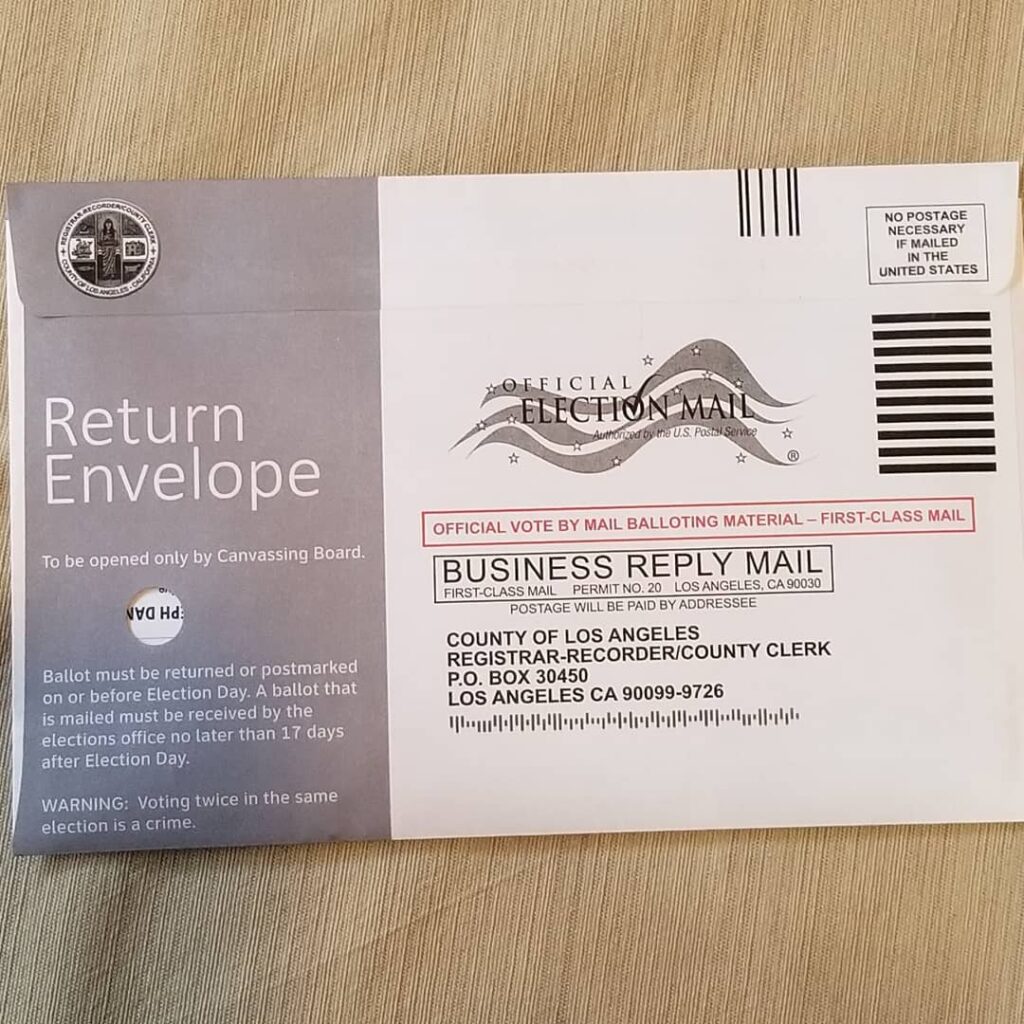
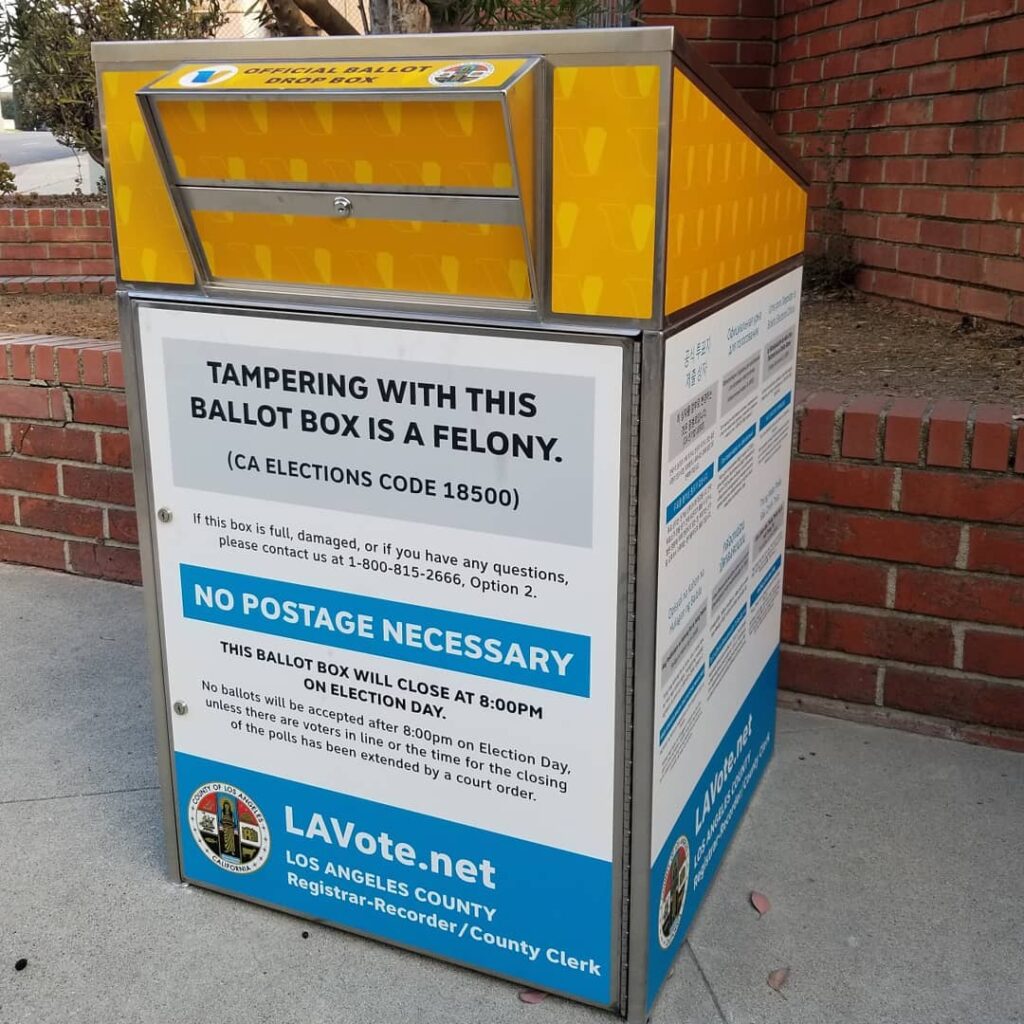
Come November 3, 2020 — and even as early as October 5, 2020, when mail-in ballots started being sent out to California voters — please vote and mail them early. Or drop your completed ballots in secured ballot boxes.
It is time to set aside our fears and renew America to be: a nation indivisible, a true light upon the nations! We need to recapture the soul of America, once a beacon of hope for the entire world.
I voted for change and to assure a better future for my 5yo granddaughter #princess2015la. I am a 68 yo Filipina American immigrant, a grandmother now, who was naturalized as an American citizen 42 years ago. I have voted in every election since, and voted for Pres. Jimmy Carter, President Bill Clinton, and President Barack Obama.
It was the 44th US President who helped actualize my love for America in my heart such that daily, since he announced his campaign to run for President in 2007, after a stint in the Oprah Winfrey show, I have been posting in social media. I daily posted what I was doing to organize for his campaign, and contributed few more than hundreds of dollars, which I have done only for Jackie Goldberg’s campaign. I did not believe in funding my chosen candidate, until Obama changed that for me. His messages resonated with me and converged with my aspirations and longings for a progressive soulful America in my heart.
I used my own funds to travel including door knocking in Vegas while the candidate Obama paid for three tour buses filled with volunteers from LA to go to Las Vegas, that was turning blue.
I used my funds to attend two inauguration events of Obama, covered Pope Francis’s visit to the White House garden (now the site of superspreading Coronavirus event announcing Trump’s appointee to succeed Associate Supreme Court Justice Ruth Bader Ginsburg), and the Presidential Medal of Freedom.
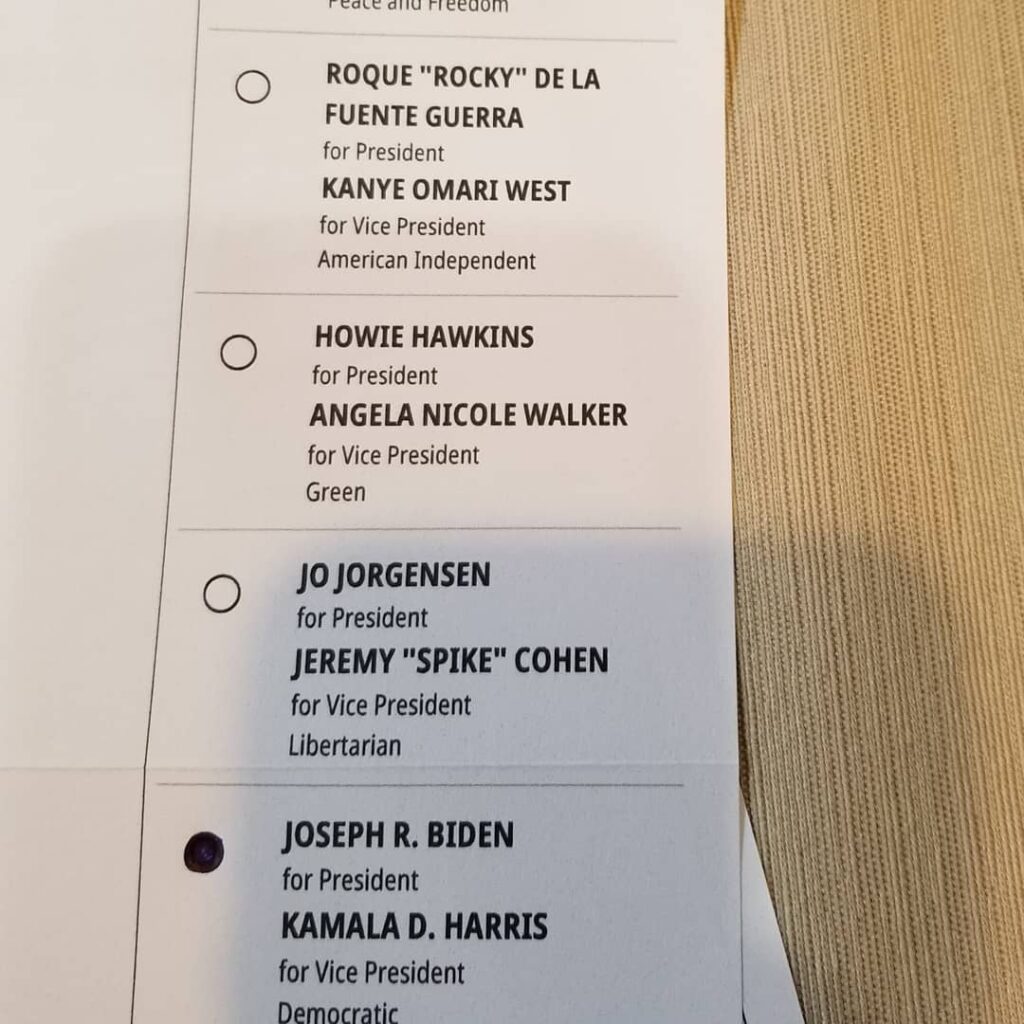
Today, I am at a high risk group for Coronavirus, just as other asthmatics are. I will not travel. But, the first thing I did today was research, fill up my ballot, but only after attending mass at Holy Family in Artesia via Facebook live, and deposited my completed ballot 29 days early. I was excited to complete my ballot.
Imagine this 68 year old grandmother excited to exercise her voting rights, an immigrant who came to this country, born in the Philippines where guns, goons, and gold and tampered machines were used to alter the election results by the nefarious elites.
I was at a gym in West Hollywood in 2007 when I was reading from Obama’s Audacity of Hope book. A white woman in her 40’s asked me why I was reading his book. I proudly said that he was my candidate and informed her that the last time America had 75% of its registered votes came to the polls, it was Kennedy’s time. When the majority votes, it reflects the true will of the people.
I told her that in my country, elections are a reflection of minority choices and blood of folks are spilled. She revealed that she has not voted, not even once, since she became eligible to vote. She was so ashamed as she was born in America. The following week, she informed me that she has registered and will vote for the candidate I passionately shared with her.
My 2020 vote, 29 days early, is for a hefty progressive vision of reversing climate change and reversing global warming; affirming competent Black women as leaders, more school funds investments but with more oversight and audits; protecting uber and lyft drivers.
I did not vote for self-interested candidates for State Assembly whose bio profile talked more about the two films he has produced. He is in the wrong ballot.
I voted for a non-incumbent candidate for the Board of Supervisors as she took the time to discuss her vision about foster children, gave concrete examples of neglected ones and she has a more forward vision.
I did not vote to encumber businesses as they need to recover from Coronavirus and when we don’t take that into account that they are small to medium businesses, we are the losers as they cannot provide decent wages to their employees. We need viable small to medium businesses to grow the economy, but not greedy huge corporations.
And last but not least, I voted for #TitoJoeBiden2020 as I want truth, honesty, genuine public service, decency and respect for WHO, NATO, and United Nations, while I also want to see less funding for the sheriffs, police, military and towards more civic projects.
Lastly, I want President-to-be Joe Biden address the #CoronaVirus pandemic with science-driven facts, common sense, and provide reasonable oversight for the swift distribution of the vaccines, preferably beyond the established HMOs and supporting clinics too with competent nurses and health professionals.
It is our future, America and we need to chart a new course of inclusion, including black and folks of color females in our national, state and local leadership and recapture the kind, compassionate, fair Soul of America. #lavotenetAsian Pacific Islander American Vote (APIAVote)Joe Biden 2020Joe Biden
It was almost like committing suicide for an African Americans to go to the courthouse in the Delta of Mississippi or the Black Belt of Alabama and declare his or her intention to register to vote. White organizers were risking their lives trying to register black Americans to vote. Segregationists saw the cameras of reporters, their pads and pens, as an invitation to brutality. OUR homes were bombed and our jobs were threatened. Some of us were expelled from college or run out of town. Peaceful, nonviolent protesters were trampled by horses, struck with bullwhips, beaten with nightsticks, arrested, and taken to jail. Some were shot and even killed, but we buried our dead and kept on coming. We knew we would not stop; we would never turn back until we tore down the walls of legalized segregation. We didn’t have a cell phone. We didn’t have a website. We didn’t have a computer or even a fax machine, but we used what we had. We had ourselves, so we put our bodies on the line to make a difference in our society. We were just ordinary people with an extraordinary vision, imbued with the discipline and philosophy of nonviolence.
Congressman John Lewis, Road to Freedom: Photographs of the Civil Rights Movement, 1956-1968, High Museum of Art, Atlanta, 2008
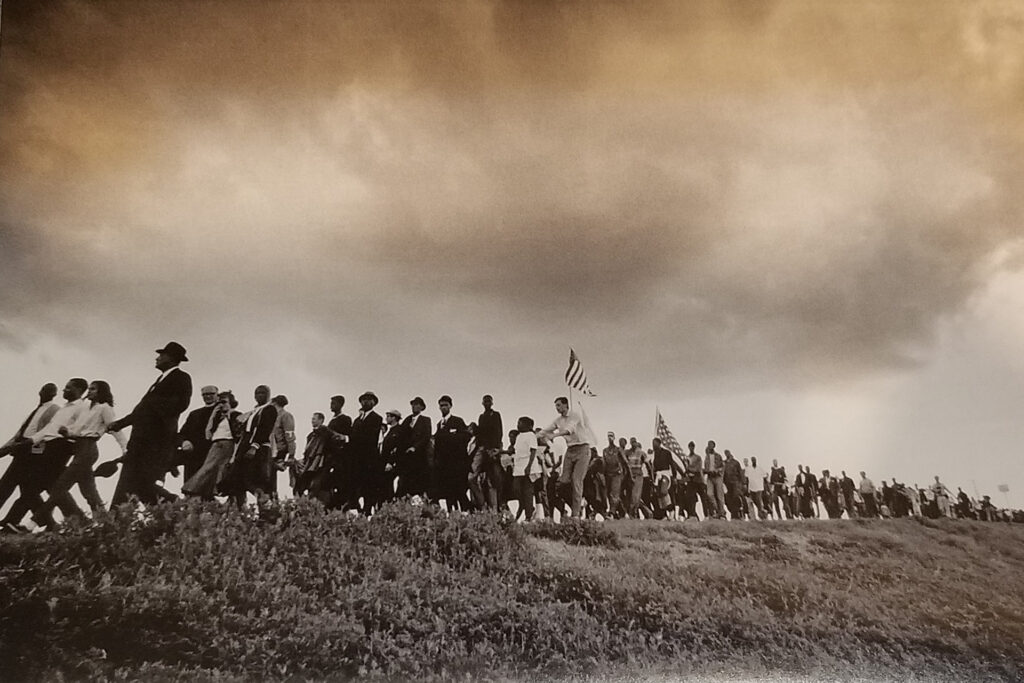
It was July 2016, at the Democratic National Convention, when I saw Congressperson John Lewis in Philadelphia. I approached him. I told Rep. Lewis that I am a grandmother who came from Los Angeles. He quickly stood by my side, stopped his aide from distancing me, and the aide graciously took three photos. His generosity of spirit resonated with me to this day that a poetic photo of John Lewis’ casket as it crosses the Edmund Pettus Bridge in a horse-drawn carriage during a memorial service on July 26 in Selma, Alabama, taken by John Bazemore, Associated Press, got me sobbing.
Lewis was twenty – five years old when he had the raw courage to lead some 600 protestors over the bridge to advocate for the right of African Americans to vote. In his own words: “it took nothing short of raw courage for participants in the movement to stand up to the governor, to the citizen’s council, to mounted police, tear gas, fire hoses, and attack dogs. It was dangerous — very dangerous—for anyone to say no to segregation and racial discrimination simply by taking a seat at an integrated lunch counter or on a public bus.
Washington Post’s Sydney Trent on July 26, 2020, described how John Lewis was “first to be beaten in the clash with state troopers, who cracked his skull with a billy club on the date that became known as “Bloody Sunday.”
The violent beatings were seen by a dozen legislators in Congress who spoke about this state-sponsored violence: “I have just witnessed on television the new sequel to Adolf Hitler’s brown shirts,” one anguished young Alabamian from Auburn wrote to The Birmingham News. “They were George Wallace’s blue shirts. The scene in Alabama looked like scenes on old newsreels of Germany in the 1930s.
Two months later, that state-sponsored violence led to an enraged nation calling for the passage of the 1965 Voting Rights Act.
Selma to all cities in the US: Blacks are Us
As if mimicking 1930, 1965, we are presently seeing in 2020, the teargassing and baton-whipping by unidentified military personnel in Oregon attacking demonstrators who are participating in Black Lives Matter rallies. It led to a wall of Moms defending these protestors, followed by leaf-blowing dads and a wall of veterans and disabled.
Nationwide rallies have emerged with sustained strength and frequency since George Floyd’s death on May 25, 2020. It began day after his death at the hands of Derek Chauvin, a Minneapolis police officer, who callously placed his knee on George Floyd’s neck for 8 minutes and 46 seconds, while his three companion officers held down George Floyd’s back.
George Floyd was sitting in his car when he was reported to have passed a forged $20 bill by two convenience store staffers. Instead of simply questioned, he was handcuffed and held down on his back by three police officers, while Chauvin knelt on his neck, a very fragile part of his body, which choked off his breathing.
This was videotaped by several bystanders and a special timeline was put together by the New York Times to document that inhumanity.
In a framed image of that video, both the face of anguished Black George Floyd and a white man’s face of scorn for another human being makes us see the “hunter hunting down his prey.” Except it was a human being.
While Floyd summoned his deceased mother:“I can’t breathe” 20 times. 20 times that Chauvin could have stopped himself from taking Floyd’s life, and even by police officers at the scene.
Many mothers have interpreted Floyd’s call to his mother as summoned by Floyd to all mothers, including Filipina mothers to reestablish in America, a culture of solidarity that considers we all belong to one another, a culture that regards we are all God’s beloved children, no exceptions.
Chauvin and the three other officers have later been arrested, after nonstop protests demanded their arrests, while a state sponsored autopsy pronounced Floyd’s death might have been caused by other factors, other than police brutality.
Why did protest rallies in over 2,000 cities and towns in 60+ countries globally in support of the Black Lives Matter movement that multimillion folks marched into the streets? Coukd it have been a tainted American history of systemic brutality and injustice towards Blacks?
From Virulent Racist to Solidarity-soulful culture in America
I saw the exhibit, “Breach of Peace: Photographs of Freedom Riders,” by Eric Etheridge on April 2010 at the Skirball Museum in Los Angeles. He took photos of young black men and women inside a burning Greyhound bus on May 14, 1961.
“That day, May 14, 1961, was a quiet Mother’s Day in Anniston, Alabama, described by the companion Road to Freedom book: “A Greyhound bus traveling from Atlanta to Birmingham, carrying fourteen passengers (including reporter Moses Newson, covering the Freedom Rides fro the Baltimore Afro-American) pulled in to the terminal, where the station doors had been locked shut. The bus was immediately set upon by a mob led by a local Klansman named William Chappell, its tires slashed and windows smashed. There were no police in sight.
When law enforcement finally arrived (after approximately twenty minutes), they gave the bus a cursory inspection for damage and ordered the driver, O.T. Jones of Birmingham, to leave the terminal, escorting him to the town limits, where the vehicle was left to the mercy of the following mob. The bus limped along the highway for about six miles before being forced off the road on the outskirts of Bynum by a convoy of cars and trucks that had grown to forty or fifty in number. The bus was stormed by the mob, the passengers were trapped inside, and the bus was firebombed.
Postiglione captured the drama in a shocking series of pictures that until recently was known only through a handful of photographs that he made available to the news services. Two pictures were sold to AP and UPI and seven were reproduced the following day in the Anniston Star.”
A young 12-year-old girl Janie Miller offered water to these passengers, even as she was taunted by the Klansmen to stop. Her kindness was met by more threats until her family had to leave and seek refuge elsewhere. When the black bus riders went to the local hospital, doctors refused to treat them.
“They were eventually rescued in the dead of night by a squadron of cars sent by Rev. Fred Shuttlesworth, pastor of Sixteenth Street Baptist Church in Birmingham.”
The exhibit’s photos showed dogs unleashed on Blacks, Clorox bleach poured into the swimming pool while a Black woman swam, with fire hoses directed at her.
Many Blacks were lynched and hung on trees pursuing freedom. Homemade bombs were set off in black homes and churches by the Ku Klux Klan.
On Sept. 15, 1963, four girls were killed: Addie Mae Collins, 14 years old; Denise McNair, 11 years old; Carole Robertson, 14 years old and Cynthia Wesley, 14-year-old and 14 injured in a bomb blast at the 16th Street Baptist Church in Birmingham, Alabama, as reported by CNN.com.
200 church members with some attending Sunday school classes before the 11 am service were inside the Church.
The bombing of the Baptist Church was the third in 11 days. Alabama George Wallace sent out 500 National Guardsmen and 300 state troopers to this city joined the next day by 500 police officers and 150 sheriffs’ deputies.
It was not until May 16, 2000, when a grand jury indicted Bobby Frank Cherry and Thomas Blanton with eight counts each of first-degree murder. Cherry was found guilty after two years and was sentenced to four life terms. On Nov. 8, 2004, he died in prison.
A week after this exhibit, I went to California’s African American Museum where a prototype of a boat that transported slaves packed like sardines in its lowest deck is displayed. I went inside to feel what it was like and I saw the chains and the dog collars used. How inhumane could that be?
“I appeal to all of you to get into this great revolution that is sweeping this nation. Get in and stay in the streets of every city, every village, and the hamlet of this nation until true freedom comes,” Rep. Lewis implored.
That includes us, Americans of Filipino descent.
Back then, Voting Rights were not recognized for all Americans, and for a long time, only white Americans were considered citizens. A 1790 Naturalization Act defined American citizenship as limited to only “free, white persons.” Armenians who came in this early period were designated whites and gained citizenship with the help of anthropologist Franz Boas.
With blood spilled, lives lost, men and women lynched, beaten up skulls and bodies, do we now understand that our voting rights come from the sacrifices of our Black brothers and sisters?
The false legend of “all that is white is right, black is wack”
Are we conscious enough to recognize that racism is like an octopus?
That it moves below the ocean surfaces of our minds, with unexamined beliefs and unconscious gut reactions?
Do we go so far as to claim that we are not racists, yet uncaring in Blscks losing their lives to the police, even with no provocation and without threat to life, liberty, and property?
Like an octopus, racism rears its ugly tentacles of racial animus, the outright showing of hatred towards Blacks, based on the color of their skin.
That animus leads to malice when Blacks are framed for wrongdoings and scapegoated for blame, robbing them of their most fundamental right to be respected.
An animus leading to malice followed by intentionally favoring and accruing privileges for Whites, justified by a belief that they naturally belong in America.
They are welcomed to sit at the decision-making table, entitled to unearned privileges. It is an invisible backpack of privileges, handed down from generation to generation, to Whites only, leading to a culture that showcases predominantly Whites in public squares and cultural spaces, assuming dominance in film, art plays, musicals, theater, schools, universities, clinics, hospitals, industries, foundations, non-profits, media and government.
Whites stay in their comfort zones of occupying majority of the decision making positions at higher levels of civil and military structures, until affirmative action introduced demands for diversity to reflect the present demographics, then abuses of power in law enforcement thereafter in the last few decades.
On July 26, Rep. Lewis’ casket was horse-carriage driven one last time crossing over the Edmund Pettus’ bridge in Selma, Alabama.
Thousands braved the Coronavirus pandemic’s risk to pay their respects, while shouting out loud, “I love you,” “We love you.” The majority were wearing masks.
Can we perhaps consider the belief that Rep. John Lewis articulated: “Central to our philosophic concept of the Beloved Community was an affirmation of faith in humanity – the willingness to believe that man has the moral capacity to care for his fellow man. When we suffered violence and abuse, our concern was not for retaliation. We sought to understand the human condition of our attackers and to accept the suffering in the right spirit. We believed that ends and means were inseparable, so we wanted to create a peaceful society, then we had to use the methods of peace and goodwill. Our protests were love in action. We were attempting to redeem not only our attackers but the very soul of America.”
Much like Rep. Lewis’ casket crossed the Edmund Pettus’ bridge, can we as Filipino Americans and Asian Americans, have the courage to be part of the solution, of redeeming the soul of America, solidifying our ties to Blacks and challenge the evil of racist animus to not be in our midst?
But more than that, as American citizens and future citizens to be, it is in our hands to create a more just and peaceful America by exercising our votes, choosing better representatives who will work not just for a mighty few 1%, but mostly assist small businesses to grow, for working labor to be paid living wages that can support families and sending our children and grandchildren to college, a valuable Filipino family value of improving each generation.