“His music is current. It contains a sense of tradition with an edge. It is not boxed in, and it has a current writing style.” —Nové Deypalan, D.M.A.
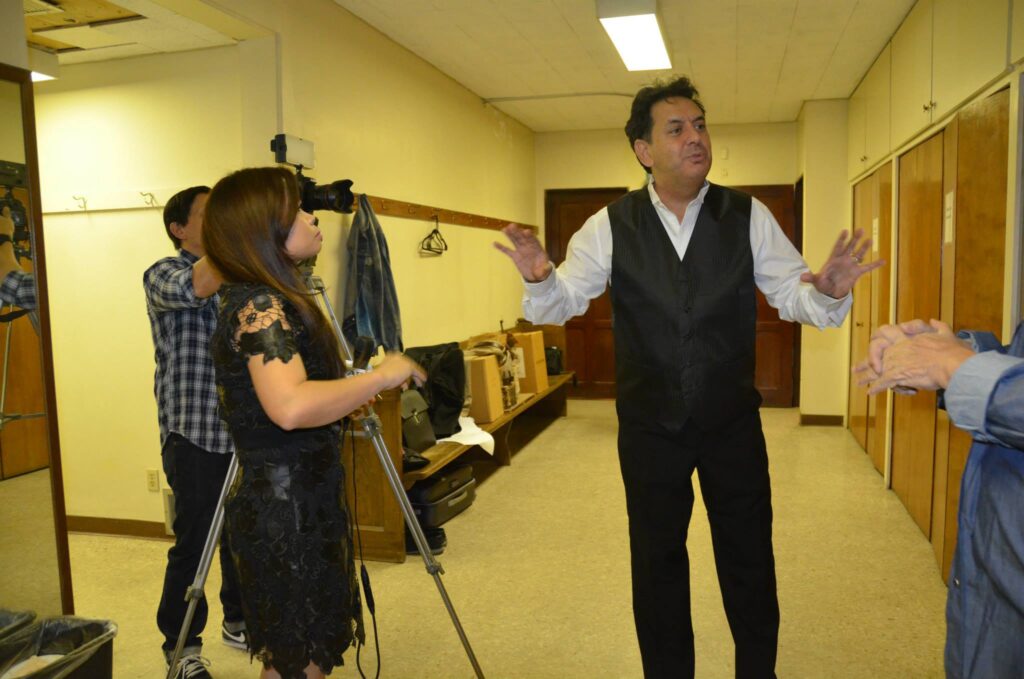
Andrea Morricone’s illustrating his points
John Middleton Murry once said, “For a good man to realize that it is better to be whole than to be good is to enter on a strait and narrow path compared to which his previous rectitude was a flowery license,” as Parker J. Palmer quotes him, in “Let Your Life Speak: Listening for the Voice of Vocation” and amplifies in “The God whom I know dwells quietly in the root system of the very nature of things. This is the God who, when asked by Moses for a name, responded, “I Am who I Am.”
It is with a sense of certainty that Andrea Morricone describes who he is as “perhaps already swimming in music, conceived in the womb of his mother, Maria, listening to the music of Ennio, his father, a trumpeter.”
I feel blessed that Andrea Morricone — a world-class composer of “L’Inno All Fede” (Hymn of Faith), a Vatican acquisition, “Anthem for Russia” performed for the Russian elite, in “The Musical Seasons at the Constantine Palace at St. Petersburg, Russia, in 2014, and “La Forza del Sorriso,” a theme song to be sung by Andrea Bocelli at the Expo Milano 2015 — would reach out to Filipino-American talents.
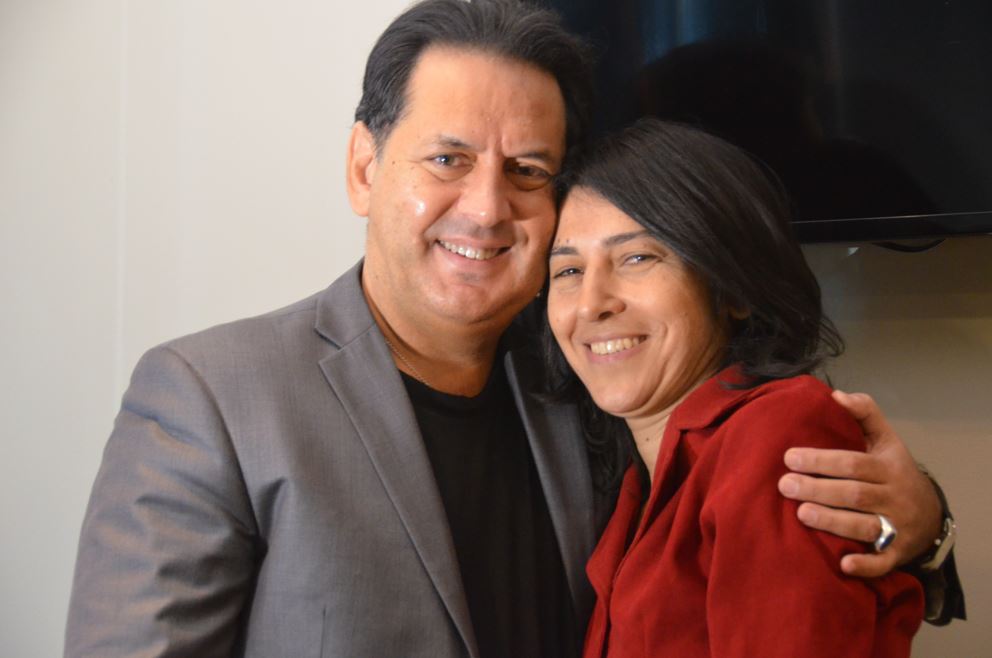
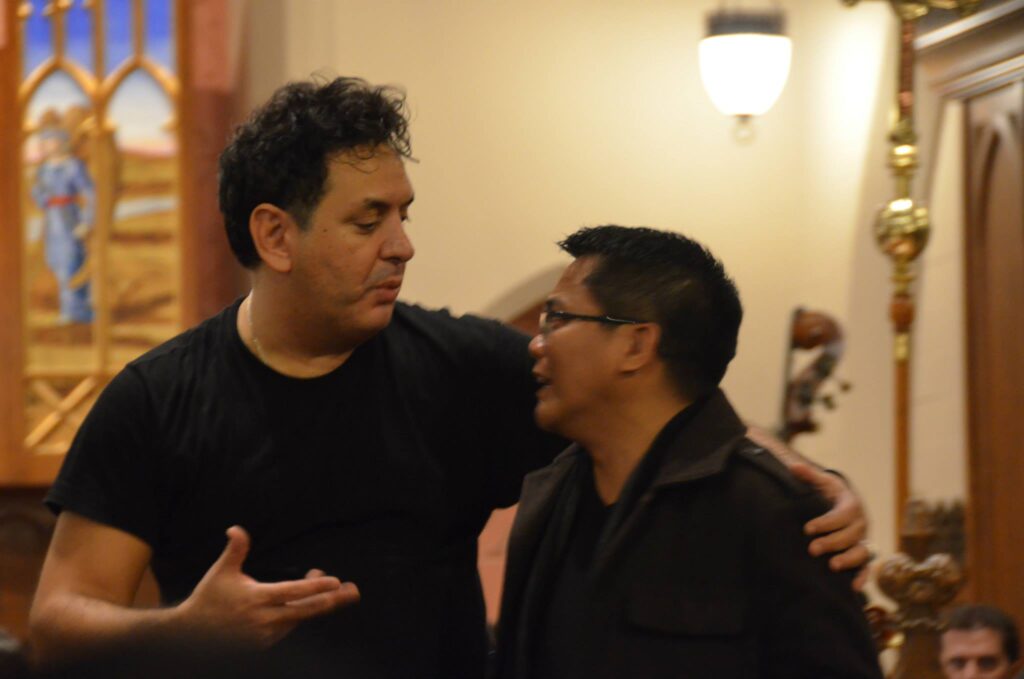
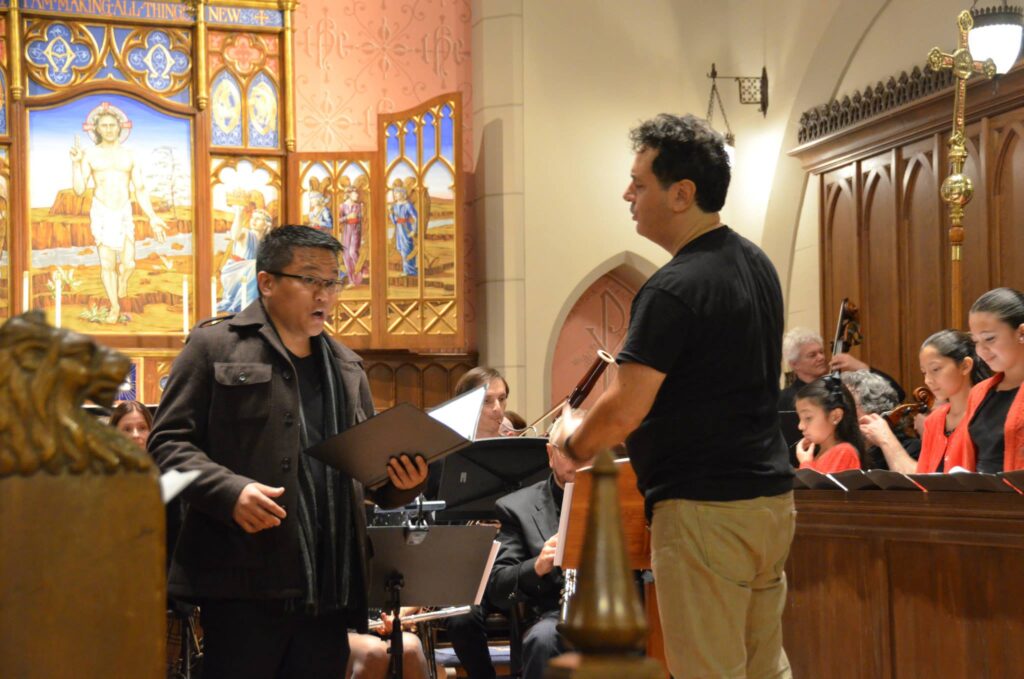
I was generously brought into Maestro Andrea Morricone’s life orbit by his colleague and effervescently cheerful assistant, Salpy Kerkonian, and tenor par excellence Christopher “Pete” Avendaño. I then invited Dr. Nové Deypalan, who graciously attended the dress rehearsal of Andrea’s Christmas Concert 2014 and gave me a mentoring session on Andrea’s composition notes which I took during the interview.
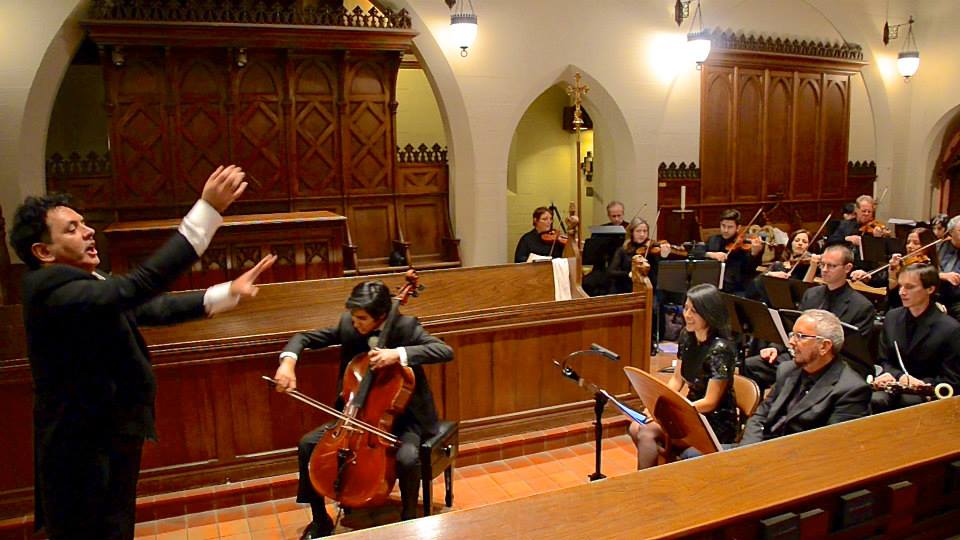
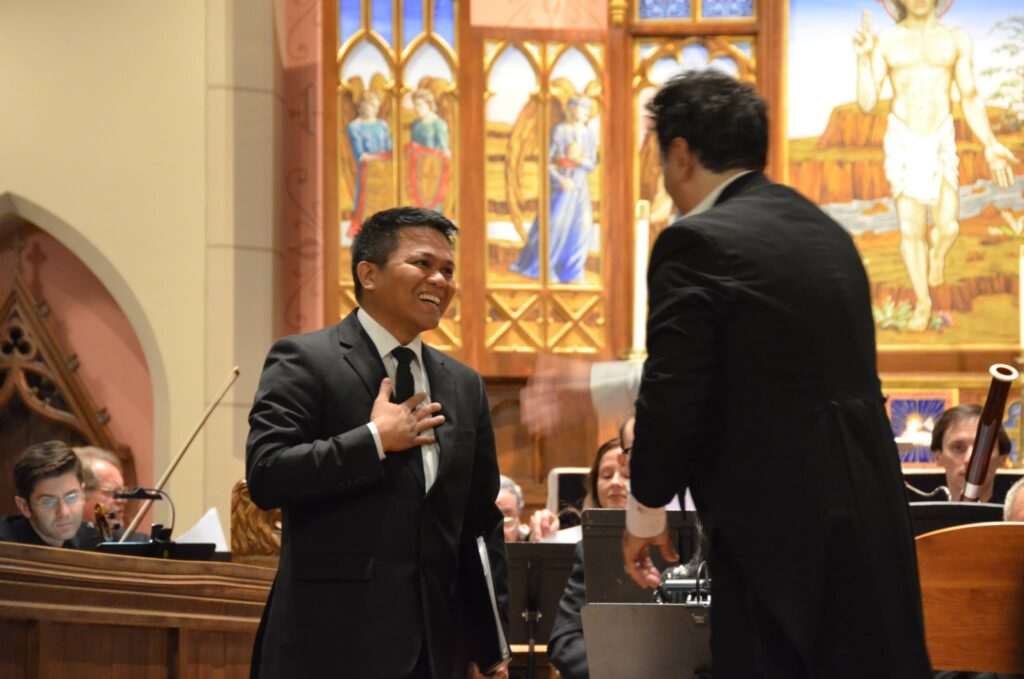
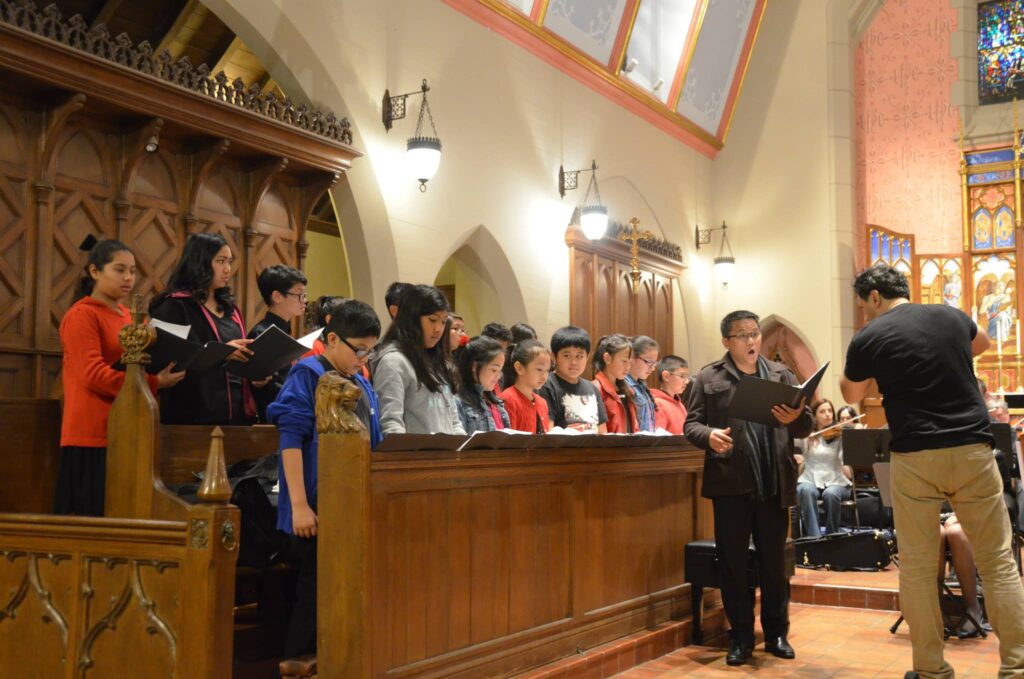
Andrea Morricone created original compositions, including new arrangements for these hand-picked Filipino American artists: “Canzona Filipina,” “Ave Maria,” ” YOU” for Pete (tenor), and a choral accompaniment from the a cappella winning champions and silver medallists Children’s Choir of Immaculate Heart of Mary School and their companion Holy Family School (chorus) and “Adagio in C Major” for Cello, Harp and Strings for Matthew John Ignacio (solo cellist) and a graduate of Colburn School of Music.
On Dec. 9, 2014, Andrea Morricone shared his timeless theory of musical composition, which is perhaps an exquisite synthesis of an entire history from traditionalists composing classical music, to the romanticists, to the Germans, to today’s composers.
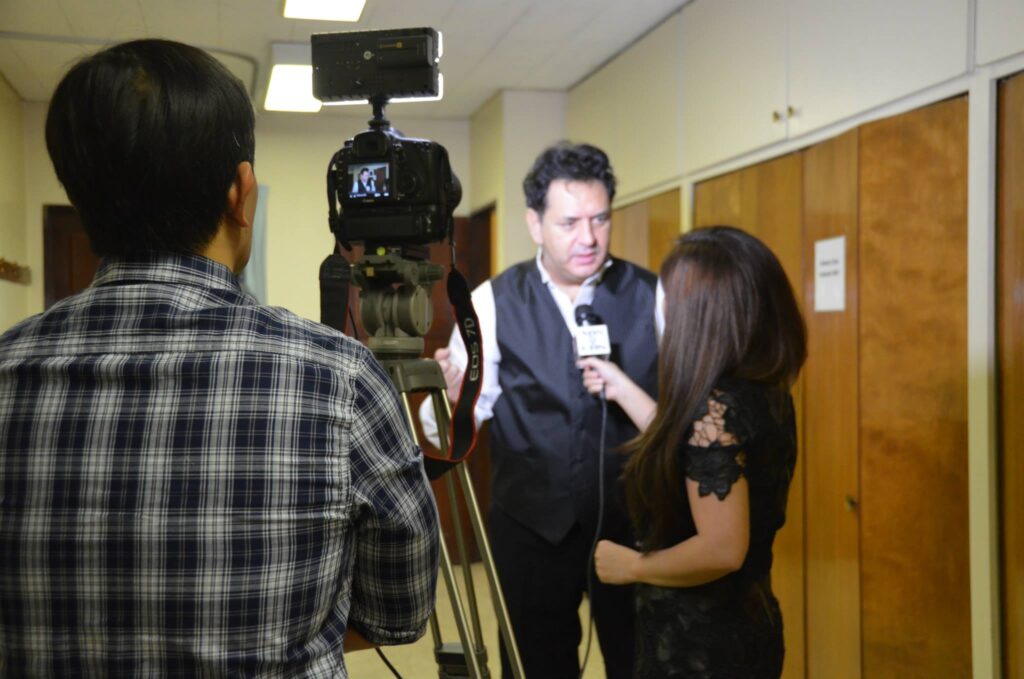
He walked into the offices of the Asian Journal, en punto, and greeted us: “I am honored to be in your presence.” It was such a reversal like an avowed world-class artist and an Oscar award-winning film scorer when one is greeted, not with the aplomb of snobbiness, but with humility and gracious warmth. It was unexpectedly disarming.
For this writer’s sense of bearing and certitude, Ding Carreon, the Asian Journal’s photographer/videographer, videotaped this historical gift of encounter.
“What does it feel like to compose music for God’s representatives in the Vatican, Russia, and a world-class artist, Andrea Bocelli,” I asked the maestro. “That would be for the musicians who play my music to answer,” he humbly responded. Instead, he articulated his wish to do a concert in Manila and conduct an orchestra of highly skilled musicians.
“I am very happy and thrilled about the music itself! What happens to me is this big work, music that comes from far away, in the sense of time, in the sense of information, [the] result of a long process, [of composing, of creating,] even if it takes only two to five minutes a piece. It is a piece that is meant to be.”
The elements of his musical composition: concepts of necessity and madrigalism
Much like the “Canzona Filipina,” which Andrea composed in only an evening (the night before the Christmas Concert of 2014, in fact) based on Felipe de Leon’s work of creation, “Payapang Daigdig,” which was inspired by waking up to the morning after the destruction of Manila during World War II. He arranged Felipe de Leon’s piece from a “deceptively simple, yet complex and created by a person who is well versed in music” into a piece of virtuosity that defies description of words, other than to witness the Amor Symphonic Orchestra members (mostly LA Philharmonic musicians) give life to Andrea’s beautiful arrangements, that made the packed St. Mark’s Church clamor for another encore, to which the maestro obliged, with “The Theme in D minor.”
Imagine Andrea’s self-restraint in considering his impact and opting instead to talk about three elements of classical music composition: the concept of necessity, the concept of madrigalism, and the shape of a melody which shows up as a question mark, unanswered. It is like any piece of art, with enough ambiguity, vagueness, or even metaphors to allow the reader or the viewer’s interpretation to come forth.
But the concept of necessity, as described by Dr. Nové, is similar to when cooking with too many spices, one loses the dish’s essence. Much like music, each note has to serve its purpose, “if it is necessary, put it there.”
Andrea describes that in his music, it is important that there is order. That ultimately, the musical composition has to have a good sound. But it also has aesthetics, an order, organized art verse, a refrain, a chorus or a climax, a sense of arrival, a descent, and an ascent to the summit, before the descent.
I interviewed a young composer who shared her original compositions from her dreams, on-demand, or inspirations.
This piqued the maestro, who quickly said: “I do not believe in dreams, I prefer to sleep. But music comes to me all the time. In music, I choose.”
It was as if he was describing all of his inner molecules are made up of music, his heart, his mind, his soul, and his entire spirit breathed in and exhaled music.
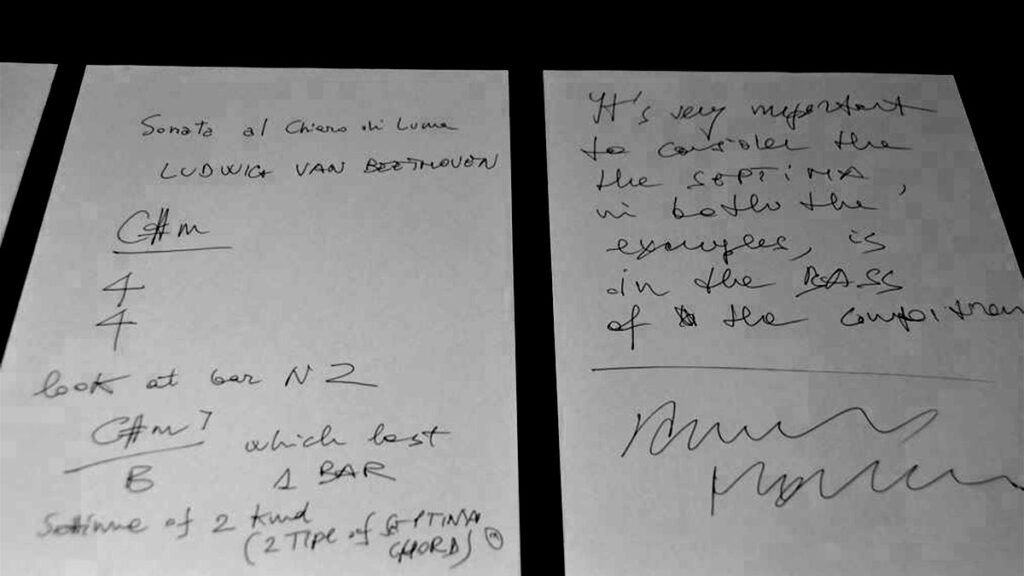
He drew a half a heart symbol, with rugged tips at the base of the heart and a smooth apex, and wrote, “eight times of question marks” and its title, “Madrigalism.”
He illustrates more by writing peroration, where most composers create at C Major 7/ over B, and that tune would last a bar, forming four tips of a Septima chord.
Dr. Nové explained that during the 19th century (Liszt), there was an interplay of music and landscape. Musicians told a story through their music or described it as their music shared their life stories, there is a strong madrigalism.
“The shape of the melody shows up as a question mark” in Andrea’s compositions. Perhaps, this is the signature Morricone sound that Enrique de la Cruz, Ph.D. (this writer’s husband), describes after listening to Andrea Morricone’s Christmas Concert in 2014.
Andrea continued, “It is a big question mark that everyone has to deal with by himself. The melody appears four times, it is the same question mark, and eight times question marks become infinity. The oboe starts high (when the maestro at rehearsal calls it a crescendo), and then it curves down, where the oboe is now reacting to the question mark. There is no piece in the known history of music making by men, according to me [referring to himself, Andrea], there is no chord C Major F, over B lasting over a bar. It is difficult to find a Septima of four or four types of Septima chords.”
“The tension it creates keeps going up and up, it is huge, and the oboe keeps going up, I believe, something unique.”
The closest composer coming to what Andrea has done is Ludwig Beethoven, in his “Sonata Al Chiero de Luna,” according to the maestro. I validated Andrea’s statement by interviewing Dr. Nové Deypalan, another music conductor and arranger who has a D.M.A. (Doctorate in Music Arts) from USC, and he, too, affirmed that the maestro’s statements are historically true and accurate.
During the medieval period, circa 1150 to 1400, Gregorian chants were created. For 300 years, the rules were about one music line, monodic. Recall hearing Lamentations by Thomas Tallis or works of Giovanni Pierlugi da Palestrina’s Adoramus te –in early Latin masses that we were steeped in as Catholic Christians?
I might be losing you by now, my dear readers, but stay with me as it gets better.
After being constrained for 300 years, i.e., creating music using one music line, Renaissance artists started their own ways of composing music, flexing their creative muscles of freedom.
From 1400 to 1600, Renaissance musical composers created movements called “harmony” and “polyphony, “ organizing them into major and minor music scales.
Recall Leonardo da Vinci, who did an exquisite synthesis of face and landscape with a timeless classic painting of Mona Lisa, which to this day, attracts an admiring pilgrimage of travelers? That was the period of 1503 to 1506, as the freedom in music grew, so too were the paintings, art, and architecture.
The likes of Johann Sebastian Bach, Handel, and Vivaldi also paved the way for their Renaissance compositions to be played by a modern orchestra.
During the Baroque period, circa 1600 to 1750, these artists gave birth to more musical genres: chorus, sonata, opera, cantata, and even bolder strings of a violin, viola, cello, and harp. Color and textures were used to describe their distinct sounds.
The classical period of 1750 to 1830 gave the world the likes of Wolfgang Amadeus Mozart and Joseph Haydn, followed by the Early Romantics composers of 1830 to 1860: Verdi, Liszt, Mendelssohn, Schumann, Chopin, and Berlioz.
“If Baroque music is notable for its textural intricacy, then the Classical period is characterized by a near-obsession with structural clarity, “ according to Naxos, while the late Romantics made music “often pacing their compositions more in terms of their emotional content and dramatic continuity rather than organic structural growth, “the likes of Mahler, Tchaikovsky, Puccini, Strauss, while the post-war periods gave us diversity, experimentation of styles, the likes of Gershwin, “THE RHAPSODY IN BLUE,” and of course the diabolical sounds of Stravinksy.
Mahler#8, if you recall, was conducted by the exuberant musical genius Gustavo Dudamel, with 1,000 musicians in the Shrine Auditorium. This writer wrote of the participation of the Philippine Chamber Singers-LA in that vast, historic collaboration.
Exquisite synthesis of traditionalist and modernist composers.
Now fast forward to the 21st century, and here comes Andrea, who captivates us with his work, now eloquently described as influenced by traditionalists, with a signature sound of his father Ennio Morricone, yet, distinctively Andrea’s, with his own creative edge, and educated by the music of the early classical musical composers.
Andrea likened his music to approximating Ludwig van Beethoven’s “Sonata al Chiaro di Luna” in C sharp minor, and he said, “look at his bar #2,” and Andrea writes in his own handwriting, “C sharp minor over B which lasts one bar, a Septima of two kinds.“
“This is incredible, also an unknown in the history of classical music,“ and “even more unique than what I did,“ Dr. Nové Deypalan admitted to this writer.
“There is a stronger emotional point of view when this is done,” Andrea continued, with a high sense of assurance as to who he is in the context of the timeline of composers. There is not a single person I have interviewed who has this sense of certainty about who they are in the context of history, the now, and the future.
Andrea underscored his theory: “It is very important to consider the Septima, in both of these examples, it is in the bass of the composition.”
He signed his four pages of explanations in his own handwriting with descending ripples of half a heart.
Pete Avendaño described Andrea Morricone’s timeless theory of classical music composition, “Who knows if 100 years from now, his theory might be the preferred art form for other composers to use? It is a clever use of dissonance to highlight and emphasize the harmonic blending.”
Frances Marie Noble-Ignacio described Andrea’s music as: “Dazzling talent, penetrating brilliance, and relentless innovation is the hallmarks of Andrea’s music and musical history. And, it is no surprise that his works, like those of his father, from classical compositions to scores for film and television, have been duly recognized worldwide by some of the most prestigious music industry organizations. Andrea’s unwavering, enterprising commitment to composing and conducting and his repertoire of compositions that pulsate with ingenuity are inspiring, and yes, award-winning.”
If I kept you hanging in this piece, remember the genius mind is like that of an ocean; we cannot contain the ocean waters into a hole in the sand.
Much like our interview with Andrea Morricone, who left us with priceless pearls of wisdom, you are simply left with “Morricone sound,” “Beautiful,” “Exquisite,” “Very Expressive,” “You cannot touch, nor see, but you feel it, the only art form, triggering one’s emotions, one’s tears, one’s knees to drop in prayer to God, to thank the gifted maestro, who is so generous in giving his creations away, gifts coming from his heart.”
“After 15 years of starting again on my own in America, much like Arnold Schoenberg did in relocating from Europe to Los Angeles, I am now a well-prepared conductor/composer, that from a spiritual point of view, I can tell you that music is all my life and those who are around me belong to me in a very deep way. That man, Goffredo Petrassi, [the grand old man of Italian music, a leading Italian modernist composer] was fascinated by my mind. He felt what I could become in music. Music is all of my life, people who are around me deeply belong to my life. I can say this about Salpy, she plays my music so well, she becomes part of my life, my heart, she is inside here, “ and gestures to his heart as he repeats, “she is inside here.” For me, music is easy. It comes to me all the time.”
As if to underscore he is accessing the collective mind, the intelligence of the collective subconscious, he said, “ What I am living now will be bringing me to another now. I will be in another now, always in the now. My soul is moving into the now. We are made of nows.”
I responded, “the collective nows, our collective intelligence.” Yes, he responded, “I am always now.”
“Your soul is moving into eternity,“ and he nodded his head to my reaction and said, “My life is a big perspective, I can see many images like they all have spaces in my heart. Like all those I have loved before, I still love them.”
“[Ollie] Cantos, like the [blind] brothers [Leo, Nick, Steven Argel] had a hard time growing up. He says he didn’t have any friends, and people made fun of him. He taught the brothers how to use their canes better by taking them to the corner store.One day, the store clerk asked Cantos if Leo was his son. Before Cantos could answer, Leo put his arm around him and said, “Yeah, that’s my dad.” As Cantos remembers it, Leo said, “Well, you take us places, you protect us, you help us with our homework and make us happy. Sounds like a dad to me.” “Whenever I hear you call me ‘Dad,’ ” Cantos tells the three brothers, “it’s the highest compliment to me.You three used to be in the same situation that I was, and to see you come out of that and to be the way you guys are now, it’s impossible to describe how grateful I am that I get to be your dad.” Jasmyn Belcher, NPR Radio, 2014
I believe that mentoring is a soul to soul connection. It cannot ever be reduced to a money transaction, where one pays to have the services of a mentor. How can one even consider that the love and a care of a mentor, quite priceless like what Ollie Cantos has for Leo, Nick and Steven Argel can even be reduced to a coin? It just makes for such a cheapening of human relationships!
Let me share my priceless interview with this blind Filipino-American lawyer, who was recently recognized as one of the 50 inspiring Loyola Law School’s alumni out of 16,000, an odds of .0003125, which does not even come close to 1/10 of 1%. The odds become even smaller, as 16,000 alumni have to be vetted by a Board of Governors. The selection pared down to those who stood out for “the highest standards of personal integrity, professional ethics and concern for justice. They are accomplished lawyers, business men and women and public servants for the last half a century,” as described in the school’s website.
And to think that Olegario (Ollie) D. Cantos VII graduated in 1997, yet illustrious enough to join some of these prestigious folks, the likes of Gloria Allred, the lawyer of precedent – setting cases on women’s rights and discrimination for 30 years; John Anderson, for which an entire UCLA School of Management is named for him and his philanthropic gift of $50 million to Children’s Hospital; Hon. Ben Cayetano, the first Filipino-American governor of the State of Hawaii; Johnnie Cochran (deceased) the finest lawyer of social justice and civil rights who defended O.J. Simpson, Michael Jackson and Geronimo Pratt; and Hon. Otto Kaus (deceased) an associate justice of the California Supreme Court.
But before I get to the nuts and bolts of our interview, I know you are curious as to how this Filipino-American lawyer joined the ranks of these inspiring alumni group of 50.
“Alumnus Olegario D. Cantos VII ’97 has dedicated his life and career to civil rights, impacting more than 50 million Americans. He started his career as an attorney at the Disability Rights Legal Center right here at Loyola, later becoming General Counsel of a 60,000-member non-profit. Next working both in Republican and Democratic administrations, Cantos was Special Assistant and later Special Counsel to the Assistant Attorney General for Civil Rights at the U.S. Department of Justice, Vice-Chairman of the President’s Committee for People with Intellectual Disabilities, and Associate Director of the White House Domestic Policy Council. He is presently Special Counsel to the Assistant Secretary for Civil Rights at the U.S. Department of Education. He has championed legal services to the poor as Vice President of the Legal Aid Foundation of Los Angeles and Member of the State Bar’s Committee on the Delivery of Legal Services. In addition to having been a role model with Big Brothers/Big Sisters, he has mentored younger attorneys as part of the ABA. Blazing new trails, Cantos is the first blind person in the more than 70-year history of the U.S. Coast Guard Auxiliary ever to have served as Legal Officer and at the uniform rank equivalent of Lieutenant Commander. He is also President and CEO of Prosperity International, LLC, providing individuals and organizations tools and techniques to enhance branding, visibility, marketability, and influence.”
I first met Ollie on a trip from Washington, DC to New York, to see Miracle in Rwanda, a play conceived and directed in SoHo, starring Leslie Lewis, with my cousins Mila and Alfred Tecson and their then teenaged children, Justin and Hannah. We were in a van, all 7 of us. Though cramped in that van space, we were expansive in spirits: laughing, non-stop story-telling, snacking, that 19 hours together can be summarized in three F’s: fun, food and friendship.
We watched Leslie Lewis give life to 9 characters, in five languages, at the Ohio Theater in New York in 2007. Leslie dramatized the life of Immaculee Ilibigaza’s (an engineering student in Rwanda, who survived the genocide in 1994) by hiding inside a bathroom, with six other women, confined there for 91 days. Immaculee and 6 women survived the extremist Hutus’ genocidal attacks, with the pastor’s generosity and courage, their collective faith in God and by praying the rosary. Immaculee was inside this cramped square, along with 6 women, and Leslie used a masking tape, defining the square onstage, simulating the 3 by 4 foot space, inside the home of Immaculee’s pastor. The women were fleeing the barbarity of April 6, 1994, when almost a million Tutsi men, women and children, were murdered by the Hutus in 100 days.
Our discussion was of course subdued, given the play that we just saw, but our journey was made more endearing, with Ollie telling stories about his mother, stories of love, determination, faith and humanity.
Ollie became blind from oxygen depletion during premature birth. But, Evelyn and Orlando’s (Ollie’s parents) determination to treat him as without disabilities, pushed him to do things for himself. He carefully uses his cane to guide him as he walks the sidewalks, and navigates the terrain, using his other senses to hear changing sounds.
I was surprised that he would describe the landmarks, as we passed bridges, or that he would tell me to wait as it is still a red light, and to not hurry to cross as yet, making me respond: “Ollie, are you sure you are blind?” He laughed vigorously. More on next week’s column on Ollie’s mentoring principles and how to stay bipartisan in Washington, DC, to enable him to serve his country with loyalty, while working for two administrations now, younger G.W.Bush and now, our President Barack Obama.
My recent trip to the Philippines during Holy Week was unique and special on many levels,” reports Rob Bonta, Assemblymember and the first Filipino American elected to the California Legislature.
Despite nearly six months having passed since the strongest typhoon ever recorded in history wrought havoc in central Philippines, the evidence of its destruction was still very apparent in and around Tacloban, Leyte, when Bonta visited the area.
“Yet, regardless of the thousands that have perished and thousands more displaced in its wake, I experienced many memorable instances of resilience, resolve, and determination to continue. The spirit to move on and rebuild has become synonymous with the people of this archipelago nation, which I am proud to say is the country of my birth,” Bonta wrote last January.
This trip was particularly meaningful for him as he was able to take it with his father, daughter and chief of staff.
“Shortly after arriving in Tacloban, my daughter and I and others as part of the Gawad Kalinga, USA delegation, were able to assist one of the rebuild efforts by helping to fill bags of concrete mix that would be used in the construction of approximately 150 units of housing for residents whose homes were destroyed by Typhoon Haiyan/Yolanda this past November,” recalls Bonta.
His trip to Leyte happened after Bonta had won his seat in the California state legislature. He had shattered the glass ceiling at the Capitol, which had been kept intact for 162 years.
“I may hold an American citizenship, will even die for the United States, but we are Filipinos,” Mia McLeod, who joined Bonta’s trip to the Philippines tearfully shared.
“We went there connecting to Motherland, and at the tail end of our trip, the taxi drivers who were shuttling us around, were in tears, too. They treated us like family and were inspired to meet Filipinos that care, even though they live abroad,” she added.
He told the crowd that his mom, Cynthia, was raised in the Visayas. Raised by his parents who were union organizers, he grew up in the California farms where he saw poverty firsthand.
“I am in the Assembly for a reason. That’s what I said to voters, I am what my values are. And I want to serve. If the voters deem that I have served them well, then I am there for another term, and to do it in a team spirit, ” Bonta continued.
Bonta’s supporters tend to echo what his beliefs are.
I spoke to Ken, CEO of a four-generation strong company, who came to support Bonta. Ken told me he thanked one of his clients for a private donation of water system pumps and filters, which successfully reached typhoon-ravaged Leyte.
Butch, a lawyer, and an activist during the Anti-Martial Law movement days described Bonta as “a very worthy man, working for a very worthy cause.”
“Before [he went to] Yale, he [already had] a great heart,” Lem, another supporter volunteered. “He has done more in educating youth not just about Latinos, but about manongs, so they are not forgotten, as their contributions are not taught in history. He is breaking the cycle of marginalization.”
“He is the biggest hope for Filipino presence in the USA, “ Menard Leelin opined.
Atty. Abraham Lim, a frequent supporter of Philippine Consulate events, summed up: “Rob represents a growing awareness in Filipino migration for future generations. Unfortunately we will not be around to enjoy that. When we were educated, only Spanish was taught, they omitted the Fookien influence in Philippine culture. Now, we will be educated about the Filipino contributions to the diversification of the USA. We need people like him [Bonta]. He was raised well by his parents.”
Melissa Ramoso, state chair of the Pilipino American Caucus of the California Democratic Party, said: “He governs with integrity, transparency and honor. Everything he does is with the purest intention.”
Bonta’s mom, Cynthia, is also amazed at what her son has done in such a short period of time.
“I did not imagine that he could accomplish all those things. It seemed like a miracle to have all that done,” Cynthia says.
Could it be that the manongs, our Uncle Larry Itliong, our Uncle Philip Vera Cruz and our ancestors, were watching over him?
“I am in the Assembly for a reason. That’s what I said to voters, I am what my values are.”
Assemblyman Bonta rallied the California Legislature to respond to the typhoon’s destruction. Bonta’s leadership brought together state legislators in an unprecedented press conference and fundraising effort for the Philippines, raising close to $7,000,000 and garnering support from organizations throughout the state. From the state treasury came a hefty contribution of $6,000,000 for the survivors of Typhoon Haiyan.
Not content with that, Bonta launched a personal fundraising effort on Crowdtilt, contributing his own leadership donation of over $4,000 and crowd-magnetizing it to reach more than $40,000.
By the end of December, Panda Express presented another $650,000 donation to build homes in the Visayas. Half of that amount was raised by Panda Express customers and then matched by the corporation.
His uncommon leadership qualities quickly became evident in the legislative ideas he pursued and passed last year.
“I was extremely proud that the Governor [Jerry Brown] signed 10 of my bills last year, including four bills that I authored as Chair of the Committee on Public Employment, Retirement, and Social Security,” Bonta says.
The bills he pushed:
• AB 1377: Raise for Hard Working State Workers — Bonta’s first bill to be signed by Governor Brown includes a 4.5 percent pay raise for SEIU members by 2015.
• AB 123: Filipino Contributions to the California Farm Labor Movement — This first-of-its-kind bill requires the State Board of Education to provide statewide curriculum on the significant role of Filipino Americans in the California Farm Labor Movement.
• AB 514: Oakland’s Safe Schools for Safe Learning Act — This new law will help students affected by gangs, gun violence and psychological trauma by providing them with information on resources where they can find help.
• AB 817: Language Access for Voters — Expands the pool of available bilingual speakers to serve as county poll workers and volunteers by allowing lawful permanent residents to serve as poll workers in order to assist citizens who are not fully proficient in English.
• Assemblymember Bonta has also taken a leadership role on controlling gun violence in communities in the state, including Oakland.
Bonta was appointed by Speaker Perez to be Chair of the Select Committee on Gun Violence in the East Bay. He conducted hearings throughout the East Bay on gun violence how to find reasonable legislative changes to address the problem.
• Bonta also found creative ways to improve the health of the state by expanding trauma informed care for students impacted by violence (AB 174), increasing gun safety protections in Oakland (AB 180, AB 187), and creating safer opportunities for prisoners (AB 999).
At dinner in a shabu-shabu restaurant in Southern California one winter evening, Bonta elucidated on his vision as assemblyman: “It is a true honor to serve in the Assembly. California is doing well, on the right track and we now have a budget surplus. We have come out of a deficit of $40 billion out of $100 billion. We are now reinvesting in education. We are covering more in health insurance. We are creating regional improvements. We are supporting businesses. We have STEM to support the workforce of tomorrow. We are very proud to serve Filipinos up and down the state. We will know more about Filipino-American history, about the Filipino-American farm workers. When I went to the Speaker of the House and the Senate leadership, they were eager to provide support and assistance. As part of the largest 1.5 million Filipino community majority born in the Philippines, these are important progressive steps. I have to run for re-election every two years. I am sorry for it being so often. I would change it if I could. One million voting-age Filipinos in California are not registered to vote. Awakening the sleeping giant, we can exert our power and influence we deserve. I really appreciate everything.”
After giving his Christmas wishes, Rob Bonta left to catch his flight back. He wants to get home in time to greet his son Andres, a happy birthday the next morning.
“We dream of seeing him in the White House!” says a young person at the restaurant. Another one says, “Hopefully in our lifetime!”
Prosy Abarquez-Delacruz, J.D. writes opinion-editorials and feature stories for Balikbayan Magazine and Asian Journal Press in Los Angeles. She is a patron of theatre arts, concerts, musical theater, and indie films. She loves to travel to national parks with her husband, Enrique.
The company of CINNAMON GIRL (Photo by Blake Boyd)
Anation which does not help and does not encourage its theatre is, if not dead, dying; just as the theatre that does not feel the social pulse, the historical pulse, the drama of its people, and catch the genuine color of its landscape and of its spirit, either laughter or with tears, has no right to call itself theatre, but an amusement hall, or a place for doing that dreadful thing known as “killing time.
Federico Garcia Lorca
In Los Angeles, there are at least 20 theatrical venues that are buzzing with life onstage, competing with the energies of New York’s Broadway stages. They include La Theater Center, Kirk Douglas Theater, Getty Villa, Pantages, Broad Stage, Geffen Playhouse, Mark Taper Forum.
One of the theater directors preferred by emerging playwrights is Jon Lawrence Rivera, a Filipino-American, who has stayed true to his craft, whose signature is quality. Check his calendar and you will find him directing a play every other month, sometimes back to back.
I have now seen six plays that Rivera has directed: “Dallas Non-Stop” by Boni Alvarez (a Filipino-American); Euripides’ “Helen” by Nick Salamone staged in the august and breathtaking Getty Villa; “The Girl Most Likely To” by Michael Premsrirat; “Flipzoids” by Ralph B. Pena, which will be produced and staged in Manila’s Music Museum this coming July; “Ruby, Tragically Rotund” by Boni B. Alvarez; “Dogeaters” by Jessica Hagedorn, which was staged in the Kirk Douglas Theater.
“From top to bottom, it is quality, from the acting, the singing, the lighting, the stage props.”
His latest, “Cinnamon Girl,” a musical, showcased two Filipino artists in prominent roles of protagonist (Jennifer Hubilla Quinn) and antagonist (Dom Magwili). It recently ended its run at the Playwrights’ Arena at Greenway Court Theatre 544 North Fairfax Avenue in West Hollywood. (See more at BitterLemons.com.)
I gauge the beauty of a play by how it moves the audience to interpret its dialogue lines, its songs, including the artist’s insights, in performing their roles onstage. But, proof of a musical’s impact is when you hear your seatmates hum, sing and even move their bodies, with the actors onstage.
The audience loved the lyrics of this song in “Cinnamon Girl,” performed by Magwili as Ranil, the plantation caretaker, who is also the play’s villain. We were listening to his every word. Why? The lyrics are a delicious foreplay to what the audience is about to see, the peak of the conflict.
Jennifer Hubilla (Photo by Blake Boyd)
“Morality’s a Loser’s wager Carnality gains Woman, girl, child, my Daydreams run wild Let me breathe let me think on the brink I’m steeped in drink Damn! These evil thought’s such deep guild I’ve had my fill Or have I? What control? With addictions, Cold winds blow How I love her Can’t live without her Now her daughter – damn! Looks just like her, My mind’s all a blur Please stop me please help me look at me a bankrupt man Damn! Base urges on the verge Where love at what cost? I’ve broken all the laws ….damn!
Velma Hasu Houston, who wrote the book and the play, also wrote the lyrics, which captures and carries the feelings of the characters. I appreciated how gifted she can be. With the tunes composed by Nathan Wang, and the direction of Jon Lawrence Rivera, this ensemble cast has everything going for it.
This play, according to Houston’s notes, is “set in 1939 British Ceylon, which was ruled by the British Empire as part of the British Commonwealth from 1815-1948. Before 1972, Sri Lanka was Ceylon.” The story is set in a highlands tea plantation. Can you guess how the seaport is cleverly imagined with the waves, receding back and forth onstage?
(L-R) Dom Magwili, Byron Arreola, Kerry K. Carnahan, and Jennifer Hubilla (Photo by Blake Boyd)
Peter Mitchell (Wendell) sings beautifully as the privileged son of the British tea plantation owner, “Privilege in every pore, rights of others forsaken, rights to call our own,” as he recognizes his status and stature. “Both ways of being, different from status quo, new ways of being, new ways of seeing” signal the play’s transformative elements.
We get to see the evolution of plantation workers who are kept down even as they dream of new lives: “What we do for our own good, what we do to feed our lives, keep your head down and carry on, keep my nose to the grindstone, I’m in my own little home, it is up to me, castles in the skies, pretty everywhere, there’s always magic in the air.”
The lead character of Salani is played by Jennifer Hubilla Quinn, whose ethnicity is referred to as Burgher, a “mélange of European, Asian and African heritages,” according to the author. Salani is prominently transformed through various emotions of grief, hardship, loss of innocence, finding herself and love.
“Learning to stand on my own Declaring my independence I can bear any burden alone I am the backbone of this land Learning to stand on my own I won’t let the world define me It’s time for realities not dreams Real beauty is more than skin deep”
“I’ve really grown to love the song ‘Learning to Stand On My Own,’” says Hubilla. “Like Salani at this particular point in the show, I’ve had moments of realization in my own life where I do feel a sense of empowerment, especially after going through times of hardship. I love the first few lines of the song—‘Real cinnamon trees thrive in native soil. The fruit ripens and the seeds come alive. The roots are deep within the earth.’”
Hubilla is prominent in this play, virtually performing on every scene and singing on her own, or as part of a quartet or duet. With barely weeks to know her songs and memorize her dialogues she is very much the professional lead actress we saw moons ago, “Miss Saigon.” Her voice carries its perfect pitch with not a false note. I can still hear her singing “Castles in the Air.”
Peter Mitchell, Jennifer Hubilla (Photo by Blake Boyd)
Props were minimal, yet the clever juxtaposition of two lifestyles at the same time on stage is effective: the plantation owner’s house with its formal furnishings against the bare floors, wood pallets and mats workers sleep on curled up in fetal positions.
Another effective scene is portrayed by Leslie Stevens as Empress, the plantation owner’s wife, when she sings “Is it love when your feelings are not there, When I am not there, When I don’t pick up the phone, When I don’t have a choice, I have to teach myself,” as she recalls growing up as a sunflower in Wichita.
Kerry Carnahan (Praveena) exceptionally owns her character, and next to pregnant Salani squatting over the harvest, declares “Many men in this world, never found as reliable as my job.”
Byron Arreola (Tourmaline) is credible as both the female sister of Praveena and the male soldier who goes away to fight a war:
“What you see is what you believe, the eye of the beholder, I am soldier, look at me, see me, believe your very eyes, look at me.”
The latter scene gives me goose-bumps. Carnahan’s voice is distinctly higher in octave as a female. Then, when he becomes a soldier, his voice gets lower, as if a bass instrument in tone. This scene has the audience clapping, moved by the powerful performance.
As I exited the playhouse, I asked Terry Lloyd, who works at Paramount Pictures, what he thought of the play: “From top to bottom, it is quality, from the acting, the singing, the lighting, the stage props. The best part, I am walking away with a lesson to learn about history, the production of cinnamon, what they did then, where they came from. It just flowed well.”
Every moment counts in “Cinnamon Girl.”
(L-R) Byron Arreola, Anne Yatco, Jaime Barcelon, Jennifer Hubilla, Kerry K. Carnahan, Ren Hanami. Michael Hagiwara (Photo by Blake Boyd)
In 2006, one of director Jon Lawrence Rivera’s peak periods, he directed seven plays with four world premieres—including two at the Edinburgh Film Festival. It was an efficacy rate of 81 percent, sustained at a very high level of quality with a ceaseless flow of creative energy.
Rivera founded Playwright’s Arena, housed in the Los Angeles Theater and now in its 22nd year, to give home to independent playwrights and stage plays with diverse casts of actors and actresses. Imagine nurturing a vision from thin air, which is now a reality and catalyst for substantive plays in Los Angeles.
For his part, DomMagwili, with his wife, Saachiko, pioneered the teaching of Pilipino Cultural Nights (PCNs) at UCLA from 1983 to 2004. For more than two decades, they worked tirelessly in staging PCNs on a shoestring budget, creating magnificent productions. Each year, for a decade and a half, this writer and her husband, Enrique, took their children, Carlo and Corina, to PCNs to expose them to Filipino culture in Los Angeles. As a result, while at UC Berkeley and at UC Irvine, both became part of PCNs. Carlo danced the La Jota, while Corina performed the Igorot dance onstage.
Magwili was responsible for guiding thousands of young minds towards what “Filipino” means in America and the issues of immigrants. I recall the best-written script of PCN in UCLA was done by Ted Benito, who also acted the main part of honoring our manongs and Pilipino heroes, pretty much what we are reminded to do today with Larry Itliong and Philip Vera Cruz.
Magwili has both theory and practice under his belt, being a graduate of MFA in Acting from Cal State Long Beach, American Conservatory Theatre in San Francisco and BA in Communication Arts in San Francisco. He acquired experiences first before getting his MFA in 2008. Perhaps it is why he could write the thesis: “A Funny Thing Happened On The Way To An Assassination, a Commentary By A Pilipino American Actor In Stephen Sondheim’s Musical Play, “Assassins.”
He directed for East West Players’ “His Girl Friday,” “Midsummer Night’s Dream,” and even toured and directed “Allos: The Carlos Bulosan Story.” He also directed, wrote and produced for Japanese American National Museum’s “Alice’s Jive Bomber Concert,” “The 490” and for the John Anson Ford Amphitheatre’s “Tungo Sa Liwanag.”
Magwili has cleared many career paths, like Jennifer Hubilla Quinn’s. She earned a BFA in Musical Theatre from CSU Fullerton. She played the role of Kim in “Miss Saigon,” touring the US and UK, Mulan in Disney’s “Mulan” (Tuachan Center for the Arts, Princess Jasmine in “Alladin” (Brighton Theatre Royal, UK). She has been a performing arts actress for 12 years.
90 miles of Wonderland Trail exists in Mount Rainier (it takes 10 to 14 days straight of walking to navigate the entire circumference of Mount Rainier). We walked 4 miles of it one day, and another 3 miles on another day. We crossed White River, and walked into the forest, climbing up and down.
FR. RANDY Odchigue, Ph.D. described grace as getting the blessings you don’t deserve and not receiving the punishment due.That simple statement allowed me to harvest the grace in my life which profoundly became my defining moments.
Grace first appeared to me through my parents, Eleazar and Asuncion.
From Eleazar, I learned generosity of spirit — to love and to be a gardener of souls, one that sees the beauty in hearts and spirits. From Asuncion, I learned fierceness of ambition and the right of women to pursue their dreams. She taught me focused discipline and how to pursue your dreams with hard work.
From both of them, I got the best education — from St. Rita’s College, where I learned love and social justice is to be shared with a community, and University of the Philippines, where I learned critical thinking.
From that university, I learned what it is to be free, to freely express myself, but also to think without constraints and limits.
The second appearance of Grace to me are my sisters: Rose, Sion, Rachel and Nimfa. One of them is here, my favorite, Sion Ferrer. She and I have journeyed life together. She will tell you as she credits me and I will credit her now — we save each other from falling into the precipices of challenges. We save each other by pointing out what is good in a personal crisis, and character (good character is most important of all), and not to become desperate. She and I are partners in making sure we stay in the lighted path that our parents showed us.
The third appearance of grace to me is my husband, Enrique — a retired professor and chair of Asian American Studies at CalState University in Northridge. He is the love of my life, who showed me that spirituality is not just inside the Church, but it can be found in the stillness of nature: in the mountainous trails we climb, in the depths of colors that we see in sunrise and sunset and what it means to dream with the moon in the background and in service to the community.
He also saved my life twice — once, when I hemorrhaged 9 days after giving birth to my beloved son, Carlo. He nursed me back to health, he fed our newborn, took care of our first born Corina (who was barely four years old) and cooked for us, while still sustaining a full-time job and being part of the Anti Martial Law Movement, which brought back democracy to the Philippines. A second time, in Leyte when I had a triple breakdown of my system from asthma, influenza and allergies, he walked miles to reach a pharmacy so I can have my medication.
The fourth appearance of grace to me is my very good friend, Fritz Friedman, who is the Senior Vice President of Worldwide Publicity at Sony Studios and the highest ranking Filipino-American in Hollywood today.
He credits me for being his partner in community causes, but I credit him with teaching me invaluable things that changed my life qualitatively — that is to be bold, and to think big for the community.
Apl.de.Ap’s Hollywood Bowl’s concert on July 8 would not have been possible 12 years ago, but with Fritz’s guidance, we learned not to compromise with quality. Why not?, he says. We are God’s creatures. Why should we think small for our community, not deliver the best there is and even to ourselves? But more importantly, he taught me that you must keep your word, you must tell the truth, and you must act honorably. It is from Fritz’s example that I learned grace, even when detractors vehemently attacked me. Tonight, his partner, Jeff traveled a distance too, more than three hours, to be with me tonight.
The fifth appearance of grace to me is Cora Oriel, the publisher of Asian Journal and her visionary husband, Roger Oriel. Tonight, they are receiving the Community Service Award from Immaculate Heart of Mary Church’s community and pastors, Fr. Rodel Balagtas and Fr. Miloy Pacanza.
Both are businesspersons, successful enterpreneurs, and both taught me not to focus on my detractors but on the community, the country and the world. Cora taught me the value of consistent positive thinking and consistent right actions that resonate for generations to come. From her, I learned even more to pay attention to where grace comes from and to keep praying.
The sixth appearance of grace for me is Hydee Ursolino Pichai. From Hydee, I learned to trust more of my artistic instincts and to stay open-hearted to receive and accept God’s grace in any form. It is from Hydee that I learned to trust more that the Universe will always provide in my daily art of writing and creating. She brings enormous joy and highest standards of quality in my community and personal life of documenting what we do.
The seventh appearance of grace for me is Benel Se-Liban and her family, Cris and JP, who, as a unit travel the rest of the world, run after buses and trains and teach me the value of having fun and playing as a family together, praying together and eating together. With them, I have the heartiest meals and the most profound conversations about community leadership.
The eighth appearance of grace to me is Fr. Rodel, the pastor of IHMC. He not only welcomed me warmly, he opened my heart to what is true grace: The Grace of Mama Mary and the Grace of God’s love. In opening up my heart to these sources of divine love, my writing got easier to do, inspiration appeared everywhere and it seemed like doors to my dream got opened.
Who would think and even imagine that in one week, I could see live the actions of two presidents, Obama and Aquino? I never even imagined it, nor planned for it, but in practicing heroic love, loving even those who do not deserved it as my mind would say, I became self-contained, and I gained emotional and spiritual peace. But, that grace also came in the form of profound wisdom of Fr. Miloy, who in the ordinariness of things, gets to harvest what is truly profound in our relationships with God, nature and each other.
Finally, the last appearance of grace to me is my momma Rocio and her warm, gentle, kind unconditional love for me. This is why we call her momma because she is a gentle, kind mother to me. Yes, she is my girl friend, one of my best friends. But when she gives me the “look” or kind advice, it is about opening up my heart even more. Tonight, she has three generations of Nuyda, ever so fashionable, but radiating their inner beauties of grace personified: Carlyn, Faye and Eloise.
To Pete Avendano, to Venice Avendano, to Mike Zuniga, to Susan Alcantara, you are not just my church friends, you are all grace, personified. So are you, Bernardo Bernardo and Annie Nepomuceno.
So to all of you, I thank you for showing me GRACE, which I don’t deserve at times, but for which I am most grateful for! I am spiritually richer because of all your living examples. I am so happy tonight, I can say I have lived up to what my parents taught me – to give and receive grace! Maraming salamat po!