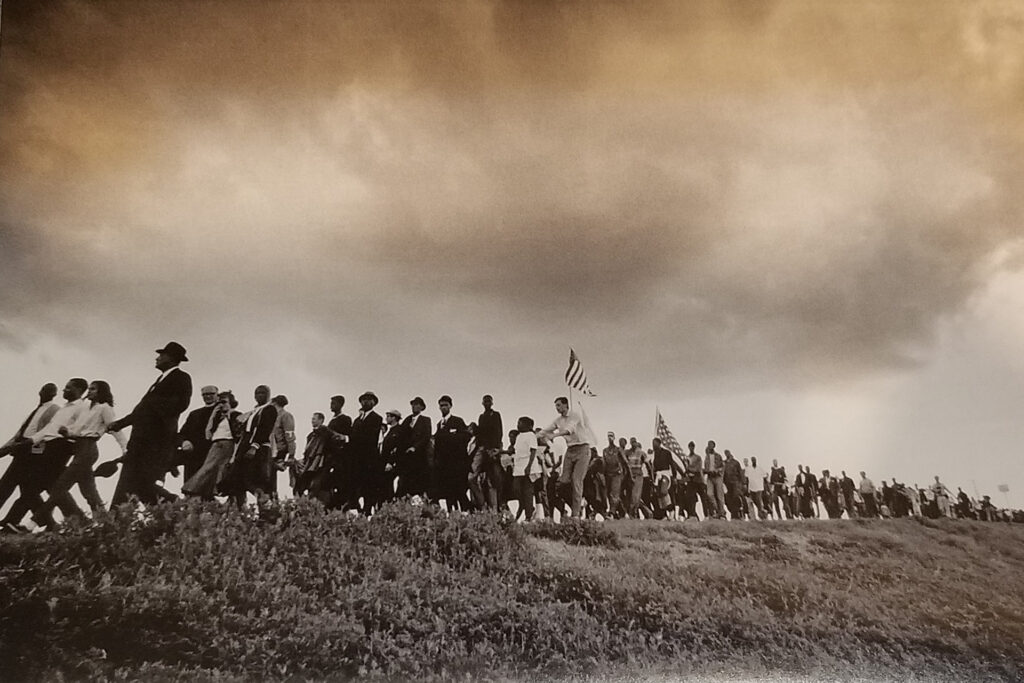
It was almost like committing suicide for an African Americans to go to the courthouse in the Delta of Mississippi or the Black Belt of Alabama and declare his or her intention to register to vote. White organizers were risking their lives trying to register black Americans to vote. Segregationists saw the cameras of reporters, their pads and pens, as an invitation to brutality. OUR homes were bombed and our jobs were threatened. Some of us were expelled from college or run out of town. Peaceful, nonviolent protesters were trampled by horses, struck with bullwhips, beaten with nightsticks, arrested, and taken to jail. Some were shot and even killed, but we buried our dead and kept on coming. We knew we would not stop; we would never turn back until we tore down the walls of legalized segregation. We didn’t have a cell phone. We didn’t have a website. We didn’t have a computer or even a fax machine, but we used what we had. We had ourselves, so we put our bodies on the line to make a difference in our society. We were just ordinary people with an extraordinary vision, imbued with the discipline and philosophy of nonviolence.
Congressman John Lewis, Road to Freedom: Photographs of the Civil Rights Movement, 1956-1968, High Museum of Art, Atlanta, 2008
It was July 2016, at the Democratic National Convention, when I saw Congressperson John Lewis in Philadelphia. I approached him. I told Rep. Lewis that I am a grandmother who came from Los Angeles. He quickly stood by my side, stopped his aide from distancing me, and the aide graciously took three photos. His generosity of spirit resonated with me to this day that a poetic photo of John Lewis’ casket as it crosses the Edmund Pettus Bridge in a horse-drawn carriage during a memorial service on July 26 in Selma, Alabama, taken by John Bazemore, Associated Press, got me sobbing.
Lewis was twenty – five years old when he had the raw courage to lead some 600 protestors over the bridge to advocate for the right of African Americans to vote. In his own words: “it took nothing short of raw courage for participants in the movement to stand up to the governor, to the citizen’s council, to mounted police, tear gas, fire hoses, and attack dogs. It was dangerous — very dangerous—for anyone to say no to segregation and racial discrimination simply by taking a seat at an integrated lunch counter or on a public bus.
Washington Post’s Sydney Trent on July 26, 2020, described how John Lewis was “first to be beaten in the clash with state troopers, who cracked his skull with a billy club on the date that became known as “Bloody Sunday.”
The violent beatings were seen by a dozen legislators in Congress who spoke about this state-sponsored violence: “I have just witnessed on television the new sequel to Adolf Hitler’s brown shirts,” one anguished young Alabamian from Auburn wrote to The Birmingham News. “They were George Wallace’s blue shirts. The scene in Alabama looked like scenes on old newsreels of Germany in the 1930s.
Two months later, that state-sponsored violence led to an enraged nation calling for the passage of the 1965 Voting Rights Act.
Selma to all cities in the US: Blacks are Us
As if mimicking 1930, 1965, we are presently seeing in 2020, the teargassing and baton-whipping by unidentified military personnel in Oregon attacking demonstrators who are participating in Black Lives Matter rallies. It led to a wall of Moms defending these protestors, followed by leaf-blowing dads and a wall of veterans and disabled.
Nationwide rallies have emerged with sustained strength and frequency since George Floyd’s death on May 25, 2020. It began day after his death at the hands of Derek Chauvin, a Minneapolis police officer, who callously placed his knee on George Floyd’s neck for 8 minutes and 46 seconds, while his three companion officers held down George Floyd’s back.
George Floyd was sitting in his car when he was reported to have passed a forged $20 bill by two convenience store staffers. Instead of simply questioned, he was handcuffed and held down on his back by three police officers, while Chauvin knelt on his neck, a very fragile part of his body, which choked off his breathing.
This was videotaped by several bystanders and a special timeline was put together by the New York Times to document that inhumanity.
In a framed image of that video, both the face of anguished Black George Floyd and a white man’s face of scorn for another human being makes us see the “hunter hunting down his prey.” Except it was a human being.
While Floyd summoned his deceased mother:“I can’t breathe” 20 times. 20 times that Chauvin could have stopped himself from taking Floyd’s life, and even by police officers at the scene.
Many mothers have interpreted Floyd’s call to his mother as summoned by Floyd to all mothers, including Filipina mothers to reestablish in America, a culture of solidarity that considers we all belong to one another, a culture that regards we are all God’s beloved children, no exceptions.
Chauvin and the three other officers have later been arrested, after nonstop protests demanded their arrests, while a state sponsored autopsy pronounced Floyd’s death might have been caused by other factors, other than police brutality.
Why did protest rallies in over 2,000 cities and towns in 60+ countries globally in support of the Black Lives Matter movement that multimillion folks marched into the streets? Coukd it have been a tainted American history of systemic brutality and injustice towards Blacks?
From Virulent Racist to Solidarity-soulful culture in America
I saw the exhibit, “Breach of Peace: Photographs of Freedom Riders,” by Eric Etheridge on April 2010 at the Skirball Museum in Los Angeles. He took photos of young black men and women inside a burning Greyhound bus on May 14, 1961.
“That day, May 14, 1961, was a quiet Mother’s Day in Anniston, Alabama, described by the companion Road to Freedom book: “A Greyhound bus traveling from Atlanta to Birmingham, carrying fourteen passengers (including reporter Moses Newson, covering the Freedom Rides fro the Baltimore Afro-American) pulled in to the terminal, where the station doors had been locked shut. The bus was immediately set upon by a mob led by a local Klansman named William Chappell, its tires slashed and windows smashed. There were no police in sight.
When law enforcement finally arrived (after approximately twenty minutes), they gave the bus a cursory inspection for damage and ordered the driver, O.T. Jones of Birmingham, to leave the terminal, escorting him to the town limits, where the vehicle was left to the mercy of the following mob. The bus limped along the highway for about six miles before being forced off the road on the outskirts of Bynum by a convoy of cars and trucks that had grown to forty or fifty in number. The bus was stormed by the mob, the passengers were trapped inside, and the bus was firebombed.
Postiglione captured the drama in a shocking series of pictures that until recently was known only through a handful of photographs that he made available to the news services. Two pictures were sold to AP and UPI and seven were reproduced the following day in the Anniston Star.”
A young 12-year-old girl Janie Miller offered water to these passengers, even as she was taunted by the Klansmen to stop. Her kindness was met by more threats until her family had to leave and seek refuge elsewhere. When the black bus riders went to the local hospital, doctors refused to treat them.
“They were eventually rescued in the dead of night by a squadron of cars sent by Rev. Fred Shuttlesworth, pastor of Sixteenth Street Baptist Church in Birmingham.”
The exhibit’s photos showed dogs unleashed on Blacks, Clorox bleach poured into the swimming pool while a Black woman swam, with fire hoses directed at her.
Many Blacks were lynched and hung on trees pursuing freedom. Homemade bombs were set off in black homes and churches by the Ku Klux Klan.
On Sept. 15, 1963, four girls were killed: Addie Mae Collins, 14 years old; Denise McNair, 11 years old; Carole Robertson, 14 years old and Cynthia Wesley, 14-year-old and 14 injured in a bomb blast at the 16th Street Baptist Church in Birmingham, Alabama, as reported by CNN.com.
200 church members with some attending Sunday school classes before the 11 am service were inside the Church.
The bombing of the Baptist Church was the third in 11 days. Alabama George Wallace sent out 500 National Guardsmen and 300 state troopers to this city joined the next day by 500 police officers and 150 sheriffs’ deputies.
It was not until May 16, 2000, when a grand jury indicted Bobby Frank Cherry and Thomas Blanton with eight counts each of first-degree murder. Cherry was found guilty after two years and was sentenced to four life terms. On Nov. 8, 2004, he died in prison.
A week after this exhibit, I went to California’s African American Museum where a prototype of a boat that transported slaves packed like sardines in its lowest deck is displayed. I went inside to feel what it was like and I saw the chains and the dog collars used. How inhumane could that be?
“I appeal to all of you to get into this great revolution that is sweeping this nation. Get in and stay in the streets of every city, every village, and the hamlet of this nation until true freedom comes,” Rep. Lewis implored.
That includes us, Americans of Filipino descent.
Back then, Voting Rights were not recognized for all Americans, and for a long time, only white Americans were considered citizens. A 1790 Naturalization Act defined American citizenship as limited to only “free, white persons.” Armenians who came in this early period were designated whites and gained citizenship with the help of anthropologist Franz Boas.
With blood spilled, lives lost, men and women lynched, beaten up skulls and bodies, do we now understand that our voting rights come from the sacrifices of our Black brothers and sisters?
The false legend of “all that is white is right, black is wack”
Are we conscious enough to recognize that racism is like an octopus?
That it moves below the ocean surfaces of our minds, with unexamined beliefs and unconscious gut reactions?
Do we go so far as to claim that we are not racists, yet uncaring in Blscks losing their lives to the police, even with no provocation and without threat to life, liberty, and property?
Like an octopus, racism rears its ugly tentacles of racial animus, the outright showing of hatred towards Blacks, based on the color of their skin.
That animus leads to malice when Blacks are framed for wrongdoings and scapegoated for blame, robbing them of their most fundamental right to be respected.
An animus leading to malice followed by intentionally favoring and accruing privileges for Whites, justified by a belief that they naturally belong in America.
They are welcomed to sit at the decision-making table, entitled to unearned privileges. It is an invisible backpack of privileges, handed down from generation to generation, to Whites only, leading to a culture that showcases predominantly Whites in public squares and cultural spaces, assuming dominance in film, art plays, musicals, theater, schools, universities, clinics, hospitals, industries, foundations, non-profits, media and government.
Whites stay in their comfort zones of occupying majority of the decision making positions at higher levels of civil and military structures, until affirmative action introduced demands for diversity to reflect the present demographics, then abuses of power in law enforcement thereafter in the last few decades.
On July 26, Rep. Lewis’ casket was horse-carriage driven one last time crossing over the Edmund Pettus’ bridge in Selma, Alabama.
Thousands braved the Coronavirus pandemic’s risk to pay their respects, while shouting out loud, “I love you,” “We love you.” The majority were wearing masks.
Can we perhaps consider the belief that Rep. John Lewis articulated: “Central to our philosophic concept of the Beloved Community was an affirmation of faith in humanity – the willingness to believe that man has the moral capacity to care for his fellow man. When we suffered violence and abuse, our concern was not for retaliation. We sought to understand the human condition of our attackers and to accept the suffering in the right spirit. We believed that ends and means were inseparable, so we wanted to create a peaceful society, then we had to use the methods of peace and goodwill. Our protests were love in action. We were attempting to redeem not only our attackers but the very soul of America.”
Much like Rep. Lewis’ casket crossed the Edmund Pettus’ bridge, can we as Filipino Americans and Asian Americans, have the courage to be part of the solution, of redeeming the soul of America, solidifying our ties to Blacks and challenge the evil of racist animus to not be in our midst?
But more than that, as American citizens and future citizens to be, it is in our hands to create a more just and peaceful America by exercising our votes, choosing better representatives who will work not just for a mighty few 1%, but mostly assist small businesses to grow, for working labor to be paid living wages that can support families and sending our children and grandchildren to college, a valuable Filipino family value of improving each generation.
There are settings and institutions led by people whose identities do not depend on depriving others of theirs. If you are in that kind of family or office or school or hospital, your sense of self is enhanced by leaders who know who they are. These leaders possess a gift available available to all who take an inner journey: the knowledge that identity does not depend on the role we play or the power it gives us over others. It depends only on the simple fact that we are children of God, valued in and for ourselves. When a leader is grounded in that knowledge, what happens in the family, the office, the classroom, the hospital [the business] can be life-giving for all concerned.
Parker J. Palmer, Let Your Life Speak, 2000
When I met Sulpicio Tagud, Jr. he was rushing to get to his business meeting, yet, he paused. He shook my hands firmly. Ester, his wife and my classmate since elementary to high school, introduced me. I told him that I have heard many good stories about him. “I hope they are all good,” he said. “They are.” He smiled.
The next time I saw him he was on the way to the Sanctuario de San Antonio for Sunday mass. He greeted me with engaging warmth. “Have you had breakfast?” It was close to noon. “Yes, I have, thank you.” As we walked towards the driveway, he held Ester’s hands and helped her inside the car. That gesture towards his wife would be repeated few more times, that of holding her hands and together, walking with ease alongside one another. That intimacy, trust and affection struck me as genuine, as well as our classmates, who teased Ester that their oozing sweetness was enviable, even after 4 decades of marriage.
At lunch, I joined their family at Hotel Dusit Thani over Thai food. Mr. Tagud ordered for all, but consulted his wife and sons, Stephen and Chin Chin, for their choices too. When the food arrived, he waited until we all have gotten our fill, and near the end of the meal, he reached out for what he wanted.
His selflessness reminded me of Assemblyman Rob Bonta, where at a Los Angeles fundraiser, the legislator stopped at each table to check to ensure each guest had their meals, before he even sat down for his own.
To me, the gestures of these two men in power reveal who they are: other-focused, caring and service-oriented.
2Go Travel—an Oasis for Seafarers under Mr. Tagud’s Leadership
James Loyola of Manila Bulletin on April 10, 2017, reported: “There is a changing of the guards at listed integrated transport solutions provider 2GO Group, Inc. as the SM and Udenna groups took over control of the company from former chief executive Sulficio O. Tagud, Jr. In a disclosure to the Philippine Stock Exchange, the firm said businessman Dennis A. Uy has been named the new president and chief executive officer (CEO). Uy is the chairman of Udenna Corporation, the parent of Phoenix Petroleum Philippines, Inc. and Chelsea Logistics Corp. Tagud has retired both from the management and the board of the company after having tried to block the entry of Udenna as shareholder and Uy as board member.”
2Go Travel has modernized transport by sea. Under Mr. Tagud’s leadership, 2Go Travel elbowed out its competition and became attractive for purchase: “The SM group acquired 34.5 percent of Negros Navigation Co., the parent company of 2Go, for $124.5 million from Chinese shareholders while Udenna acquired its Nenaco shares from its Kuwaiti shareholders,” Manila Bulletin’s James Loyola wrote,“We thank Mr. Tagud for his contributions in making 2GO resilient and more stable than ever. We hope to continue guiding it to further growth and sustainability,” said Uy.
Mr. Tagud granted an exclusive interview with this writer in May 2017. I asked him about the process of creating an industry standard, an integrated transport solutions, 2Go Travel, which included a fleet of ships that transported passengers and cargo from Manila to Bacolod, Iloilo, Dumaguete, Butuan City, Iligan, Dipolog, Cagayan de Oro, Zamboanga, Ozamis, Puerto Princesa and Coron.
“How did you create this industry standard, I asked?” “By taking over an almost bankrupt Negros Navigation (NN). It was established in 1932 before the war. During 1997, the Asian financial crisis, it hit some countries 3 years, while the impact to the Philippines lasted 5 to 6 years. In 1995, the company borrowed to buy vessels, but because of the Asia-wide slow down and less people travelling by sea, the lower income group was the worst hit. There was little income and folks did not travel often, there was cutbacks those years. It now got transferred to Metro Pacific Group (MPG) holding company which includes communications (PLDT, SMART, etc.) hospitals, toll roads, infrastructure, Maynilad water utilities and majority of Meralco. MPG brought in expatriates as consultants hoping for a turnaround, until the company filed to be under a corporate receiver, something similar to Chapter 11 bankruptcy, a reorganization of debts. One month into the job, even after retrenchment, NN still had 1,000 employees dependent on separation pay, paid in installments,” Tagud shared.
Most of the employees who were let go still had not found jobs. He was faced with a dilemma, “Even if I liquidate and collect my fee as corporate receiver, what happens to the 5,000 mouths (assuming 5 in a family) depending on the company for support?”
Tagud decided if he rehabilitates the company, and with the same 1,000 jobs retained, then, 5,000 families will continue to thrive.
While it may have been easiest to liquidate, his heart continued to say, “save the jobs from being lost. Do this as your social work. To push it back as far as I go.”
In understanding providential order, one must know how to live according to nature which is living according to reason. That means living in full appreciation of the interlocking design, that God provides for all human beings.
It also meant according to Charles Taylor, an author, “more fully, it generally meant finding one’s highest satisfaction in furthering the design itself…the good life requires that in carrying out the activities which have been marked as significant, one espouse the spirit of whatever has so marked them. Humans are called to a broader perspective, to embrace the whole. What was charity now merges into benevolence.”
He went to Manny Pangilinan, the head of Metro Pacific Group (MPG) who understood what must be done. Mr. Pangilinan asked him to locate a buyer for NN. At that time, Mr. Tagud had fixed up most problems: reduce losses, addressed the large debt issues and managed relationships with creditors. NN had started to turn around, and now has positive business value. Five companies had looked at NN, some from Indonesia and Malaysia. But, after due diligence, they pulled back and said, “No interest.”
At this time, MPG was entering into another foreign venture partnership and was in the process of buying another business, but NN was pulling down the balance sheet because of its current business value.
So, Tagud boldly made an assertion, “Why don’t you sell the business to me?” The asking price of NN at that time was Php 150 million.
Mr. Tagud offered what he had, Php 5 million, eliciting a laugh from MPG. MPG reconsidered. Mr. Tagud acquired 85% of NN for Php 5 million, with 15% to MPG, in case the rehabilitation of NN succeeds.
But first, “I had to convince my wife, Ester, to put her faith in me, to invest our “blood money, our retirement money” before the executed sales documents were done,” Mr. Tagud said.
“Where did your confidence come from,” I asked?
“I started to work with another company before, a big real estate company which I ran for 5 years so it could recover and it did recover,” he said, “ I had solid experience handling distressed companies, 4 distressed companies have now been helped. So, it did not faze me. But for Php 5 million cash I handed over, I was acquiring Php 3 billion loans and a potential equity, not yet realized, for Php 4.2 billion if managed right. If all else failed, what else is new, the business I was buying was a failure anyway. So there can only be one direction, to succeed.”
“So here I am now,” he said, “I am handing over Php 5 million to MPG, who is now going to pay the transfer tax, Php 9 million to the Bureau of Internal Revenue?” MPG paid the transfer taxes to complete the transfer of ownership from MPG to Tagud in Dec. 2006.
In the first quarter of 2007, the 2 years of earlier hard work paid off and NN was posting positive gains. By then, NN was owned by 2,000 shareholders. MPG asked why is it making money under Tagud’s ledership, to which, Tagud replied, “Boss, you could just not wait.”
By 2008, NN had increasing profitability and was looking to increase revenue to upgrade its vessels. Tagud was introduced to a Kuwaiti private equity fund group. They had lunch that Friday and the group was scheduled to leave the next day. They reconvened and and made a presentation to them Saturday morning.
The presentation was comprehensive, including a revenue and liabilities analysis, particular to each of the 9 ships NN had at that time, “When you ran the business, you look at the performance of each ship, it is like owning 9 different stores, we cannot aggregate them. Of the 9 ships, I assigned a senior officer as business manager of the ship. They all accepted the challenge and there was a healthy competition amongst the senior officers.”
Months passed, and the Kuwaiti group invested in NN. With their investments, the Php 2.5 billion debts were paid off. But, first, Tagud negotiated for the loans to be repaid at Php 33 cents for every peso in debt. That zeroed out the debts of NN and left them enough money to modernize some of the ships. After that, and with operations turning in more profits, NN also alloted Php 250 million to buy back the 15% interest of MPG. Instead, MPG took Php 150 million for its 15% interest in NN and gave back to Tagud the Php 100 million in Sept./Oct. 2008.
By Sept. 2010, an old acquaintance told Tagud about another company being sold, the Aboitiz Transport group with five times bigger assets than NN. This is not the case of a bigger company buying a smaller company, instead this is the ‘smaller David’ company buying up a ‘bigger Goliath’ company. “Perhaps it is the Quijote complex in me,“ Tagud continued. Tagud approached a Chinese Equity Fund and made them choose whether to invest in NN or the Aboitiz company. The Fund preferred the management of NN and invested in the smaller company. So, the deal was made, a smaller NN acquired a five times bigger in assets, Aboitiz. The integration of both companies led to the rebranding of the merged entities into 2Go Travel.
A successful acquisition requires managing people well
From the get go, Tagud told his management group, “We are not coming in as a conquering army. We are to integrate – it is to pick up the good things from the other entity and to be nice to them. The general default attitude is resistance and feeling superior to them. Don’t assert that you are superior to them. Decide overall to retain competence in the organization. It is not to behave like buyers, we are the boss attitude. It took two years to integrate the two companies under a new corporate vehicle 2GO GROUP, INC which then embarked on expanding its business from shipping to full scale end-to-end logistics.
Tagud shared some more, “Revenues increased, profitability increased and we became the darling of foreign investors. In considering investing in logistics business in the Philippines, 2Go Group came up #1. My son, Stephen is responsible for rebranding. After the acquisition, it is not as important to be the biggest shipping company. But what is more important, because we are islands, is that shipping becomes the biggest enabler of an integrated logistics operations. If we consider logistics, end to end from factory to store shelves, our shipping company became a convenient platform. If goods need to be in Cebu in 36 hours, it will be there in 36 hours. We became a warehouse, land transport, sea transport, and distribution company. It was a seamless connection of all segments. 2Go Group, Inc. had the ability to deliver end to end anywhere in the Philippines. Last year, both the Chinese fund and the Kuwaiti fund were happy to achieve 20% return on their investments at 2GO. SM beat me to acquiring the shares of these partners, even if I built it. SM’s acquisition and introduction of another group, will now mean clash of cultures and their management style is different than mine so, I sold my shares.”
To Tagud, “the greatest happiness is when you give something and see someone smiling and may even thank you.”
To his management group, 60% of the sales went to Tagud, and 40% to 11 managers, “I have made all of them millionaires,” he said. All of his NN employees also got 2 months pay also from the proceeds of his personal holdings.
Published on Balikbayan Magazine and  Asian Journal

Part II on love, marriage, faith and family success which will be in the next issue.
Happy advanced birthday @barackobama – you are the very first President, whom I dare say with my heart’s certainty, that you told us the truth, acted with compassion and for the #commongood, with honesty, integrity and accountability.
When I shook your hand at then Senator Barbara Boxer’s fundraiser, I shouted with glee:”Mr. President, dream come true.” You gave me your broadest smile and shook my hands.
You are someone I deeply respect and I gave my all to campaign for, including walking door to door to knock on the homes of Las Vegas’ citizens. Weeks before the elections, I knew in my heart you would win as folks were proud that they were voting for you.
I volunteered to be a poll watcher and recalled a couple, Americans of Korean descent, with an infant on a stroller, running to meet the 8pm deadline. When they got to my table, I told them to breathe, and to take their time to vote. After voting, the young mother said, “We are so happy to vote for him, the very first Black President and our very first time to vote. We hope he wins.”
You captured over 120 million votes in two elections.
I have been voting for years but my votes were reluctant votes for the lesser evil. When I voted for you, #44th, I was voting for the very best presidential candidate to be the very best 44th US President. I got to hear your voice thanking your campaign volunteers, sensed the hoarseness, your weariness yet still you had the energy to thank us all.
Through the 8 years, I casually would email you via the website created by the White House. One day, I got your email explaining in depth your foreign policy process towards Syria. I was surprised.
I kept emailing you and recall that I challenged you to consider working doubly hard for diplomacy negotiations, to redouble earnest efforts for peace and even consider a trip to Hiroshima.
I am not sure if you were persuaded, but a year later after I went to Hiroshima, you became the first US President to make an official visit to Hiroshima in Japan.
For all the public good you, our 44th US Pres. has done, I like the most is how you show your genuine love for Michelle Obama, children, and your staff.
Women who are successful exude a sense of confidence in themselves. One of the things such individuals have in common is their ability to harness their own thoughts and behaviors; they bring a great deal of personal intention to their lives. They realize that they’re the directors of their own destinies and therefore take a positive stance as they look forward. They’re happy people-by happy, I’m referring to an experience of contentment, joy or positive well-being. It’s the sense that life is generally good, meaningful and worthwhile.
Cheryl Saban, Ph.D., 2009
Notice the LA Times newspaper in your front doorstep? That when you pick it up, it is contained in a plastic bag? When you pick it up, think of a young Abigail, an immigrant at 4 ½ yo, who sorted the inserts so her mother, brother and sister can bundle them together and put the newspaper inside a plastic bag. Do you know how early Abigail started her day with her family to work? 1am.
LA Times newspaper sorter to Magna Cum Laude at USC
Abigail was 4 ½ when she joined her mother, Lolita, and her two siblings, Michael and Shielah in America. Michael, Shielah and Abigail were first raised by their grandmother and their aunt in the Philippines, until they came to America to join their mother Lolita.
With only a New Yorker relative to lean on, and no support system in Los Angeles, the family of four fended for themselves. Shielah and Michael acted as stand-in mother and father to Abigail, while Lolita worked two jobs.
The family worked together as a unit at the LA Times shortly aftermidnight. Abigail and her siblings formed an efficient, assembly line. Barely three feet tall, Abigail stood on a stool, sorting newspaper inserts, which she handed over to her mom, standing next to her. Not knowing how to handle the work at that young age, Abigail developed eczema from unhealed paper cuts. When her young body got tired, she slept inside the shopping cart, propped next to the assembly table. The cart was her bed, where she was safely tucked in. By 6am, the morning newspaper had been delivered, their sorting shift is done, but Lolita has to go to her day job at an insurance company, while all three children went to school.
When they got home from school, Michael and Shielah looked after Abigail. Michael prepared their meals, while Shielah helped Abigail with her homework, and became Abigail’s emotional support and “stand-in mother.”
When Abigail needed anything, like lunch money or clothes for school, it was her sister that she asked, and her sister, only 10 years older than her, that provided.
“What would you be when you grow up, Abigail?” Shielah asked Abigail.
“I want to be a lawyer.”
At age 5, she was certain who she wants to be. Keep asking her and her answer is: “I want to be a lawyer.”
In high school, she was voted “most likely to succeed, carrying a briefcase.” Inside that briefcase, you will find that Abigail’s mother, sister, and brother packed into it, their own examples of discipline and pursuit of excellence.
Pushed to excel by their mother, all children were expected to bring home the highest grades from school work. She told them, no matter what and no matter what their family circumstances, the children were made to believe “you will be successful if you excel in school.”
One summer, when Abigail was in 7th grade, she brought home one B+. Not good enough for the mom, Abigail was grounded for the summer: no phone, no television and no friends. At 9pm each evening, Abigail dutifully complied and respected the rules. She would even unplug the phone and take the phone equipment to her mother’s bedroom. Even then, Abigail was aware of the concept of compliance to a higher authority.
All three siblings got close, supporting one another, becoming each other’s only avenues of support.
A Hard Worker with an Articulate Voice
Shielah described the family’s trip to New York in 1983 to visit Auntie Rose, who now lives in Las Vegas. They were all riding the subway, when young Abigail blurted out: “That man stinks.” Mom Lolita quickly told Abigail to restrain herself as that was not a nice comment.
Although Abigail grew up to learn empathy, Abigail’s voice could not be suppressed. She used her writing voice and got admitted to USC and even earning a modest scholarship through her mom’s employment. At USC, she graduated magna cum laude. Starting freshman year in college, she worked in the library 20 hours a week and by junior year, she got a second job at the LA Superior Courthouse, working 35 hours a week while going to school full-time. She relished working and earning a paycheck, but “most important for me is the people I work with. I want to work in a family atmosphere.”
She was admitted to the UCLA Law School, one of the nation’s highest ranked law schools, where she did not easily make friends. She candidly shared being uncomfortable at UCLA, a university which had done away with affirmative action, and was less than welcoming and inclusive.
With sons and daughters of rich folks going to law school at that time, she felt out of place. But, determined to be heard, she dressed unconventionally: fishnet stockings, combat boots and of course, she was seen.
She bonded with other Filipinos who were organized under a long-honored tradition of “adobo night potlucks.” She joined La Raza, where she was accepted for who she is. She also joined Asian Pacific Islander Law Student group. She adjusted, and she credits the nurturing she received from other students of color, including African Americans law students, with whom she studied [only five in a class of 300], who welcomed her in “Section 5,” as key to her success in law school.
“When I first got there, my dress was different. I tried to change my attitude to fit others. I had always received good grades throughout my life because I was true to myself. But my first semester in law school, I tried adopting a thinking process that was not my own–I studied in groups and tried studying from others’ outlines., , But it was not my work, it was not me. . In college, I had straight A’s, except for one B. After I received my first semester’s grades in law school, realizing I was below the curve, I cried for two weeks. Once my tears dried, I realized why. I needed to be me and not try to be like anyone else or study like anyone else. By second semester, I raised my grade point average to to a 3.4. And I did it studying the way I had done it the past fifteen years. I regained confidence in myself.” Abigail shared.
With that self-assurance, Abigail and the entire family applied for the citizenship process: “When I took the citizenship exam, the INS agentwas apologetic. As a third year in law school, I was more educated than he was and he felt embarrassed to confirm that I knew answers as to questions like how many stars appeared on the American flag.” Shortly after she graduated from law school, Abigail finally got her citizenship. “I remember holding that U.S. flag and crying so much.” It was a double win for Abigail in 2003, a higher education degree and finally becoming a naturalized U.S. citizen after more than twenty years. She was so proud and felt, “I can be me,” the lawyer she always wanted to be.
Meeting her Mentorand Becoming One
She applied at her first law firm and was thrust into labor, class action, and entertainment law. Before finally landing her first job, she received some help from her mentor Fritz Friedman, who acted like a big brother figure to her.
Fritz made her feel comfortable about “who I am.” She was insecure, but he assured herthat she was a good person who could do great things. He even helped her set up a few job interviews. Abigail said: “He made me believe that I was special, but he was always painfully honest. One day, he called and said honey, I just saw you in a photograph. May I tell you something? You’ve gotten fat. I always want you to be the best you can be in all aspects of your life.” That’s all it took and Abigail lost the extra weight in a matter of few months.
She is now one of the shareholders for the Jaurigue Law Group (a recent promotion to partner at the law firm), where she also acts as the managing counsel.
At the firm, she describes using “encouragement and positive language” for staff to find the best practices in what they are doing, and she holds the record of knowing how to “efficiently handle” paper, given her early exposure at the LA Times. She values the foundational attribute of the firm, a “family atmosphere,” which she nurtures for the staff as well.
38 million folks reside in California, 27% of which are immigrants, with one in four foreign-born. State Bar of California reports 248, 240 are lawyers, 72.83% are active in their practice.
In the Los Angeles’ Filipino-American Community, four are designated Super Lawyers whom I know: Joe Sayas, Paul Estuar, Michael Jaurigue and Abigail Zelenski (formerly Abigail Treanor) as a Super Lawyers Rising Star, given her young age. Three, including Abigail, have served on the Filipino American Library Board. Both Abigail and this writer were recruited to serve on the Board by Fritz Friedman.
Credibility, according to Super Lawyers, is a precious commodity that must be guarded using a rigorous process, peer evaluations and third party research on performances of these attorneys, and a recognition process wherein folks do not pay to play. Super Lawyers is a rating service choosing outstanding lawyers in various practice areas in 12 performance indicators and track record of performance. 2.5% are chosen Super Lawyers Rising Stars (for those who are under 40 years old) and 5% are chosen as Super Lawyers (for those who are over 40) each year, through a selection process, that is now recognized by the U.S. Patent Office.
4 ½ yo immigrant Abigail is now a U.S. citizen and a practicing lawyer, with distinction, shared with an elite 2.5% of the lawyers in California, publicly known as a Super Lawyer Rising Star for the past two years.
Abigail credits that designation to the trust she instills in her clients. “That’s how I get clientsI know that trust and kindness are two of the most important attributes in an attorney. Clients come to me for their legal needs because I always perform my work with those two attributes in mind..”
Her positive self-worth designed her destiny as a Super Lawyer Rising Star! But also, she carried the briefcase, that was packed by her family’s example of hard work, discipline and quest for excellence, along with her emotional anchors in life, Shielah and Michael.
Update:
In the fall of 2018, Abigail Zelenski founded Zelenski Law, PC, a boutique law firm where she services clients on a wide range of employment-related issues. She practices with her husband and partner, David, both of whom have practiced employment law for the past seventeen years. In the summer of 2019, Abigail was appointed by Los Angeles Mayor Garcetti, and confirmed by City Council, to serve as a Commissioner on the inaugural Civil and Human Rights Commission and began her term in 2020. The newly formed Civil and Human Rights Department was formed to maintain and strengthen Los Angeles’ diversity, equity, and accountability through oversight, outreach, legal remedies, and empowerment. Likewise, in 2020, Abigail was tasked to serve as President-Elect of the Philippine American Bar Association, the largest and oldest local association of Filipino-American lawyers in the United States and will serve as its President in 2021. Abigail continues to volunteer her time in the community, including with Search to Involve Pilipino Americans, where she previously served on its Board. She also makes sure to spend time with her lovely family, David, Zoe, Marty, and George.
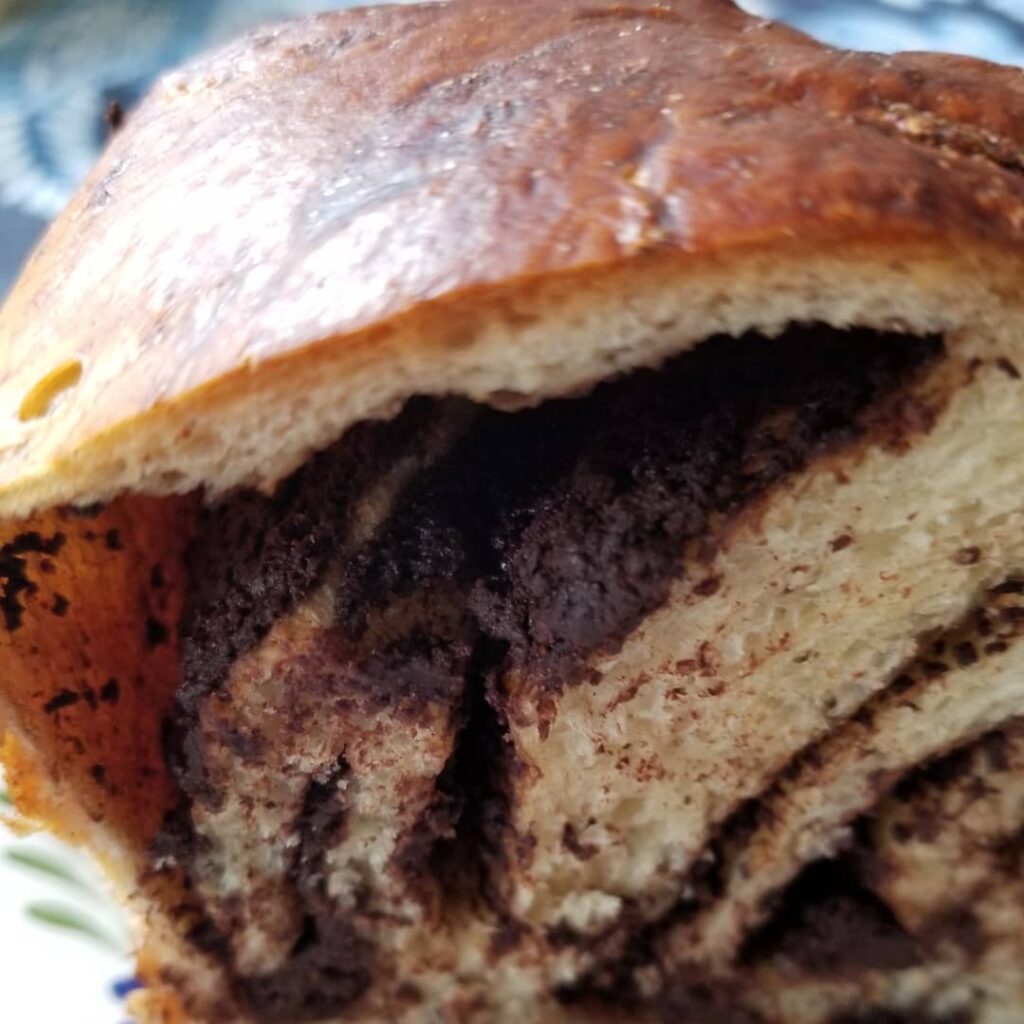
Today is my first time to make pizza dough from scratch. Guess who helped me measure ingredients, locating the right measuring spoons, measuring out the yeast, flour, salt and more. My 5yo #princess2015la.
After mixing the dough, she said it was sticky. So I asked her for the solution – should I add flour?
She confidently said yes. Then she shared a story that sourdough bread dough is sticky and she and her mom have to work with the stickiness.
After adding the flour, she even knew it was the right consistency. So, we set it aside to rise.
“Grandma, what does rise mean?”
“It gets bigger in size, it becomes two dough pieces, one for you and another for your mom and dad for your dinner.”
“But, Grandma, I don’t like basil.”
“I thought you are vegetarian?”
“I eat broccoli, but not basil. I also eat chicken tenders.”
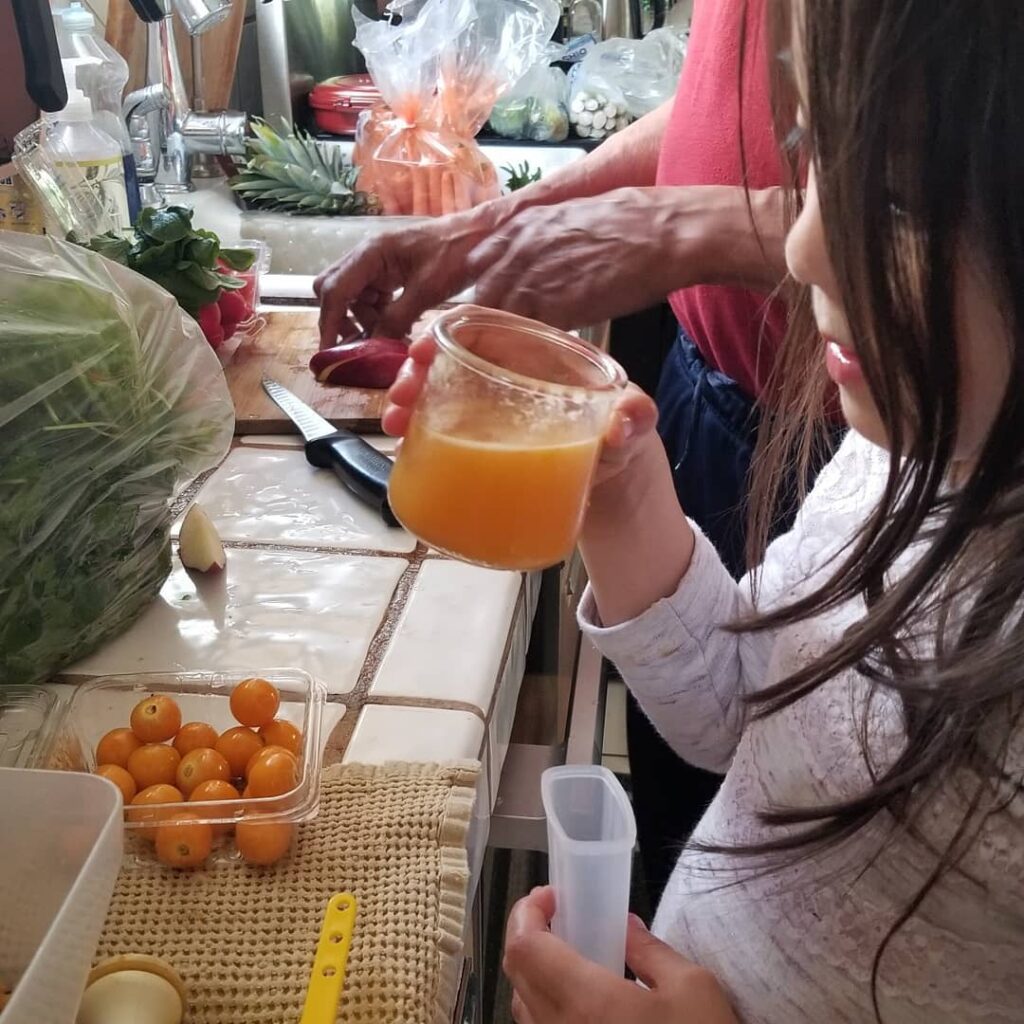
Grandma told her if she made just plain apple juice, it will turn brown due to oxidative browning when its enzymes are exposed to the air. She said she likes brown color anyway.
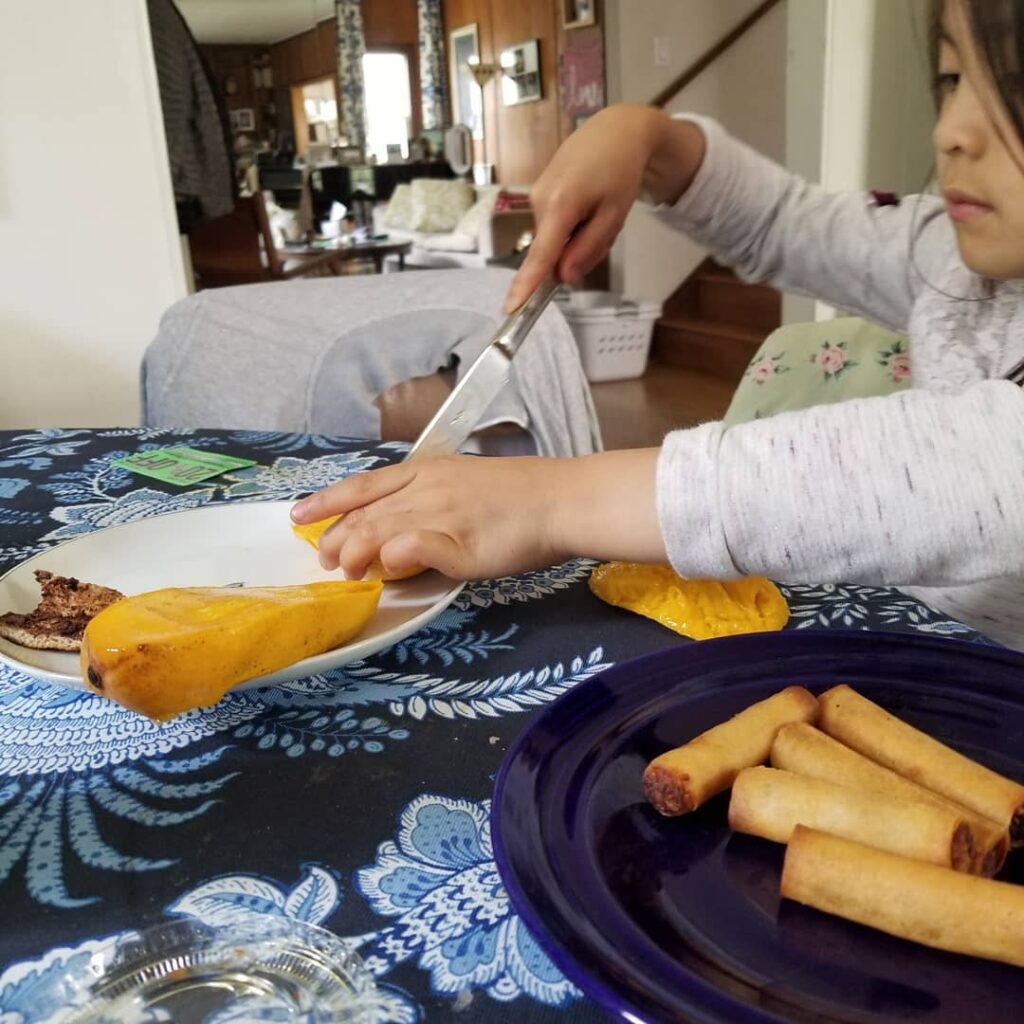
She experimented with adding gooseberries. #lolo cut up apples and now she is busy with an activity.