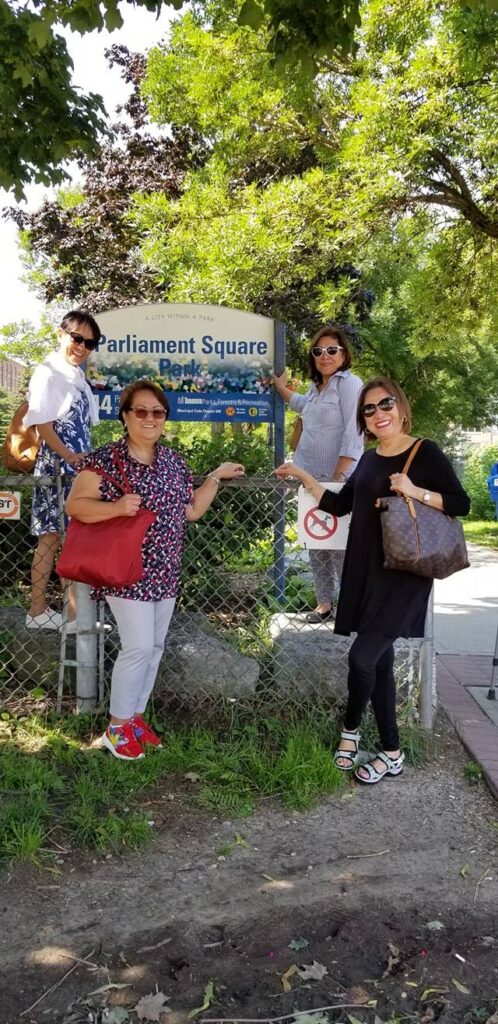
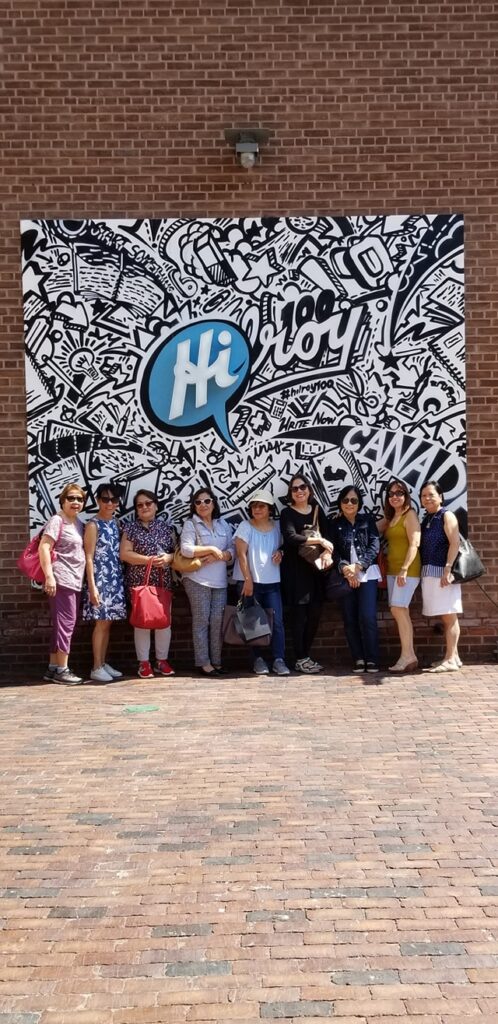
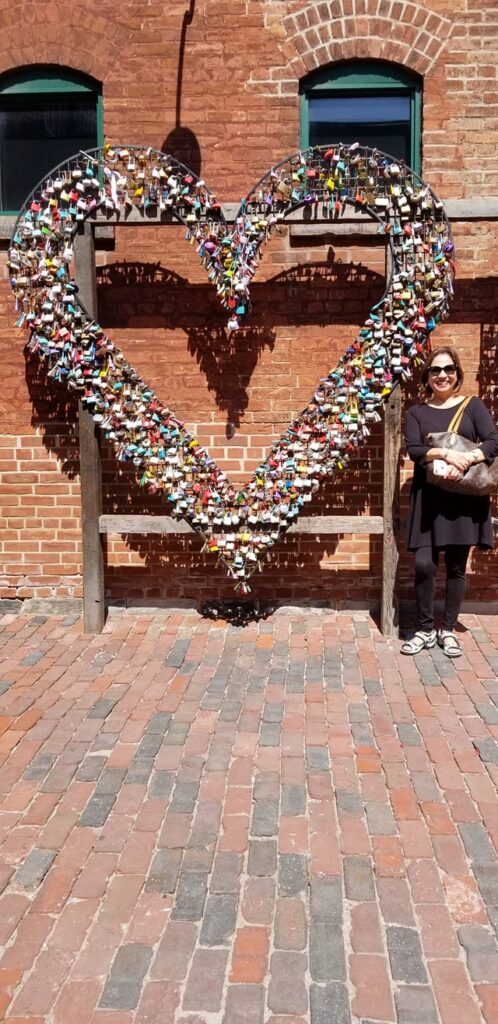
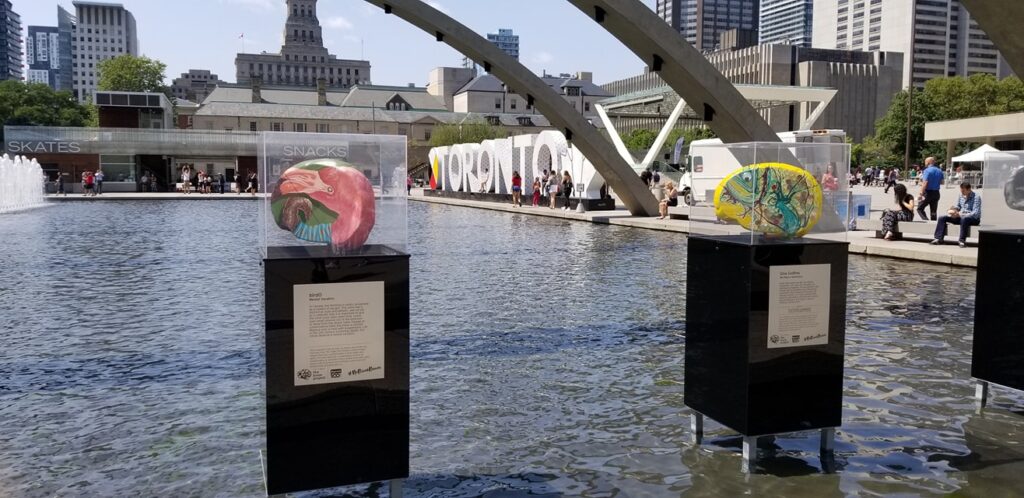
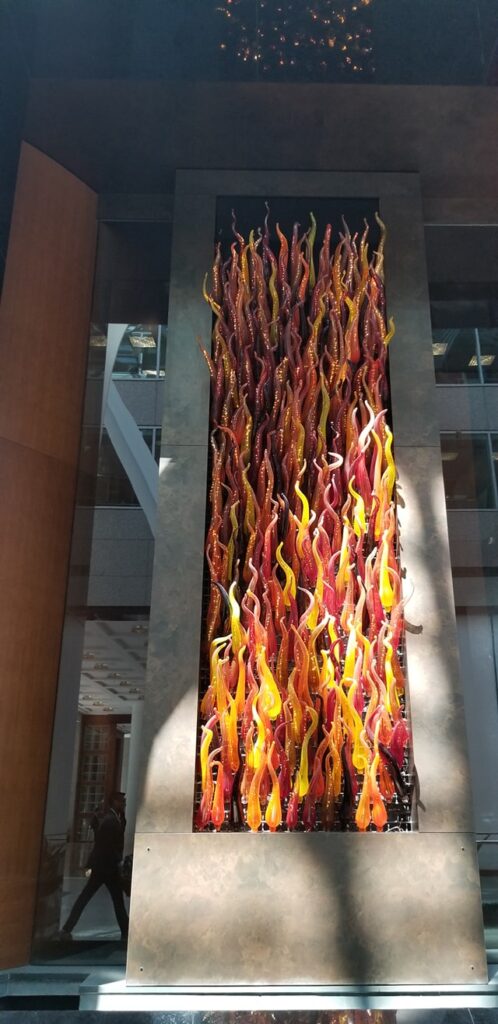
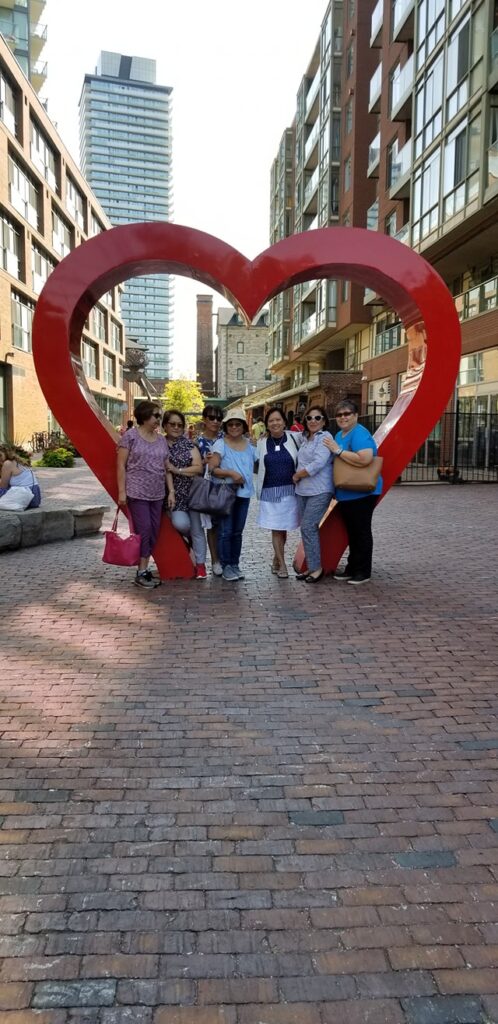
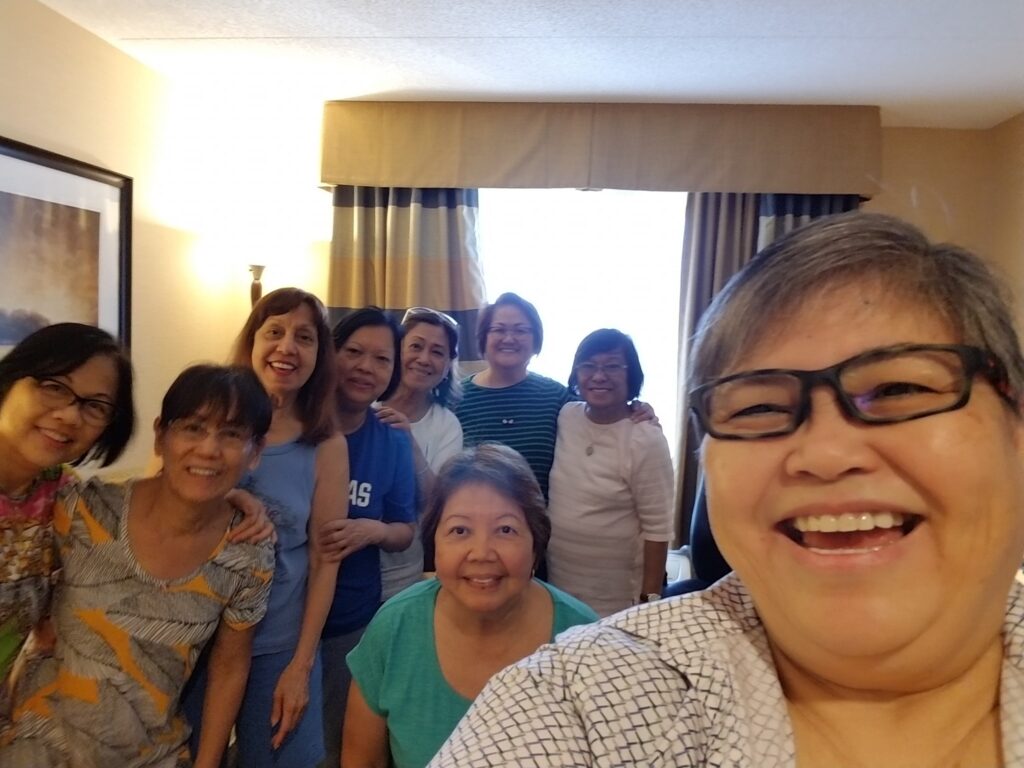
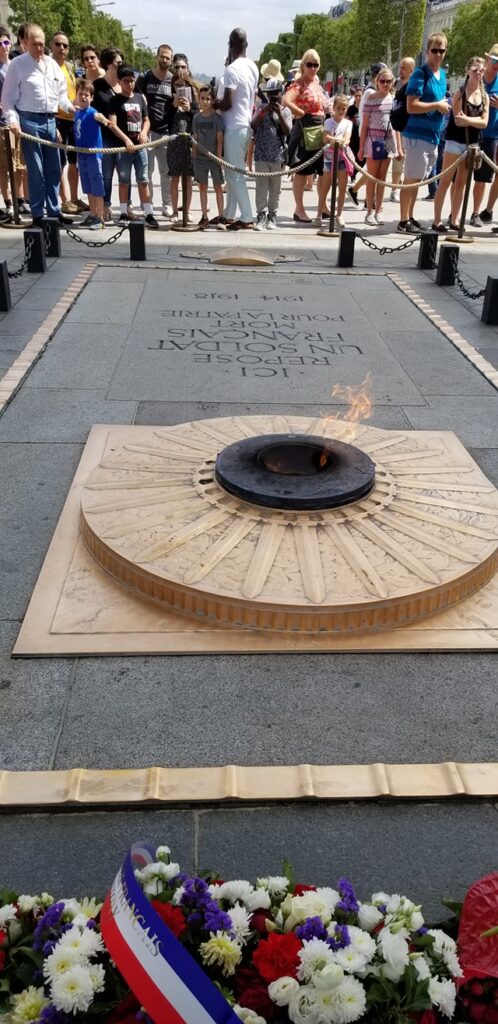
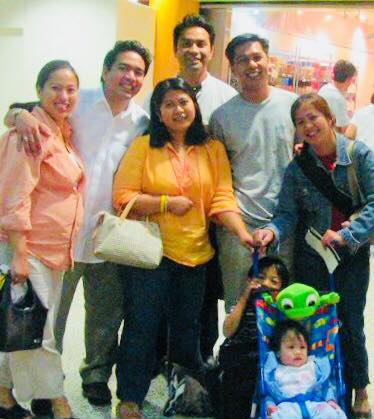
Our #crazyrichasians 51st high school reunion. Full of joy, walking for miles and miles, eating, artworks seen all around the city, fresh flowers surrounding you. What a great, healthy, livable, walkable, orderly, clean and plant-based nutrition at most places. @ Toronto, Ontario
Our host, Seny Reyes Zamora, gave us the red carpet welcome treatment. She singlehandedly cooked and prepared 8 courses, including dessert, brazo de Arsenia, a very delicate one and went to Chinatown twice to get us our favorites: lanzones, atis, mangoes and mangosteen. When we were looking for more of the brazo, it was magically gone to some other classmates’ tummy. That is how much we loved her cooking!
Elizabeth Cortez, another Canadian host, picked up classmate Beth Aspiras, brought turon dessert and led us in a brisk walking of their underground city, 3.7 miles in one day. Prior day – we walked two miles. All in all this reunion got us into doing something we were uncomfortable with: walking long miles briskly, knowing GPS, and travelling alone by oneself. It is what we challenge ourselves with each reunion — for each of us to evolve and to grow healthier.
Some of these lolas aka grandmothers have fake knees, meaning they have now been replaced to keep them moving after the original parts have worn out. Yet, even with their physical ailments, their smiles will not reveal their limitations at all. One is even injecting herself with insulin to keep her blood sugar level, yet, you will not hear her complain at all. Another had an aching back, a prelude to gallstones being an issue for her, yet again, with no complaints and simply kept going and walking. Another had episodes of rapid heartbeat yet, she kept going. Now, she found the right heart medication and no more episodes after this trip to the Niagara Falls. It is as if God gave us all a challenge and because of our optimism and goodnaturedness, most of the physical ailments got resolved after this Canadian trip.
Imagine these grandmas braving the rains, driving 10 hours one way from Chicago to Toronto, and another 10 hours to return from Toronto to Chicago, with a stop at another classmate’s house in Michigan. I am in awe of their fearless, adventuresome spirits! They are strong, fierce, loving women with such generosity of spirits! I am in awe of their bravery and courage, their deep faith in God which fuels them to be optimistic, positive and cheerful.
Oh of course, we had 5% drama, but the beauty of being grandmothers, we can choose to be noble so after a temper tantrum (of all issues, Trump as few of my classmates are die-hard supporters of Trump, as some of us are die-hard supporters of Obama), one chose to distract us all by changing the topic and another was so brave, she sat down with the grievance-venting group and got them to change their moods. Since I am the obvious die-hard of Obama, I went to the Trumpie supporter and told her – “Our friendship will outlast any political figure in office. We are bound by our love for St. Rita.” She gave me her biggest smile and in our goodbyes, we hugged tightly. We are looking forward to our 9th reunion in Dec. 2018.
Thank you for making this a very joyful reunion, my 8th now!
P.S. Hornblower Toronto boat cruise liked my IG post on these adventurous grandmas, they want to feature them in their marketing brochure. How about that?
We made it to the US side and Canadian sides of the Niagara Falls on our second day. We were meant to be lost as we caught double rainbows. Today is a great day, after the gray clouds cleared. A first adventure for most of these grandmas. I even got to drive in Canada with very supportive classmates and a great first time navigator.
Love today invites us to look beyond the short-term, taking a concern for the generations to come and not leaving them a legacy of easy solutions…It invites us to move forward without numbing ourselves to reality, without being ostriches burying their heads in the sand in face of failures and mistakes. Love invites us to accept that in our very weakness is all the potential needed to reconstruct our lives, to be reconciled with each other, and to grow.
Pope Francis, Only Love Can Save Us, Homily May 25, 2012.
Bishop Robert Barron delivered a homily at the ordination of the five deacons at the Cathedral of Angels in Downtown Los Angeles on August 11, 2018.
He recalled Fr. Larry Kelly (his spiritual mentor) and the important lesson he learned from him, which continues to inform his priesthood: “that within the bounds of law and morality, you are free to do what you can.”
Bishop Barron called it pastoral creativity. He emphasized to the deacons “to stay in God, in prayer, to reflect, and to serve.” He considered his 33 years as a priest, a life of adventure.
Like Bishop Barron who has over 30 years of priesthood, Fr. Alden Sison has been a priest for 32 years. Fr. Alden Sison was installed as St. Genevieve Church’s (St. Gen) pastor on Sept. 21, 2008, and he said, “I celebrate 32 years as a priest – unworthily – this Sept. 2018, God is good!”
In an interview with the Asian Journal on April 24, 2018, he shared his background, his spiritual mentors and his journey to the present.
I asked, “Are you related to Dr. Ramon Sison?”
He jokingly responded, “you mean the communist leader Sison, referring to Jose Maria Sison?”
“No, I am not. I was told I could be related to the former Congressman Nancy Sison and Archbishop Juan Callanta Sison. The Sisons come from Lingayen, Pangasinan,“ he added.
Pangasinan is where salt and bagoong making and carving wood furniture are some of the livelihood sources. This sense of place seems to inform his current stewardship/leadership of St. Gen’s community. Why so?
Salt is a condiment used to flavor our food. Even granola has salt added to it to spike the flavors, but also to preserve its shelf life. It seems that Fr. Sison’s pastoral stewardship is to salt the surroundings, to make communities more viable and to create more alive ministries, able to build bigger communities. It may have come from his early exposure to the Columban nuns, spiritual mentors and nuns, who taught him culturally-competent ministries.
Humble beginnings of Fr. Alden Sison Fr. Sison grew up in Lingayen, Pangasinan. He was raised by his grandmother, Florentina Arias, while his parents worked overseas. He went to St. Columban’s Academy, run by the Columban sisters, whose principles include “ministering to people of various cultures as a way of witnessing the universal love of God. Their mission is to facilitate the formation of vibrant faith communities and help struggling people regain their dignity, challenged by illiteracy, violence and injustice.”
In the 7th grade, his grandmother passed away, and he joined his parents, Sid and Lilia Sison, who were overseas Filipino workers in the U.S. The family settled along Beverly and Rampart Blvds. in Los Angeles and he went to Virgil Junior High School.
He considers Fr. Ernest Hoerdemann a discoverer of his God’s calling. During that period, racial discrimination was on the rise, as its overt and covert features of shunning, bullying and alienation in the early 70s. While excited about his new surroundings and being in America, he felt like an anomaly, as a Filipino. He went with his family on Sundays, and at St. Kevin’s, he met Fr. Ernest Hoerdemann, an associate pastor who was previously assigned in Cebu. Fr. Hoerdemann took him to the Divine Word Missionary in Riverside, where he went to a year in high school.
Msgr. Patrick Collins, then pastor of St. Kevin’s, became his second spiritual mentor who further nurtured his God’s calling. He asked him to consider Queen of Angels High School in Mission Hills. From there, he went to St. John’s College (now closed), housed in the same campus as the seminary.
At St. John’s, there was a lot of questioning, a process of discerning – is this the life for me?
“I had a confirmation of my interior calling, a community calling, supported by my mom, who prayed the rosary and many novenas for me. My mother has not ceased saying rosaries and novenas for me,” he said.
Recall what Bishop Barron’s mentor said on pastoral creativity and how a priest can do anything, as long as within the bounds of laws and morality? Fr. Sison learned important lessons on morality from the nuns who taught him.
“I learned my chemistry lessons from Sister Leo Francis of the Sisters of St. Joseph of Carondelet, who taught me patience; chemistry was not my strongest subject,” he said.
Sister Patricia Benson of the Sisters of St. Louis taught English and from her, he “learned how to respect women’s rights, how to promote women’s rights, and to draw a line on abortion, based on being a moral leader of the Church’s teachings. Sister Patrice had a very strong influence in sensitizing me to women’s issues in those early days.”
Sister Patrice Benson then moved to become a professor on literature at St. John’s and Fr. Sison minored in literature. He recalls the display of the Guttenberg Bible at St. John’s Seminary that was sold to finance the seminary needs. Only a photo remains of that rare antique bible, encased inside the second floor of the St. John’s Seminary in Camarillo.
He was ordained in 1987 by Cardinal Roger Mahony at St. Vibiana. Of Fr. Sison’s journey during his Silver Jubilarian (25th year of priesthood), Angelus News wrote: “Father Alden Sison was born in the Philippines, in 1961.
In his sophomore year at Notre Dame High School in Riverside, he entered Our Lady Queen of Angels High School Seminary and was ordained from St. John’s Seminary in Camarillo. He has a bachelor’s degree in liberal arts and a master of divinity. His first assignment was at Holy Family, Artesia, for four years followed by six years as associate at St. Bernardine of Siena, Woodland Hills. Father Sison was named pastor of Our Lady of the Valley, Canoga Park in 1997, and since 2008 has been pastor of St. Genevieve, Panorama City.”
His journey to cultural competence He credits Sister Marilena Narvaez of Sisters of Social Service as a good example of culturally relevant social ministry. He described her as fierce, undaunted and fearless and perhaps, may have pioneered the installation of Simbang Gabi masses in the Archdiocese.
She sent him to different churches to celebrate Simbang Gabi masses, “I had to go to nine consecutive evenings to nine different churches, from Dec. 16 to 24, and even to Santa Barbara to celebrate mass.” He also credits Cardinal Mahony of being supportive of this ethnic ministry.
In serving at different churches, first at St. Kevin’s, he observed that Filipinos have several devotions, one of which is the Wednesday novena to Our Lady of Perpetual Help. Because of that devotion, it solidifies their practice to attend church regularly.
By 1996, he became the youngest pastor, at 34 years old at Our Lady of the Valley in Canoga Park.
“I had to become culturally sensitive in my ministry. That includes women and because I am a Filipino, I also need to focus on ethnic ministries. In this church, it was populated by mostly Latinos as the white flight had begun from Canoga Park to Santa Clarita. The pews were emptying of whites. I focused on ministering to the Latinos and Filipinos and established the first Simbang Gabi, a novena of nine-day masses at 5:30 a.m. in 1998 at this church,” he shared.
“I also focused on developing ministries for the older parishioners and developed programs on how to unify the Anglos, Filipinos and Latinos,” he added.
It was not about building compartments, he said. Instead, it is about developing awareness of one another, like having masses together, a fiesta where everyone can participate and that became a milestone for the growth of the church’s population at Our Lady of the Valley.
“It was about building community, a functioning community with ministries that were alive. It was about opening the classrooms so they can meet and pray for bible study and prayer groups.”
By the 11th year, he was pulled out by Msgr. Gabe Gonzalez and transferred as pastor of St. Gen.
A chance to bear fruit At St. Gen, Fr. Sison’s 10 years have not just preserved the core formations of faith, but he has enhanced its music ministry and faith formation groups.
He looks to improve structures where needed.
“In initiating the reorganization and restructuring of our educational journey, which is presently underway, I have taken a very broad view about what our two schools [St. Gen Elementary and St. Gen High School] and our students, will need in the future to become good citizens, contributing members of our society and, most importantly, good Catholics who will walk in the light of the Lord for their entire lives. I am really very happy with the direction in which we are going and ask everyone in our community to give the good works that are underway a chance to bear fruit,” he wrote in their Church’s news bulletin.
At first, these two schools were under two distinct leadership models and competing directions. By consolidating the two schools under Dan Horn, the principal of St. Gen’s high school, both schools are more collaborative, with the preschool feeding its graduates to the elementary, while the middle school graduates matriculate into high school.
Consider Charina Vergara, a single mother who is both a breadwinner and nurturer of her daughters. She still found time to head a fundraising event at St. Gen, sharing, “I am blessed with flexibility in my working hours and I have been volunteering for years at St. Gen, where I feel welcome. I consider St. Gen as our second home, with a sense of family and community. The people are warm, friendly and respectful. I find that [my] volunteering [creates] a huge impact on my daughters to become high achieving, confident, and to perform well in school. I have noticed a big change in the way they run the school, a better organizational structure now. They offer opportunities for our children to grow their faith and develop leadership skills. Missy is an active altar server and she wouldn’t miss a Sunday nor be late for mass. She finds joy and delight in serving. She is happy at St. Gen. I took a video of how excited she was that she was going to go to SG for kinder. [Years later], the excitement is still there.”
St. Gen.’s Fourth Sunday of Easter Church bulletin informed the congregation of the New SG Priests’ Residence and its open house on April 22, 2018. The pastor thanked the parishioners who made the purchase of this home for the priests possible. The Church’s community considers this a milestone of their “stewardship of treasure,” a $4 million goal of their inspiration building campaign, with pledges to date at $3,503,129 from pledges/gifts of 1,091 families, as illustrated in their church bulletin of July 29, 2018.
At the Freshmen Welcome day, Fr. Sison led everyone in prayers. He reminded everyone that as “you attend the field of games, listen to the whirlwinds of sounds and drums, it is Jesus Christ who animates us daily.”
Today, the school has boldly undertaken a strategic campaign for their Inspiration Building, now at $26 million, short of $4 million of their $30 million goal. This building will be the site of inspirational leaders’ talks to parents and students, but also where the students can freely express their music, cheerlead, dance, and perform their musicals like “Bye, Bye Birdie,” “The King and I” and “The Little Mermaid” and even their school events.
Pope Francis invites us to believe that “Only Love Can Save Us” and a universal love that seeks strategic long-term solutions for the next generations to come. It is similar to what I witnessed at St. Genevieve School and perhaps, soon from the 1,091 church-going families who had pledged and some who had already fulfilled their pledges.
One blistering afternoon in California, I asked my classmate from Chicago, who was visiting why she was so generous in attention and time with her grandchildren who came with us, adventurous grandmothers. I will never forget her answer: “I don’t have material wealth to leave them. I only have memories to bequeath and make new with them, each day.”
Since then, I never turned down an opportunity to bond with family and friends, for I want to be like my dad was, one who embodied Christmas in his lifetime.
When dear friends in New York and Paris showed me their generosity of spirits, including making the subway ride through many stops, even staying with me and my hubby till midnight at Times Square in New York, I am certain of the overall goodness of folks anywhere I go. I believe my heart can magnetize their goodness and with my Mama Mary with me, I can make more new friends.
Yesterday, a dear bff treated me to a gastronomic feast and generously shared her time, unrushed and indulged me with the best prayers that inspired her and me “to live in, to remain in” God. Her generosity inspired me to order dinner for my eldest, a working wife and mom who loves camping. Then, a priest/friend calls me to ask for prayers and reminded me “Prosy, don’t change. You have a good heart.” Will you not revel in the clouds of joy when you reflect on all these goodness around you?
In my travels, these experiences have become the miraculous moments that have now risen to a cluster, a mass so to speak of invisible and visible love, into a joyful movement and moments of hearts at peace. Thank you dear family and friends for making life so livable!
It is only with the heart that one can see clearly. What is essential is invisible to the eye.
Antoine de Saint-Exupery
The Filipino kundiman [part of OPM] is the voice of yearning love in song, plaintive in its lyrical heartbeat and yet transcendent through melodic expressiveness. The kundiman came to the fore as an art song at the end of the 19th century and early part of the twentieth, when Filipino composers such as Francisco Santiago and Nicanor Abelardo formalized the music structure and sought poetry for their lyrics, blending verse and music in equal parts. While the sentiment of the kundiman tends toward the melancholic, the commitment of the heart to passion is celebrated in every piece. The singer of the kundiman expresses the pain and beauty of love felt by every listener, for the kundiman is not merely entertainment but an embodiment of collective emotion. Endowed with such power, the kundiman naturally came to serve as a vehicle for veiled patriotism in times of colonial oppression, in which the love for a woman actually symbolized the love of country and desire for freedom. The contemporary love songs of the Philippines are as much related to the kundiman as to Western popular music, reveling in the universal theme of love but saturated with the heartfelt sentiment epitomized by the finest kundiman.
Christi Anne Castro, Filipino American Library Program, October 2002
I read the first quote to the founding members of the Philippine Chamber Singers-LA (PCS-LA). “Art opens up the heart,” as the saying goes, so did Dale Francisco’s sparkling eyes as he recalled that he was asked to sing a harana (a courtship love song) by a suitor friend for Jennifer. In singing with his friend, Dale fell in love and eventually asked permission from the suitor to pursue Jennifer. He courted her, he proposed, she said yes, they got married and are now blessed with two children. He took a sabbatical to help raise them and now that they are older, he rejoined PCS-LA “because I missed singing with them.” Dale (unrelated to Gelo Francisco) is the only singer amongst his siblings. He discovered his passion at a very young age of 3, but he was not encouraged to pursue it. In college, he pursued his love for music by forming a University of Santo Tomas choral group and when he immigrated to the U.S., he co-founded PCS-LA.
His mentors included Lourdes Osuna, an instrumentalist for the church’s choir. He became part of the choral group at mass and would join Fr. Arnold Zamora in his concerts. He was invited to be part of the Far East Bank’s Chorale group by Doris Estallo, a much sought-after teacher of chorale groups, who became Dale’s mentor. Dale credits living in God’s grace, as he seems to be smooth sailing with doors opening in his life, it was true for his wife, his marriage, and his chorale groups. He is now a U.S. citizen.
What these musicians sacrificed to be green card holders and citizens in America
Founding members of Philippine Chamber Singers-LA (PCS-LA) from left to right, Marivic Belo Francisco, Gelo Francisco, Dino Padallan, Ana Burog, Dale Francisco, Anna Hurn. Photo courtesy of Ana Burog
Ana Burog is one of PCS-LA’s founding members, who takes care of the group’s logistics, liaisons with the community, and is their costumes’ coordinator as well.
Ana is a natural performer onstage, as Lily, her generous mother, exposed her to the various facets of the arts: piano, organ, jazz, ballet and cooking class.
“I was not trained to watch television,“ she said, “I grew up listening to the kundiman’s guitar music played by Salicio, my dad with his friends. In third grade, I auditioned for the glee club and was not accepted. But, I kept seeing beyond, that this was like playing a game, and I can be a star someday. So I applied in fourth grade, pasok ako (I got in). In high school, I was the only one singing of my three siblings.”
Then, Ana’s mother, Lily, got sick. Ana had to apply for a probationary permit, so she could go back to Manila, take care of Lily and within two weeks, Lily died. That decision bears no regrets for Ana, a daughter who chose love for her mom, chose to serve her till her dying moments, even if it meant taking a risk and prolonging her waiting period for her green card. After nine years, she has a green card.
Equally generous in spirit to Ana were her music mentors, noting “Raymond Romen was my choral mentor who exposed me to all these facets: how to prepare for a concert, how to join a competition, how to sing in harmony and while in Maryknoll (now Miriam College), I sang in a joint concert with the Ateneo Glee Club.” Her other mentor was Boy Delarmente, a De La Salle University choral conductor.
Gelo Francisco had a similar challenge when his father died. Gelo was still waiting on his green card. Each renewal of his working visa would cost $2,500.
“If I went home, I would be overstaying and that would not be favorable in getting my green card, ultimately, a citizenship. Even if I were to go home, what about my children, kawawa naman ang asawa ko. (Pity my wife?) So I had to consider my options – do I want to remember my father, while he was alive or as a corpse? Instead of going home, I ended up giving my siblings the cost of my airfare but, iyak ako ng iyak. (I kept crying and crying). But, if I stay, where do I get the monies?”
Gelo ended up taking more part-time jobs to support his pregnant wife, Marivic, including a scary-for-him graveyard shift of duplicating CDs, at an office whose window overlooks a cemetery.
“I had to keep playing sacred songs and I had to make a deal with the souls in the cemetery that I would pray for them,” he recalls.
He is now a U.S. citizen and credits Atty. Kelly O’Reilly for being kind and compassionate over a decade-long journey to naturalization. As soon as he got a chance to travel to the Philippines, he went to visit his father’s grave.
Emman Miranda helped organize a men’s choral group when he got to Los Angeles. “Hindi ko alam na iiwan ko ang buhay ko sa Pilipinas (I did not realize I would leave my life in the Philippines),” he said.
As each working visa permit arrived, he kept renewing each year. Imagine what he had to do with only $300 in his possession, with only a part-time job, what would he do now with an upcoming concert with this men’s choral group?
He was faced with the same dilemma as Gelo and Ana: “Do I go home or do I stay and keep going for permit renewal?” Given his determination and his faith in God, he stayed until he got a visa for his extraordinary talent, and now is a U.S. citizen.
I inquired as to the requirements to become PCS-LA members, not that I would ever qualify, a long-cherished dream of mine is to sing, if only I was blessed as these PCS-LA members.
So, here goes, my dear AJ readers: you may be able to sing, willing to learn the Tagalog language through songs, but most important of all, you must have a commitment to attend rehearsals, able to get along with members with a demonstrated enthusiasm for your culture or in the beginning, an interest to learn Filipino culture.
The founding members cited the enviable examples of the Ulanday couple (Lisa and Louie), both of whom are Filipino-Americans, were born here and do not speak Tagalog. But, given their love for music, previously into comedy and bowling, they went with gusto for PCS-LA, as much as they’re singing at Sunday mass for Blessed Sacrament Church.
That, plus raising a toddler son. They used to dance Pasigin, a song they learned in their gatherings, but until PCS-LA, they did not know they should be dancing like fishes.
To sum it all up, what traits would you develop, I asked PCS-LA, aside from commitment and showing up for rehearsals?
Fearlessness – it does not matter if we are a Filipino and Filipino-American choir, it is by our actions that we will command respect from anyone, as that is our past experience as UP Madrigals singing even to Germans “Dahil sa Iyo” and moving them to tears and to folks around the world.
Versatility and daring ambition – “Kaya natin iyan, kung ginagawa ng iba, kaya din natin (If others can, so can we).” It is a belief in our collective capacities. It comes from past experiences of some members who had performed in the palaces in Europe, but also the only choir allowed to sing in person for St. John Paul II in Rome.
Breaking barriers – We have no predecessors. We are pioneering our own culture as a choral group. We can break all barriers. Yet, we do our best to protect the reputation of our group, PCS-LA, alive for 14 years now. You are your own boss as a singer – you come equipped, you study the notes, you can stand alone, if needed and whenever needed. The only time you can contribute to the group is when you can say, “I can do this on my own!”
That is the expected standard from each member, a “can-do” level of heightened musicality!
Perhaps more than their masterful musicality, we are witnesses to their sacrifices to give dignity to their God-given talents and to give honor to their heartwarming heritage, as if royalty-bearers of the Filipino-American culture.