
ARTICLES BY PROSY ABARQUEZ-DELACRUZ, J.D.
Prosy Abarquez-Delacruz, J.D. writes a weekly column for Asian Journal, called “Rhizomes.” She has been writing for AJ Press for 18 years. She also contributes to Balikbayan Magazine. Her training and experiences are in science, food technology, law and community volunteerism for 4 decades. She holds a B.S. degree from the University of the Philippines, a law degree from Whittier College School of Law in California and a certificate on 21st Century Leadership from Harvard’s Kennedy School of Government. She has been a participant in NVM Writing Workshops taught by Prof. Peter Bacho for 4 years and Prof. Russell Leong. She has travelled to France, Holland, Belgium, Japan, Costa Rica, Mexico and over 22 national parks in the US, in her pursuit of love for nature and the arts.

Asian Journal, September 15, 2026 — Link To Article
“Wherever creative love enriches life, the Spirit is present and operating. The same is true when a person graciously loves himself or herself. If you enter into the love of God for yourself, knowing your wondrousness as a creature, forgiving yourself the way God forgives, then you have an encounter with the Spirit. Generous self love enables you to give the gift of love to others.” – Elizabeth A. Johnson
Read More
I was having coffee and breakfast at a busy, vintage, Japanese-owned cafe, watching Glen cook breakfast, Linda take the orders, and Maria refill water glasses.
On my left was a young woman enjoying her bacon and pancakes. She ordered Portuguese sausage with hash browns for her husband. “Nice, that’s what I would order for my husband, too,” I said.
Our conversation moved forward as we discovered our commonalities: We are both Filipinas with science backgrounds, and our fathers are from Ilocos, hers from Dingras, Ilocos Norte, and mine from Vigan, Ilocos Sur, in the Philippines. She was an avid listener, picking a word from my sentence and connecting it to hers. It was a brilliant way of telling me that she was actively listening.
We continued our dialogue weeks later at a Korean coffee shop, sharing an egg sandwich and, for me, a charcoal coffee latte. A shared meal is, for me, a form of shared humanity.
Soulful Introspection on Her Life’s Journey
Her birth name is Judith, from the Bible. As she grew older in high school, it became Judy. “Judith did not fit me anymore and after, it became Jude, it became more me. I grew up in a predominantly Caucasian neighborhood, one of three Asians in my school. I wanted to be like the other kids.”
Feeling like an outsider during her formative years in school resulted in a natural desire to belong, to be cherished for who she is. It got to a point that when she came home, she told her parents to talk to her only in English. “Even if they talked to me in Tagalog, I responded to them in English.”
Her father is Precious Andam, an immigrant mechanical engineer from Dingras, Ilocos Norte, known as the municipality’s rice granary. He became the head mechanical engineer at Children’s Hospital Medical Center in D.C. There, he met Alice, an immigrant nurse from Plaridel, Misamis Occidental, “known for its natural beauty, including the pristine Bawbawon Island and its commitment to organic farming, including kayaking, hiking and birdwatching.” They got married, had two children, and adopted two boys and a girl. Recently, they celebrated their 50th wedding anniversary.
“I learned the importance of work ethic from my parents. I saw their life examples of discipline, my dad working 9 to 5 daily, and my mom working three 12-hour days for the week.”
“I became stronger-willed growing up, though I very much like being what others want me to be — malleable.”
She described her assimilation journey and how, when exposed on weekends to folks of similar upbringing, “I felt a sense of belonging.” She described it as an inner feeling of wholeness, of liking the same stuff, of being able to relate to their activities, to the things they did, and to their supportive extended family members.
She experienced a Bildungsroman, “where a character’s name change symbolizes transformation, maturity, reinvention or identity formation. Immigrant Bildungsroman often include Anglicized names to show assimilation pressures. In a Bildungsroman, a name change can represent assimilation into a new culture, gaining autonomy and discovering one’s true self.” Source: Cora Oriel, June 2026.
So, from Judith, to Judy, to Jude, to a “disposition for benevolence, where sidestepping her ego allows mystical moments to move outside herself.” It was a case of envisioning her soul losing itself in love, as described by Gregory Boyle in Cherished Belonging. Cherished belonging is love fully engaged. It is tenderness in action.
Cherished Belonging to a Marital Partner
“I am married to Edmundo Martinez. He is wonderful and supportive,” she said with ebullient enthusiasm.
“How so?”
“We have been together now for 25 years, married for 17 years in August. It is more than just communication and growing together. It is finding who I am, who he is, and we are growing together, as us, communicating what we love and what we don’t love.”
He instilled in her certain principles in choosing her current career, and “he guided me toward what I want.”
He noticed that she enjoyed putting on makeup and suggested, why not monetize it? He illustrated the importance of concentric or overlapping circles in making decisions, the so-called Venn diagrams.
She drew three overlapping circles: one circle for compensation, another circle for skills, and a third circle for the colleagues she works with. If two circles out of three intersect, then the work is not as dreadful. And if three circles out of three intersect, there is satisfaction as “your passion, skill and purpose intersect,” she adds.
For example, at work, one is exposed to a first circle of skills, a second circle of income, and a third circle of colleagues you work with. In the first circle, are you gaining the skill set you need to improve yourself? Are you getting the exposure you need to broaden the scope of your skill set? Go to the second circle: Are you fairly compensated? The third circle is your circle of colleagues: Do you like them? Do you grow as you interact with them?
If all three circles are met, you gain an appreciation for your career path and achieve harmony and satisfaction.
That diagram has guided her decision-making since she finished her college degree. Her present career choice, now spanning 15 years, has brought her a sense of contentment and radiance.
It is as if she has reached “an interior castle where she has reached her highest degree of maturity,” and has one question left: “How do I align the compass of my heart with the energy of this wild God? We find the God of infinite welcome — of generous hospitality, close to see the intimacy of the unseen and allows us to live in the immediacy of wonder” (Gregory Boyle, Cherished Belonging).
“When you feel good with the way you look, it makes it easier to feel good about who you are,” she emphasized, a principle that resonated with me.
It is how she approaches every client — her wholesome being meeting another.
Is the Face the Mirror of a Person’s Soul?
Jude paused, thinking about her response. She described it this way: “Our faces are our ways of communicating as humans. We emote with our eyes, head, and nonverbally with our faces, connecting with people. That part of me when I work [is what I am mindful of], not to alter the way they look, but to enhance their natural beauty. Most of the time, women apologize for how they look, at times even asking to make them look in their fifties, though the client is in their sixties.”
She reminds them of their beauty, that “each spot or pigment is part of your memory.”
Where did this self-assurance come from, I asked?
“I believe I am more than my outward appearance. I learned to be comfortable in my own skin.” Others refer to that as “growing more skin,” a form of cherishing oneself.
She draws on her memories to describe how her family gives her a sense of belonging.
It is why she wants to preserve her maiden name and not change it. Andam comes from the lineage of her father, meaning “fully prepared.” She believes her surname, “Andam,” represents part of her life’s journey, and taking on another surname, her husband’s, would be “symbolized erasure.” She adds, “Fortunately for me, my husband understands that.”
She remembers what her mom, Alice, did to prepare for weekend activities.
“Perhaps it is looking at Alice Andam, my mom. I watched my mom get ready and being in so much awe of her after putting on her makeup. It was not transformation. It is enhancing what she has. I help my clients, enhancing their natural beauty, helping them be the best version of themselves. It is not transforming them, but keeping them true and real, as each face is very individualized. I am okay with wrinkles, okay with aging, and each pigment, each spot is a memory and experiences we have lived through. When you feel good [with] the way you look, it makes it easier to feel good.”
‘Imperfection Is Not Ugliness’
That multilayered wisdom, from facial aesthetics to where the beauty of her mom first drew her awe and attention to how folks mature and develop, was a revelation.
“Imperfection is not ugliness,” she adds.
I recall an African American woman who was walking on the sidewalk in front of my house. I went out the front door and stopped her abruptly. Imagine her walking briskly when I suddenly asked, “Your aura radiates peace. What is your secret to life?”
She smiled and said, “I leave any place that I find, or work at, better than I found it.” I shared that with Jude, moved by her radiance and the vibrant aura that I observed in her: no makeup, clear skin, and just serenity.
She has been working with a broad range of advertising and marketing clients, models and ordinary folks, including non-models, or even public figures like Tiger Woods.
With regular people who at times apologize for how they look, “I reassure them that their interesting faces are revealing their accomplishments, their trials, their tribulations, and why would we take that away?”
“I learned to do that during the pandemic, even more so, as within my personal bubble, without any work for eight to ten months, I went through a mental turmoil. I learned to separate my work from my self-identity. My hobbies are parts of me, but they don’t define me. Yes, I do enjoy nature, beach, travel, snowboarding, spending time with family and friends. While my job is a representation of my career, I remain curious about what I do in commercials, the fashion realm, advertising campaigns, live events, premieres, narrative work, short film, television.”
With that curiosity about her projects, she keeps learning.
A Science Degree — “Just a Piece of Paper” — to Skin Aesthetics
How did you get to where you are today from finishing a degree, I asked?
Ms. Andam graduated with a Bachelor of Science degree in marine biology from Old Dominion University in Virginia. In taking her comparative religions class, “I learned different organized religions: Buddhism, Christianity, Taoism, Judaism, Catholicism. Common to them are their origins and belief systems; their similarities prevail despite the differences,” she reflected.
“The unstated stigmas became implanted in our culture, leading to self-hatred. It made me understand transgenerational trauma — how not to pass on that trauma to the next generation. I also learned, reflecting on other people’s experiences, what I would do differently so as not to go through that traumatic experience. What would I do differently? I learned that to help my clients is by helping them be the best version of themselves.”
Armed with a college degree, she cultivated a growth mindset, aware of how conservative and sheltered her upbringing was. “So I looked at my folks’ lineage and asked questions: What can I learn from their experiences?”
From a foundation of science, she first worked in an aquarium in D.C. “I had an inkling that I did not fit in this field.” But she stayed the course.
“I was mentored by the dean of students, whom I approached, feeling that my 3½ years had been wasted. He advised me that the diploma is merely a piece of paper, that after I graduate, I can pursue what I want. I hunkered down, both in defiance and out of respect for my parents, and I graduated.”
She moved from job to job, from working in an animal hospital to customer service to working as an office manager for a chiropractor. In those jobs, she felt something was lacking and left after 18 months.
Instead of chasing after a paycheck or dwelling on disappointments, she started looking for what she wanted to do in her late twenties. Following the advice of her spouse, she researched how to monetize makeup application, something she loved to do. She looked at those who worked at makeup counters and those who were self-taught, but knowing her science background, she wanted a structured way of learning about the industry.
She went to Cosmix, a makeup school, where she undertook six months of rigorous learning about skin biology, skin physiology and skin conditions. She learned more than makeup, aced her subjects, and got high grades. Each day was tiring, yet she had immense satisfaction.
Fast-forward to today, she has a website illustrating her portfolio and her current projects over the last 15 years. Her website is a representation of the diverse genres of what she has achieved, going into another field and integrating what she learned in college.
Her sense of contentment is unlike “modern city swamps where nothing is never enough. There is a coherence in her complexity of thoughts, working within a field of fragmentation, like the center of the onion bulb that hides the propensity for growth,” as Dr. Katrin de Guia wrote in her book, Kapwa: The Self in the Other.
“When it comes to narrative work, I enjoy the emotional resonance that viewers experience through film and TV and the camaraderie that grows from working together with a production crew. My dream is to continue working on projects that inspire change and move emotions.” — Jude Andam

“Fishers of Men”, done by Jose Garcia Moreno (photo of Fr. John Ernesto Cordero)
Convergence of History, Theology and Spiritual Imagination
(Part 1 of a two-part series)
Asian Journal, August 23, 2026 — Link To Article
“We cannot claim universality [of the Catholic Church] while suppressing particularity. We cannot preach community while overlooking individual communities [ethnicities]. And we cannot celebrate diversity while treating Filipino faith as mere decoration rather than as a genuine theological contribution.”— Fr. Michael Montoya
Read More
I have not been this excited in a long time to share the nuggets of wisdom I gained from attending a consultation on Filipino Catholics: Gifts to the Church and the World.
At first, I thought the title sounded pretentious. Then I dug deeper into the positive contributions of Filipino American priests.
I recalled how my publishers, Cora Oriel and Roger Oriel, once assigned me to interview Filipino priests in Southern California. They were prescient.
The National Association of Filipino Priests, formed in 2009, has since held five national congresses, where member priests have found support, growth and unity. At the time of its formation, more than 900 priests attended the first Congress.
I wrote feature stories on 51 priests and two bishops, published in Asian Journal Press and Balikbayan Magazine. I interviewed priests of Irish, German, Japanese, Mexican, Chinese and Filipino descent.
Embedded in their stories were their struggles and the ways they transcended them, guided by the grace of the Holy Spirit, sustained by strong ties to their pastoral communities and supported by their biological families.
Some built churches and community halls; curated exhibits of statues of the Blessed Virgin Mary, including 50 collected from donors from different countries; built meditation gardens incorporating statues of saints; renovated century-old churches; and formed dynamic ministries to meet pastoral needs.
Others developed relationships with other faiths that grew into interfaith coalitions addressing community needs for unity and harmony.
In some parishes, every nook and cranny of the church was transformed through the engagement of parishioners, from the young to the old. Some priests helped establish children’s church choirs whose members later became academic scholars; built memorial shrines for ancestors with the Pietà and LED-lit candles; and led Marian and Holy Land pilgrimages.
Some pursued advanced degrees, completed doctorates and authored books. Two composed songs, and one wrote musicals to popularize the lives of saints.
Seared in my memory is the story of a priest who traveled to reach his mountain parishes, walking mountainous trails and passing through three security checkpoints: one guarded by the government military, another by the opposition and a third by a community sentry in his home province in the Philippines.
Can you imagine the interpersonal skills required to transcend fear while passing through three different security checkpoints?
Another priest rode a motorbike for hours over an unpaved road to reach a place of worship near the hinterlands, arriving covered in dust, sweat and dirt.
A historic interdiocesan gathering
On August 8, 2026, 88 attendees gathered from the dioceses of Los Angeles, San Bernardino, Orange, Las Vegas and San Diego, along with students from Hawaii, for a historic interdiocesan consultation.
What impressed me was how smoothly the six-hour seminar unfolded: concise 30-minute presentations by three priests, three group discussions and a report-back from participants.
With the use of Menti.com, our synthesis was displayed concurrently as the day progressed.
It reminded me of a strategic planning meeting I attended in 2002-2003 with 60 members of the American Society for Quality, led by Elizabeth Keim. Participants used dedicated Apple iPads programmed for a national consultation meeting.
It was impressive to see everyone’s input appear on the main screen. Participants were encouraged to share more, and by the end of the meeting, they complimented the conveners on a process that promoted democratic and inclusive participation. Every contribution was recognized; none was excluded.
I was struck by how technology could serve as an equalizer, especially given the history of this international professional organization, which since 1946 had been led overwhelmingly by men: 75 white male leaders and only six women, or about 8 percent, over its 80-year history.
I saw the untapped potential.
This consultation was no different. It was moving to see participants’ voices heard and their reflections synthesized and projected onto the large screen.
The use of Menti.com encouraged people who had initially been shy and timid at our table to stand and share stories from their hearts, some with tears as they recalled periods of isolation they had once experienced.
They were not griping or venting. They were recalling memories that had helped guide them toward healing, speaking honestly about their own experiences. Places of brokenness had become places where they were now experiencing grace.
Was it the prayers of Bishop Alex Aclan, invoking the Holy Spirit to open our minds and hearts to one another and to help us share honestly about our lives?
Was it the combined effect of the three priests’ presentations?
Was it the adept facilitation of Clarissa Ann Martinez, assistant director of the Subcommittee on Asian and Pacific Affairs of the United States Conference of Catholic Bishops?
Or was it the engaged participation and focus of the attendees?
Perhaps it was all of these.
Filipino leadership in parish life
Just as the American Society for Quality had only six women in national executive leadership positions over its 80-year history, Catholic churches did not have Filipino pastors and administrators until the 20th century.
At the rank of bishops, there are six Filipino auxiliary bishops and one full bishop, called an ordinary, while California has around 19 active diocesan and auxiliary bishops, two archbishops and a cardinal. Most recently, 12 priests have retired.
t Our Lady of Assumption, now 80 years old, Fr. Michael Montoya is the first Filipino pastor.
At Incarnation Church in Glendale, now in its 99th year, Fr. Rodel Balagtas is its first Filipino pastor. He is overseeing the renewal of the church and expansion of its campus to include a new parish community hall, two classrooms for music and art, a new courtyard and a landscaped parking lot designed in part for heat mitigation.
These renovations are intended to provide strategically for seven more generations to come. A decade ago, he also renovated and updated the century-old Immaculate Heart of Mary Church in East Hollywood.
At Holy Family in Artesia, now in its 96th year, Fr. John Ernesto Cordero, a Filipino pastor, is at the helm, following Fr. Raymond Decipeda.
There, we see more than a renewal of structures. We also see an upsurge in devotees following the permanent placement of a replica of the Black Nazarene. On Valentine’s Day 2026, it attracted more than 1,500 devotees. The replica is also transferred to churches in other dioceses, attracting additional devotees.
Holy Family Church has a new mural created by Jose Garcia Moreno around the theme “fishers of men.”
Its “intertwined fish moving through the spiral symbolize the interconnectedness of the community, from all different backgrounds, different roots,” according to Fr. John, whose flock consists of Filipinos, Portuguese, Chinese and Spanish parishioners, as well as a Panamanian deacon.
Beyond the symbolic mural and what has been called the browning of the pews is a larger reality: Filipino Catholics are increasingly part of the leadership and daily life of multicultural Catholic communities.
But the priests who addressed the Claremont consultation challenged participants to look beyond numbers, representation and physical presence.
Their argument was that Filipino Catholics bring something else to the Church: a history, a spirituality and a theological perspective that deserve to be understood on their own terms.

Convergence of History, Theology and Spiritual Imagination
(Part 2 of a two-part series)
Asian Journal, August 23, 2026 — Link To Article
Beyond “No Filipinos Allowed” — Filipino faith as a theological contribution
Three Filipino priests explore history, kapwa, dignity, and the distinctive contribution Filipino Catholicism can offer the wider Church
What does Filipino Catholicism contribute to the American Church beyond growing congregations, devotional traditions and an increasing Filipino presence in parish life?
Read More
What does Filipino Catholicism contribute to the American Church beyond growing congregations, devotional traditions and an increasing Filipino presence in parish life?
That question emerged at the August 8 interdiocesan consultation on Filipino Catholics: Gifts to the Church and the World, where three Filipino priests approached the subject not simply through demographics or pastoral experience, but through theology, history and culture.
I found a ride to Claremont on that hot, humid August Saturday and arrived as an enthusiastic participant.
I was certain it would be a fruitful discussion, supported by well-prepared slides. These three priests are gifted homilists, conscientious servants of God and continuous learners with administrative and leadership skills.
What I heard that day made me look differently at the Filipino American story.
I learned that Filipino contributions, now part of the larger American collective story, are theological and generative.
Our story began in the 16th century with shrimp farmers in Louisiana and continued through the experience of our ancestors being exhibited as cultural artifacts at the St. Louis World’s Fair in 1904, dressed in bahags even though we already had one of the oldest universities in existence.
In 1965, Larry Itliong persuaded Cesar Chavez to join the Delano grape strike to increase farmworkers’ wages to 25 cents a crate, helping spark international support, including the attendance of Robert Kennedy.
In 1930, a hotel in Stockton displayed a sign reading, “Positively No Filipinos Allowed,” documenting the intense discrimination faced by Filipino immigrants during the early part of the 20th century.
Fr. Michael Montoya offered another way of looking at that painful history.
A modern interpretation might read, “Positively Filipinos Allowed,” with an X drawn over the word “No.”
Dignity defies erasure, and exclusionary discrimination does not have the final say, as Fr. Michael emphasized.
It is about erasing the “No” and using our imagination to forge ahead in our participation, involvement and empowerment to build institutions and churches.
Three practical theologians
The three priests brought substantial academic and pastoral experience to the discussion.
Fr. John Ernesto Cordero was a former superior general, while Fr. Rodel Balagtas was a former faculty member and vice dean of St. John’s Seminary.
Fr. Michael founded a border church in Texas that became engaged in a dialogue with then-Pope Francis.
All three wrote and defended dissertations and authored books.
Fr. Michael has two upcoming books: As the Bamboo Breaks: Toward a Filipino Theological Anthropology in a Broken World and Filipino Catholics in the American Church: Beyond “No Filipinos Allowed.”
My excitement could not be contained.
I shared slides with my husband, who was at home babysitting our two grandchildren.
I realized that I was experiencing a full-circle moment in my life, one that brought together wholesomeness, humanity, spirituality, the Filipino American experience and the work of building communities.
Kapwa and a shared humanity
The seminar introduced the concept of kapwa.
It is a concept popularized by Dr. Katrin de Guia after being mentored by Virgilio Enriquez, Ph.D. It recognizes a shared humanity: I am in you, and you are in me.
It is similar to the South African concept of Ubuntu, which recognizes compassion and humanity in another person.
This resonated deeply with participants.
It is also a value we teach our children through pakikipagkapwa: getting along with another person by bringing forward one’s best self.
It led to the conclusion that the Filipino is a good seed, grown in good soil, rather than the dregs of society or a people to be dehumanized as “bottom-barrel.”
In asserting who we are, we should not limit our vision to accepting the status quo.
We are more than preservers. We can be transformative agents.
We also limit our vision when we are unable to share our story credibly, thereby sustaining our own invisibility as 2 million Filipino Catholics out of 3 million Asian Pacifics.
What untapped potential that represents.
More than a demographic presence
I return to the prophetic insight shared by Fr. Michael and echoed by the other two priests:
“We cannot claim universality [of the Catholic Church] while suppressing particularity. We cannot preach community while overlooking individual communities [ethnicities]. And we cannot celebrate diversity while treating Filipino faith as mere decoration rather than as a genuine theological contribution.”
That, to me, was one of the most important messages of the gathering.
The Filipino Catholic story cannot be reduced to the number of Filipinos sitting in church pews, the number of Filipino priests serving parishes or even the visible devotional practices that Filipino Catholics have brought with them.
Presence matters, but presence alone is not the point.
It is about saying yes: beyond being regarded merely as a treasured presence or as a contributing factor to the browning of the pews.
In our Christian faith, we need to become more deeply immersed in interculturality and in understanding that each culture carries its own distinctive wisdom.
We need more pastoral initiatives that encourage involvement, a yes to helping others, and a yes to becoming empowered people with a personal recognition of the full measure of our dignity.
The Filipino experience itself — its history of exclusion and perseverance, its spirituality, communal consciousness and instinct toward kapwa — can become part of the theological conversation.
It need not remain at the margins.
“If we are light-bearing and maternal,” then contributing our talents and untapped potential in service of a higher purpose becomes a natural response.
It is much like what I call this trio of highly educated, deeply involved and highly participatory “energizer” Filipino priests.
“The fruit of the Spirit is love, joy, peace, patience, kindness, generosity.” — Gal. 5:22.
And as Rev. Jude Winkler writes in Daily Meditations with the Holy Spirit:
“True love is a willingness to live and even die for one another. It is not a feeling or an emotion. True love is a choice that ultimately brings one to the Cross. None of us has the strength to do this on our own. It is the Spirit who gives us the grace we need.”
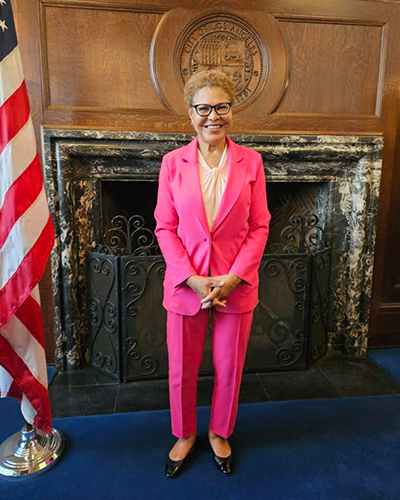
Mayor Karen Bass looking toward a bright future in LA City: Roundtable with AAPI media during Asian American Pacific Islander Heritage Month
Asian Journal, May 28, 2026 — Link To Article
Mayor Karen Bass enthusiastically greeted 17 media folks representing Asian Journal, Rafu Shimpo, Philippine Post, Bilyonaryo News Channel, The Filipino Correspondent Network, World Journal, Chinapress, UNE News Express, Yonhap News, JTBC, Chosun Daily LA, The Local, Korea Times, Korea Daily, The Filipino Channel and SoCal Filipinos, who arrived promptly, and said: “It has been an amazing honor and privilege to serve as mayor for 3 ½ years, and I look forward to taking it to another level for the world events.” She thanked us for coming to LA City Hall, despite the commute challenges. We gathered promptly at 1 p.m. on May 23, 2026, warmly welcomed by Jieun Kim, deputy director of Korean Language Communications, and Eduardo Soriano-Hewitt, senior policy director of the Office of Mayor Karen Bass.
Read More
She heads a city with about 3.8 million residents and one of the most linguistically diverse populations in the country. “I want you all to have access to us,” Bass emphasized. Given the organized themes of this briefing: housing and homelessness, public safety, economic development, small business, immigrant and language access initiatives and city services and infrastructure, it appears that this hands-on mayor has her pulse, her heart and her mind on what this city needs.
She described that her focus is revitalizing key neighborhoods that used to be tourism magnets: Chinatown and El Pueblo. She hailed Little Tokyo as the standard for a revitalized community, bustling on weekends, attracting tourists and out-of-town visitors, visiting the Shohei mural and the Dodgers shop, and showing how the Dodgers have become Los Angeles in enthusiastic energies.
Unfolding of world events and business development
Mayor Bass shared the unfolding of world events in this city: Golf FORE Her for girls from June 4 to 7 across 10 city-owned golf courses; the staging and viewing of World Cup games during the 2026 tournament period, all throughout our city; and, in two years, the 2028 Olympics.
The groundwork has already begun, illustrating her proactive strategies to help small businesses. She convened a summit attended by more than a thousand businesses on how to do business with the City of Los Angeles through www.procurela.com. Through that initiative, according to the mayor’s office, participating businesses have gotten contract awards of more than $45 million and supported 23 contract bids, including the creation of businessconcierge@lacity.
Linkages to BusinessSource Centers like New Economics for Women, Pacific Asian Consortium in Employment, Coalition for Responsible Community Development, Managed Career Solutions and Initiating Change in the Neighborhoods are aimed at “accelerating entrepreneurial journeys.”
If you recall, even while serving as speaker of the State Assembly, Bass created the very first film and television tax incentive program, and these financial subsidies have now anchored her business strategy to preserve jobs in the entertainment field. So when we see the huge “Hollywood” sign on the hills, it reminds us that more films and television shows are being made and should be made in Hollywood in the City of LA. She has called for eliminating the $750 million annual cap on California’s Film and Television Tax Credit Program to directly compete with Georgia’s uncapped production markets.
Her sustained support of this major industry has earned her key endorsements from the International Alliance of Theatrical Stage Employees, given her ongoing efforts to reduce filming costs with reduced parking rates and her efforts to keep production jobs locally. She has also earned endorsements from Teamsters Local 399, composed of location managers and casting directors, as well as AFM Local 47, which represents musicians working in television, film and live venues.
By understanding that this critical industry is crucial to keeping jobs in LA City, she has also worked on improving the ecosystem surrounding the local storefront businesses, the sporting goods stores, the bakeries, the restaurants and filming on the streets, thus her concerted efforts on reducing homelessness and increasing public safety.
Improving the ecosystem of public squares in LA City
Two years ago, I had a one-on-one interview with Mayor Karen Bass. In that interview, she emphasized her policies and focused efforts on reducing homelessness, including the structural barriers in housing faced by veterans.
She has consistently focused the city’s efforts. The Los Angeles Homeless Services Authority reported in 2025 that unsheltered homelessness in the City of Los Angeles declined by 7.9% from the previous year and was 17.5% lower than two years earlier. The city’s Inside Safe initiative has also moved unhoused Angelenos indoors and connected them to services and longer-term housing. It means more people are living with dignity than ever.
Added to that are more than 40,000 units of affordable housing that have seen red tape reduced and been accelerated through the pipeline, according to the mayor’s office.
In fact, it was this issue that motivated her to run for mayor. From the time she was installed, she issued Executive Order No. 1, declaring an emergency in the City of LA. Shortly thereafter, she announced collaborative efforts with LA County, the State of California and even the federal government. Through the Inside Safe initiative, more than 120 operations have been conducted, bringing unhoused Angelenos indoors and connecting them to interim and permanent housing.
A team composed of outreach workers with lived experience in foster homes and homelessness approaches encampments, understanding that each encampment has become a community. For two to three days, they talk to them, and on the fourth day, a bus comes to take them to motels, where community-based agencies take over to manage, supervise, secure services and provide food. In addition, there is continued engagement with the Korean American Federation of LA, Thai CDC, Little Tokyo Service Center and Chinatown Service Center to support prevention outreach.
Vacant office spaces are being developed to become affordable housing units under the adaptive reuse and affordability strategy. Also, the first update to the Rent Stabilization Ordinance in 40 years includes homelessness prevention strategies aimed at keeping residents housed and reducing their inflow into homelessness.
It is a multi-pronged collaborative systems approach linking the power of learned experiences of the outreach team members, as well as working with developers in delivering affordable units while linking LA City with community-based organizations for prevention outreach and strong collaboration with the state, the county and federal government agencies to coordinate funds. With that singular focus on keeping folks safe inside, it has led to increased public safety by increasing access to city services and infrastructure.
City services, infrastructure plans and increasing police force
Mayor Bass spoke of access by calling 311 or (213) 473-3231, or visiting lacity.gov/myla311 or the MyLA311 app. There is increased language accessibility, as 311 services are available in many languages in the city.
Personally, I have used 311 to report two incidents of missed green trash pickup, and within a day or two, they were addressed. I have called about street lights obscured by untrimmed magnolia trees on our residential street. They were attended to as well. When a tree fell on my car, LA City street services came in 20 minutes, mobilized by then-city official Susana Reyes, who waited to make sure the job of cutting the tree and disposing of it was done. Storefront businesses could not believe how fast the services were completed.
When you see graffiti removal, pothole repair and roads resurfaced, I pointed that out to the mayor during the briefing, saying that the renewed Wilshire Boulevard gave me a feeling that LA City’s infrastructure is working.
Mayor Bass also described plans for solar-powered street lights. The switch to solar, though expensive, would help address the theft of copper, and she joked that sunlight cannot be stolen. It illustrates how she cares about keeping immigrant communities safer when streets are lighted. In fact, street lights were the campaign platform that Councilperson Ysabel Jurado ran on. She described that 60% of street lights are obscured, with missing parts in her district.
For a city of 3.8 million residents, Mayor Bass wants to increase the police force. In terms of increasing it, she is pausing for the moment to focus on retaining officers. LA City needs 510 more officers just to keep the LAPD from shrinking.
She encouraged us to write more about the need for Asian officers in the LAPD and pointed out LAPD interim chief Dominic Choi. Now the LAPD is headed by Jim McDonnell, who was sworn into office in November 2024.
As to ICE and Executive Directive 17, Mayor Bass signed a policy setting boundaries on the use of city government facilities for federal immigration enforcement. Under the directive, city property is not to be used by federal immigration agents as staging areas, processing sites or operational bases. More than 450 ICE signs have been installed across city properties, parks, parking lots, libraries, the LA Zoo and more. The city has also expanded services for immigrant families to access legal, financial and emergency assistance.
“Every cultural house of countries represented here should be in the city,” Bass said. She cited the Korean festival, where the festival showcased investments in Korea, kind of like a trade show, where different foods were showcased as well as businesses in LA City. She also cited Little Tokyo as the standard for revitalization. Her focus is on Chinatown and El Pueblo.
I, too, have observed that the community leaders in Little Tokyo actively planned for the development and gave support to small businesses, such as Suehiro, with Little Tokyo Service Center working closely with LA City. Several housing developments, as well as Terasaki Budokan, a recreation center in Little Tokyo, have also been accomplished.
* * *
The opinions, beliefs and viewpoints expressed by the author do not necessarily reflect the opinions, beliefs and viewpoints of the Asian Journal, its management, editorial board and staff.
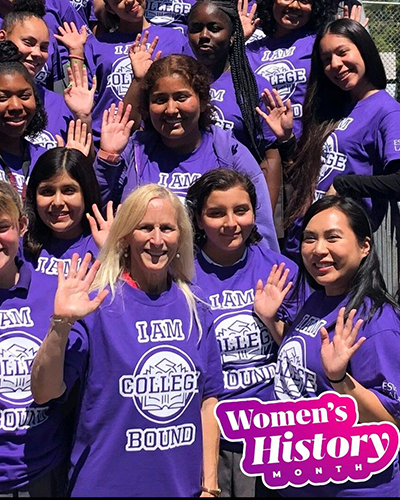
The GALA education model: The rise of a nationally recognized all-girls STEM academy
Asian Journal, May 8, 2026 — Link To Article
“Dr. Liz Hicks is an extraordinary leader whose vision, determination, and deep belief in the potential of every girl have created lasting, measurable change. She has built not just a high-performing school, but also a culture of excellence where rigorous academics, innovation, and unwavering support empower girls to exceed expectations. Her leadership demonstrates what is possible when purpose and practice align — she is setting a new standard for equity and achievement in girls’ education in Los Angeles and beyond.” — Megan K. Murphy, Global Executive Director, International Coalition of Girls’ Schools (ICGS), April 27, 2026
Read More
“Love recognizes no barriers. It jumps hurdles, leaps fences, and penetrates walls to arrive at its destination, full of hope.” — Maya Angelou
ICGS, in its mission statement, “unites educators, advocates, and partners to advance girls’ education worldwide. It connects 580 schools across 25 countries.”
The quote from Megan Murphy synthesized what Dr. Liz Hicks has created in Mid-City Los Angeles from 2016 to the present, now housed in its new campus established in 2024, located near the University of Southern California (USC) and Mount St. Mary’s University. Dr. Hicks was also pursuing her doctorate from 2015 to 2018 at USC while establishing the Girls Academic Leadership Academy (GALA). It was validated by Dr. Enrique de la Cruz, Professor Emeritus and former department chair of CSUN’s Asian American Studies, who described it to Dr. Hicks at their 8th GALA fundraiser at USC as “a civil rights success.”
I saw a slogan on a banner hanging on a chain-link fence at a successful all-boys school: “Breaking Barriers, Building Bridges,” on my way to GALA. Full of excitement, I shared this slogan with Dr. Liz Hicks, who was dressed in a green polo T-shirt with an Associated Administrators of Los Angeles (AALA) union logo, after a Los Angeles Unified School District (LAUSD) strike was averted earlier that day.
Three of us, including Novelyn Aquino, GALA events and community partner coordinator, were seated at her round conference table. Light came through the windows overlooking a sprawling green lawn, where students walked to and from their classrooms. Nearby were the front office, a library with couches, and a wooden reclining chair constructed by GALA students.
GALA has gone beyond that slogan with 100% Advanced Placement (AP) enrollment, as its 17 AP classes are open to anyone showing interest.
The girls are formed with a growth mindset. Beyond building bridges, they are boldly designing their own futures. Unafraid to fail, they are graded based on mastery of concepts rather than rote memorization.
Dr. Hicks describes it as mastery grading, where students are given multiple opportunities to demonstrate understanding and continuously improve.
Their life themes become: “Yes, why not? I don’t know that yet. Soon, I will.”
Growth mindset and mastery grading become all-across-the-board excellence.
In 9th grade, all the girls are introduced to computer basics in their AP class, and in 10th grade, all girls take an AP class on computer principles.
GALA high school graduates have been accepted to 200 universities: Yale; all University of California campuses; all California State Universities; several Ivy League schools; and international institutions, including University College Dublin and the London School of Economics.
At their 8th annual “Launch Her Future” fundraiser at USC, some of their graduates, who are now pursuing master’s degrees at Yale, Stanford, USC, and many more universities, spoke about GALA, where they learned how to think critically, continuously improve, and progress at their own pace. This event, attracting nearly 300 people, raised close to $200,000, with an anonymous donor contributing another $100,000.
Dr. Hicks believes experiences gained outside the classroom are also sources of learning. Students attend more than 60 field trips a year, not only to museums but also to workplaces where they observe women executives in action.
Girls learn from women engineers at SpaceX and Google, professionals behind the scenes at the National Football League (NFL) and the Dodgers, experts in sports medicine, and even financial literacy specialists when they visit finance centers.
GALA students are exposed to glimpses of their future careers.
Indisputable, Impressive Results of Education in an All-Girls School
The results are undeniably impressive: 700 students in this all-girls setting, residing across 100 zip codes in Los Angeles, with a 100% college acceptance rate and a 100% graduation rate, specializing in Science, Technology, Engineering, and Mathematics (STEM).
Students come from 84 different schools around Los Angeles, and their families reside in more than 100 different zip codes.
GALA is not exclusive to any zip code; it is for all of Los Angeles.
GALA ranked No. 1 public middle school and No. 2 public high school based on Niche 2026 Rankings and was considered the No. 7 public middle school in the United States.
Initially, the school had students from 79 zip codes. The current population is 30% Latinx, 29% Caucasian, 14% African American, 12% identifying with two or more ethnicities, and 11% Asian, which includes Filipinos and Pacific Islanders at 3%.
In 2016, it started with 100 students in 6th grade and 60 students in 9th grade, initially recruited from student-populated festivals, the Boys and Girls Club, Kingdom Day Parade events, and K-8 parish schools.
Four years later, the first graduating class of 2020 had a 90% graduation rate and a fairly high college acceptance rate.
Today, that has grown to a 100% graduation rate, 100% college acceptance rate, National Merit finalists, sports division champions, and millions in scholarships.
These indisputable results led to 1,400 applicants competing for 100 open slots in 6th grade in 2026.
With that waiting list, Dr. Liz Hicks said: “We need two or three more GALAs to fill that enormous need. Particularly since there is a declining enrollment trend at LAUSD, though there are more who left to go to charter schools who are now coming back to LAUSD.”
Whirlwind of Human Need
Studies have shown that only 9% of women become mechanical engineers, even as women make up 47% of the workforce. Nicholas Kristof, author of “Half the Sky,” wrote about underutilized women worldwide and the opportunities they created to change their circumstances.
In Diana Meehan’s book “Learning Like a Girl,” she wrote on page 5: “Girls have the advantage in grade school. From ages five to ten they have better social acumen, fine motor skills, and verbal ability. They are curious and engaged. In the few years since this girl was curious and engaged, society intervened: in the classroom, where the girls’ questions were dismissed quickly so the teacher could engage the more active boys; outside the classroom, where peer pressure in middle school and high school worked to counter the impulse to be smart; and the media marketplace, where the message was to be cute and sexy, specifically by purchasing products.”
Dr. Hicks came across similar findings in LAUSD.
“While boys and girls are completely equal in math and science in elementary school, the girls lagged behind in middle school, and girls chose not to enroll in AP math and science classes in high school,” she said.
Planning backward, Dr. Hicks visited UCLA’s computer science department, where incoming students had four years of math and four years of science, while many LAUSD students completed only two years of each subject in high school.
That led to her premise of establishing an all-girls school focused on STEM. But not until more research and site visits.
Unstoppable Grit of Dr. Hicks
Every human talent is influenced by both genes and experiences, writes Angela Duckworth, Ph.D., in “Grit: The Power of Passion and Perseverance,” much like Dr. Hicks.
The author of “Grit” describes 67 traits of geniuses, synthesizing grit as the combination of persistence of motive: working actively toward a definite goal without seeking change or abandoning the task in the face of obstacles. She also emphasizes the power of experiences, where grit is learned from overcoming struggles, climbing the mountain, and reaching the summit after hardship. An earned confidence to try something harder and to have something new.
“For a long time, LAUSD said ‘no’ to the idea of a single-gender school,” Dr. Hicks recalled.
“I worked several years through many ‘no’s’ to try to get GALA’s school plan accepted and approved by LAUSD, and finally, in 2015, LAUSD unanimously approved the GALA plan.”
“I consulted with the National Coalition of Girls’ Schools (NCGS), now ICGS, and Young Women’s Leadership Network (YWLN), the organization of public schools in New York. I discovered that legally we could offer this model and that the model showed phenomenal results, particularly for girls of color.”
Critical support eventually came from Superintendent Dr. Michelle King and School Board Member Dr. George McKenna, who himself attended an all-boys school and understood the need for single-gender education.
Power of Learned Experiences
Dr. Hicks was influenced by Harvey Mudd College President Maria Klawe, who served for 17 years as its first female president. Klawe transformed the institution into a national leader in Science, Technology, Engineering, and Mathematics (STEM) and increased the enrollment of women from 10% to 51% in those fields. She emphasized that computer science is essential for women, as well as strategic recruitment, increased financial aid, and curriculum redesign.
“It felt like I was being guided from above. I was not adverse to signs of divine help that were coalescing before my eyes. I was just there doing my life chaotically, daily,” she said.
“But somehow I felt like I was drawn to hear a talk by Megan Murphy on the importance of an all-girls school.”
It led to a self-funded trip to New York and Texas, and her findings were amplified with more concrete experiences.
“I also looked at my colleagues and myself who were silencing ourselves. I asked a student to specifically track how often I called more on the boys in the classroom, even though consciously in my mind, I was thinking of calling more on the girls. That too opened my eyes.”
In LAUSD, specifically, the research showed that from 2018-19 to 2023-2024, girls’ math scores saw a relative drop of 13% of a grade level, while boys improved by 29%” (EdSource.org).
Add to that a book she read on “Failing at Fairness: How Our Schools Cheat Girls,” by Myra and David Sadker, and this convergence of research findings led now from an earlier premise to a compelling conclusion to establish an all-girls school.
When we feel the whirlwind of enormous human need, how many of us would respond with grit to dedicate more than a decade of our lives to building a wholesome “whole child” solution of educating girls? How many of us would simply give up?
As if this heavy workload was not enough, she lost her husband, became a widow, while in the middle of pursuing her doctorate. Yet, Dr. Hicks was undeterred, unstoppable, in fact.
Working Actively Toward a Goal
Forming a committee of teachers, educators, advocates, and parents, they developed a plan for establishing an all-girls school and submitted the proposal to LAUSD.
After being told “no” by the LAUSD board, she finally landed a “yes” from Dr. Michelle King, the first African American woman superintendent of LAUSD, and School Board Member Dr. George McKenna.
Dr. Liz Hicks was tasked to write a school plan for an all-boys school, which she did, and Boys Academic Leadership Academy (BALA) was opened in 2017 within LAUSD.
When Dr. Hicks got the yes, she waited for a school site for GALA to be assigned. There was a vacant building at Los Angeles High School that had seen three charter schools come and go. It had fallen into disrepair.
Her group of parents, teachers, and advocates came together to paint walls, clean the facilities, and she requested a fence to be placed between GALA and Los Angeles High.
“We opened with 100 students in 6th grade and 60 students in 9th grade and we built in the different grades each year,”with the first graduating class in 2020.
Their first graduation was held virtually, as it was the height of the coronavirus pandemic that mandated six-foot distancing and the closure of onsite schools.
A Culture of Saying Yes to Opportunities
Dr. Hicks hired her first seven teachers, some of whom she interviewed at Starbucks, as they had no school site yet. Those seven became a solid team doing everything for GALA: painting walls, preparing lesson plans, training, and attending seminars together that a solid culture of teamwork came about.
Today, each new teacher is vetted by the entire department in which they will work. For example, the entire science department is involved in vetting a newly hired science teacher.
It is this tight collegiality and vetting process that sustains a thriving culture of professionalism and accountability, similar to the hiring vetting process in a university.
Dr. Hicks sets the example of teamwork, helping each colleague succeed, while also helping each student succeed until they graduate.
She actively sought funds for counseling services — four counselors to a population of 700 students, including a psychiatric social worker to attend to the interpersonal and emotional needs of students.
The first grant she wrote supported the hiring of enough counselors, having been a former counselor herself.
She found herself saying yes to increasing leadership responsibilities by then-Assistant Superintendent Michelle King to become a coordinator of counselors.
She actively organized counselors in different schools within LAUSD to publish a bulletin and inform students of college requirements, aligning them to take subjects in synchrony with what universities require.
She also created a communication arts academy that resulted in a 75% graduation rate, a discipline combining liberal arts with practical skills in media, writing, and design, preparing students for future careers as well as persuasive communication skills.
She was also given increasing responsibility to be involved with the “10 schools project with UCLA” to increase the enrollment of African Americans in that university. She realized she got more satisfaction in helping students in need.
She was then promoted to assistant principal and was mentored to move to administration and get certified, and later encouraged to pursue a doctorate in education.
Novelyn Aquino wrote her feedback as a parent at GALA: “We are so grateful for her vision and GALA. Every family at GALA hit the school lottery.”
But isn’t it love that made her jump through hoops with hope and positivity?
The opinions, beliefs and viewpoints expressed by the author do not necessarily reflect the opinions, beliefs and viewpoints of the Asian Journal, its management, editorial board and staff.