This 4th time around, Art took priority. Visited Philippines Consulate in NY for Ysabel Grace Simon’s first solo exhibit of 11 captioned oil paintings and 4 lithograph studies of Rosie, Rosie. A two hour interview with the artist went so fast. Ysabel is a young 21 yo college student with 3 majors: business, studio arts and Asian American Studies. 100 plus attended the exhibit opening.
A visit to the Neue Gallery was a treat to get a photo OP with #womaningold, a portrait of Adele Bloch-Bauer done by Gustav Klimt in 1907. Another portrait done by Klimt was at the Met.
The Met had so much to offer: the Impressionists, the Asian Art, Buddhism artifacts, Kyoto Art, Rock and Roll instruments, including the Beatles band instruments, and the Chinese atrium. The Met was a pretty good date and had me mesmerized for 6 hours. My legs were complaining but my eyes, heart and soul were recharged. I learned concepts of “loud,” “camp,” “buddha,” and more.
47 years ago with only $200 in my pocket, with a California destination to be with my elder sister, Rose, I became a regulatory official for a state public health agency. I have been retired after 27 years of public service and I have been writing a column for 11 years for a community paper.
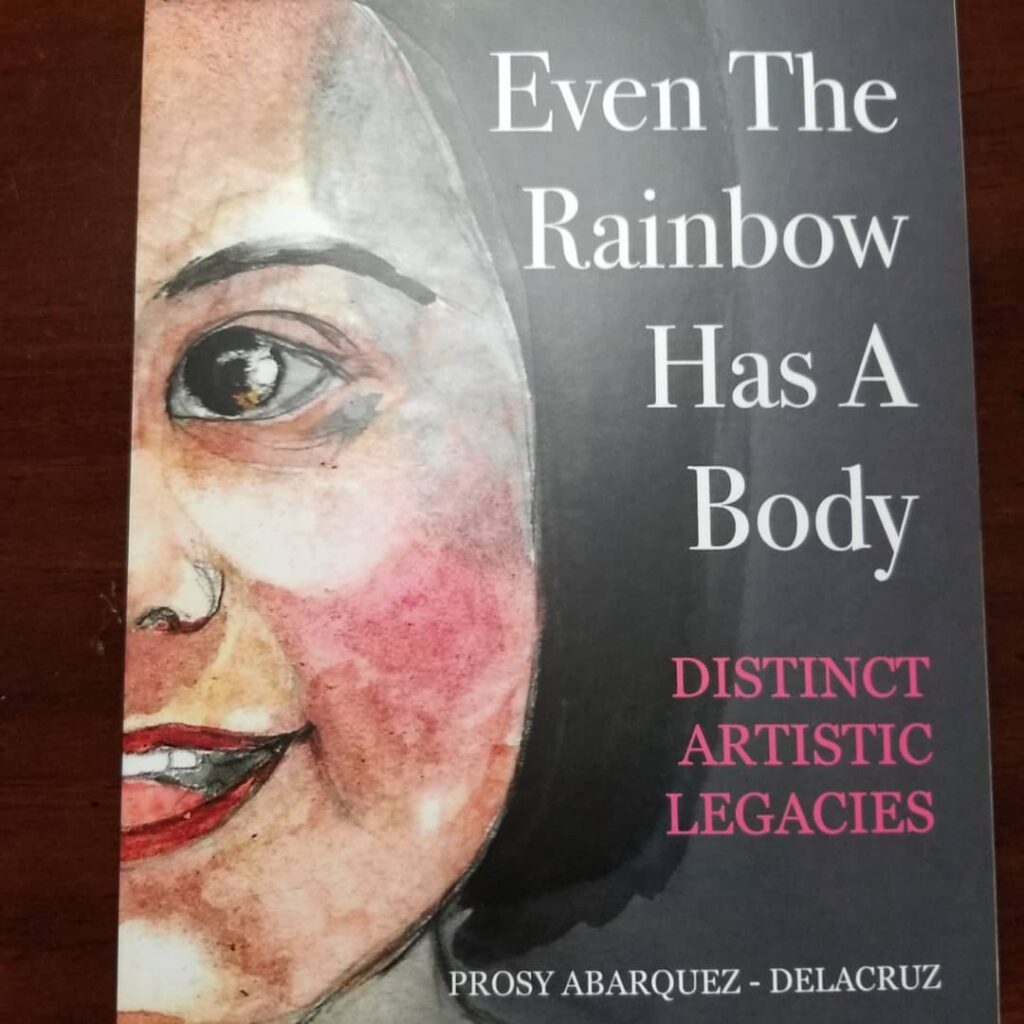
My eldest sister, Rose died 60 days of my mother in 2016. In 2016, I wrote a book called Even The Rainbow Has a Body, as a lifeline to bounce back from my two tragedies.
The book cover was designed by Ysabel Grace Simon. She said, “Half of the face is what you inherit from your parents, the other half is what you make of your life.” She was just 18 yo at that time.
At 18yo, I was a lost immigrant yearning to be back home in the islands, Philippines, and had just migrated to America.
Today, 47 years later, I just finished interviewing this 21 yo artist, an American of Filipino descent, whose love for the arts was lovingly nurtured by her global citizen parents, a practicing CA psychiatrist and a global director of IT in one of biggest universities in NY, as her hard work and the work ethic she has displayed to nurture her talents.
I loved our interview this am and here is the revelation – I prepared at least 10 questions which she answered through a free flowing discussion without me having to read half of them. I asked her – how in the heavens could you have read my mind? It dawned on me #oldsouls can, particularly when God is at the center of both of our lives.
She encouraged me to visit her favorite, #neuegallerieny and its 5 star cafe. Only two rooms had exhibits as they were curating the fall exhibit for October, one of most stunning exhibit is #GustavKlimt#womaningold painted in 1903 to 1907, inspired by 6th Century Byzantine, after Gustav visited the Church of San Vitale in Ravenna, Italy. It is a painting created without modeling. It reflects richness, luxury, Japanese lacquer work, an epitome of refinement and nobility, while lavished in gold.
“That’s the state of how I was taught, was the whole thing of Ohana, wishes family…and that’s one thing that we don’t get enough of in the Philippines; [it is] all about family and same in Hawaii and that’s one thing I’ve always enjoyed is to be able to treat my people, of the people I perform with, the people that I perform for as if we were family. I don’t go up there and become this big God and try and make people worship me. I hate that, if there’s anything about mine in my career I hate most is that. But to be able to relate to my audience to have them be the stars and not me during a two three hour concert that for me is the ultimate mission of my every show – so the upbringing of Hawaii, the atmosphere of the laid-backness of Hawaii but more than anything the Ohana factor, the family factor that became very part and parcel of my act even joking around about family how my mom raised me ala Rex [Navarrete a comedian] never end there; that kind of thing you know when he jokes about his grandmother and his mother being so Filipino is unbelievable. I put all of that in my show, okay so we got a Hawaiian Filipino with the spirit of Ohana and rich in everything.” – Martin Nievera, with Philipp Harth on Fan TV (2010).
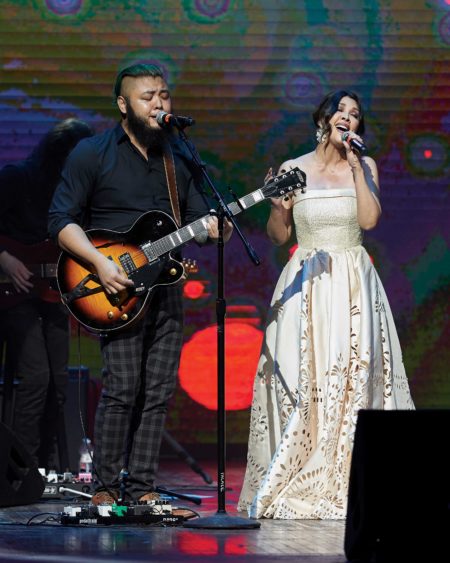
I have watched Martin Nievera at his solo concerts in Los Angeles, and wondered about his accessibility to the audience. I was not a fan yet. It reminded me of ASAP stars on The Filipino Channel with how they literally made the audience a part of their show. It makes for an unruly audience who would at times interrupt the singing with selfies. But, after watching Nievera with Pops Fernandez, my initial impression of a flamboyant singer who attracts his audience with his exuberance and enthusiasm turned into an expressive Martin who was balanced with Pops and her serenity onstage. As Pops came out in her ivory, no shoulder gown, with laced cutouts, Martin admired it by holding up the bottom to showcase the designs, to which Pops tenderly remarked to put it down as she had no slip underneath. When Pops appeared as the first Filipina judge on CBS’ “The World’s Best” hosted by James Corden in early Feb. 2019, I wondered how she became a talent judge. I, of course, did not know that she has built a formidable singing and acting career, as the better half of Martin’s love team on television and film, his former wife and the forever mother of two “wonderful treasures,” whom he referred to, their sons Robin and Ram. It was my classmate, Rose B., who reminded me of their television show, “Penthouse Live,” that she watched every Sunday for years. But more than that, Martin has garnered 18 platinum, five double platinum, three triple platinum, and one quadruple platinum albums. That amounts to millions of records sold. As an ex-married couple, the generosity in their friendship is palpable, when Pops said in a GMA interview with Janet Susan Rodriguez Nepales, “I got a call from Martin (Nievera, her ex). I was doing a video shoot. Martin texted me and asked me if I heard about the show. Yes, I told him. He said that they chose him. I said, Really, wow good for you. But then Martin said, I don’t think I can make it. I can’t make the dates. So he asked me if I could do it instead? I thought that was really touching of him to think of me. I said. That is so sweet of you. Little did I know that I would be the first Filipina to be featured in the show as a judge. It was a wonderful experience. It is a fantastic show. I hope they will do more seasons and I can get together again with the other 49 judges.” The duo performed at both Palace Theatre in downtown Los Angeles and Samala hall at Chumash Casino on two consecutive weekends. Samala, by the way, means “recognized by God” with a capacity of 1,500 seats, almost all claimed that evening. At the Palace Theatre, its 1,068 seats were all claimed, leaving the organizers to sacrifice their seats for others. Palace Theatre in its golden 50 years was located on Broadway, a major thoroughfare and LA’s major commercial district. It was the largest historic theater district listed on the National Register of Historic Places. “This venue was once graced by Charlie Chaplin, Harry Houdini, W.C. Fields, Marx Brothers,” and add to that now, Martin Nievera and Pops Fernandez. Today’s Palace Theatre has newly installed lighting and sound systems and their songs resonated loudly and a few times, one could feel actual reverberations of the band’s music go from one’s ears to the body, literally. Nevermind that the sound dynamics have to be tweaked, nor that the fans were into small-talk reunions in their seats, since thousands sat inside the theater, filled with excitement to see their idols, reunited.The opening acts occupied time, a bit raunchy for my taste that we will leave it at that. But, one singer, Cherilyn Diane, who traveled from San Diego, did not resort to any external props or raunchy dance moves, as she simply sang to the audience’s delight, “I Surrender” by Celine Dion. As soon as Martin and Pops appeared in the Palace theater, the minor irritations of gossiping fans, of sound dynamics that needed tweaking and stabilized later, all were forgotten as they sang their opening medley, “Together Again”: “Together/forever/To be together/Forever with You/Together again.” They captivated everyone with this number, and Martin started relating their journey as a duo on stage and real-life. With how it all began, he sung, “No One Can Make Me Feel This Way,” and so expressively, he made us believe, “Tell me where I went wrong,” and recounted how Pops did not like him at first, as he was perceived to be arrogant. Could it be because he was raised in Hawaii, a son of Bert Nievera, who was a member of Society of Seven? Martin got to watch his dad perform every night, at times, three times a night. He knew what a performing artist does onstage.
In 1980 at Concord Pavilion, Martin was one of the back-up singers for Barry Manilow and from that stage view, he watched as Manilow was applauded by fans and that became his dream for himself. “I was 17 years old I’d sang in a singing contest with 4,500 contestants. It’s called California State talent competition, it’s four days long and I think I was one of the only Asians in there singing. There [were] a lot of Asian dancers, Bennett singers, [to make the] long story short on the fourth day I was crowned the overall grand champion of the state of California in1981,” Martin said in a FANTV interview in 2010 with Philipp Hart.
He shared that he and Pops became a stage team, fell in love, had two beautiful children, who were raised by Pops, and admitted he” messed up.” He then asked the men in the crowd, “How many of you here messed up?” Of course, to that question, no one would fess up. He declared, “They will be my life, the rest of my life. This woman and two children.”
He then dedicated the concert to Rosie Chua, one of the organizers of this August 10 concert with this song, “Ikaw lang ang mamahalin”: “Sa bawat pag-ikot ng ating buhay/May oras kailangan na maghiwalay/Puso’y lumaban man, walang magagawa/Saan ka, kailan ka muling mahahagkan? (In this cycle of life, there is time to say goodbye, even if the heart struggles, there is nothing that can be done. Where and when can I embrace you again?)”
The crowd went wild when he sang, “Sana ang tibok ng puso ko, sana yakapin mo kahit sandali, (Perhaps with my heart’s beat, perhaps you can hug me just one moment), one could feel the loving expressions. Even if the song was dedicated to his concert organizer, expressions towards Pops and her persona were what he was singing his words to.
Onstage, the expected rancor between ex-spouses was not there, only respect, candor and humor. For every verse and lyrics they sang, “Ikaw ang bigay ng Maykapal (You are a gift from God), or “Ikaw ang Tanglaw sa Buhay Ko, (You are the light force of my life), the fans could not get enough of their chemistry onstage. Though the couplehood is gone, they are thriving as a family and as they entertain their fans, moving them to tears, as well as laughter.
During the Chumash Casino concert that I attended a week later, courtesy of good friends, Martin described Pops as ”This woman [who] became the most understanding woman in the world. She raised our children by herself, Robin and Ram. He proceeded to belt out, “Baby I love you. This is my last chance for love.”
Perhaps the most endearing numbers for me were the duets of Robin Nievera, the first-born son, with his father and mother. Robin is superb with his acoustic guitar and even his composition, “Home,” that was a fusion of his dad’s rendition of a yesterday song, “Unchained Melody,” sang in tribute to 10 million Filipinos who work overseas and in Los Angeles, over 500,000 now.
When Pops spoke of passing the torch to one of her earlier songs, “The Little Star,” she moved me to tears with her heartfelt love for her firstborn. It reminded me of how I was, giving birth and caring for my own firstborn, a special favorite girl in my heart, Corina, and even more so, my granddaughter by her, Princess.
But as this firstborn sang, “I am not them, I am me,” you know he is asserting his identity, separate in style and skills and talents from his parents, and one who is finding his way around Los Angeles, introducing emerging talents to Hollywood. Of course, he is not them, but he is from them, and perhaps by embracing the musical genes that produced him while in the womb, he can be the next Andrea Morricone, who declares, “I knew music before I was even born. Morricone, born to parents who both were into music, one of whom is Ennio Morricone. Since then, the father and son won an Oscar for their latest film score. I wonder if that is also in the future of the Nievera and Fernandez family, a strong composition, all their own to be sung and to win an Emmy or an Oscar?
Irrespective of that wish, when Pops sang, “I could have said goodbye/if I knew it would be the last time.” It was a very moving concert for me, now that I know their love story and how they manage to still bring out the best in each other, onstage and off, giving each one the generosity and support they need as parents to Robin and Ram.
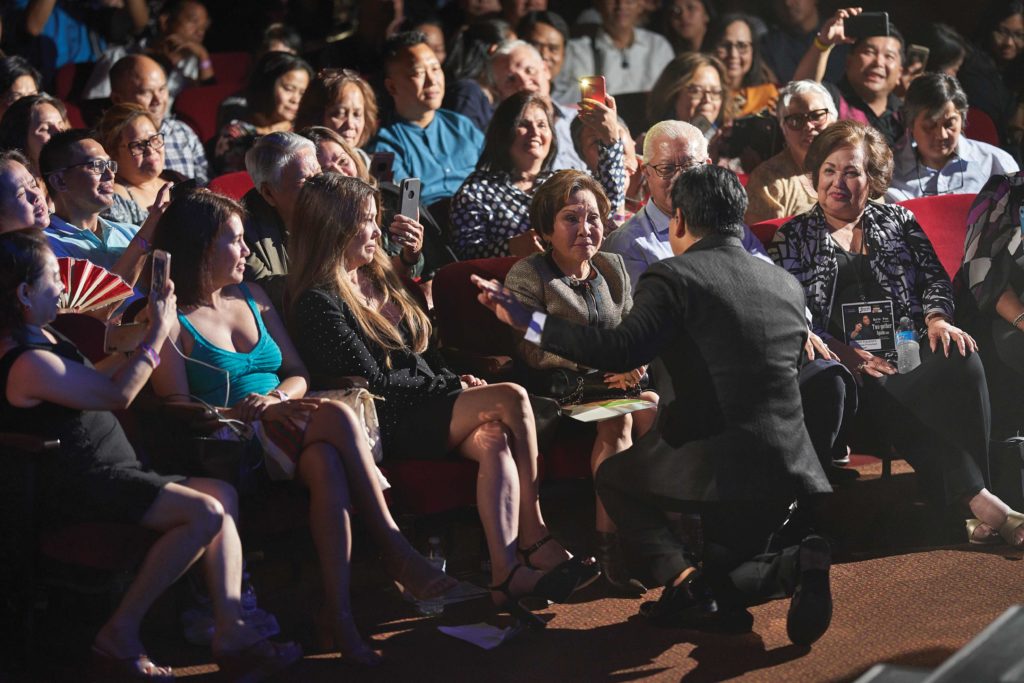
As the concert ended, Martin went to where the first row fans were seated and sang songs to Mrs. Priscilla Hunt, a respected philanthropist, whom he serenaded. Then, other fans intruded into the song to get their selfies, which Martin encouraged. Indeed, it was Ohana night, all over again, even after 37 years of performing on stage. Martin has made every concert space his own playground, his own home, and his own comfort zone, and became ours as well, even if just for a night.
You can sense a co-existence, if at all, of Modern Jerusalem and the Suburbs of Bethlehem. A common denominator in going to a restaurant next to Sheperd Fields Church and a hotel restaurant of the Pontifical Institute Notre Dame of Jerusalem Center is good food and uncommon hospitality of big portions and great tasting aioli, marinated chicken and fresh salads and warm people: Arabs, Jews, Christians and Muslims. Faith, culture and tradition intersect to become passed on heritage and values. In our pilgrimage trip, one common value is family closeness. Pictured here is the Aragon Family, headed by 85 year old Albert who keeps up walking with us, up and down stairs, at times, 19 floors a day, an average of 4.75 miles a day, or 10,900 steps. His wife Alicia, decades younger keeps up as well as Abbey, a 16 year old sophomore in high school. Albert is loved by all of us, he jokingly says he has picked up millions of girlfriends. He takes my left arm while a younger Albert takes my right. We all laughed that I had two older boyfriends for a grandma like moi. #qtstoursandtravel2019#bethlehem#jerusalem#holylandpilgrimage#footstepsofJesus
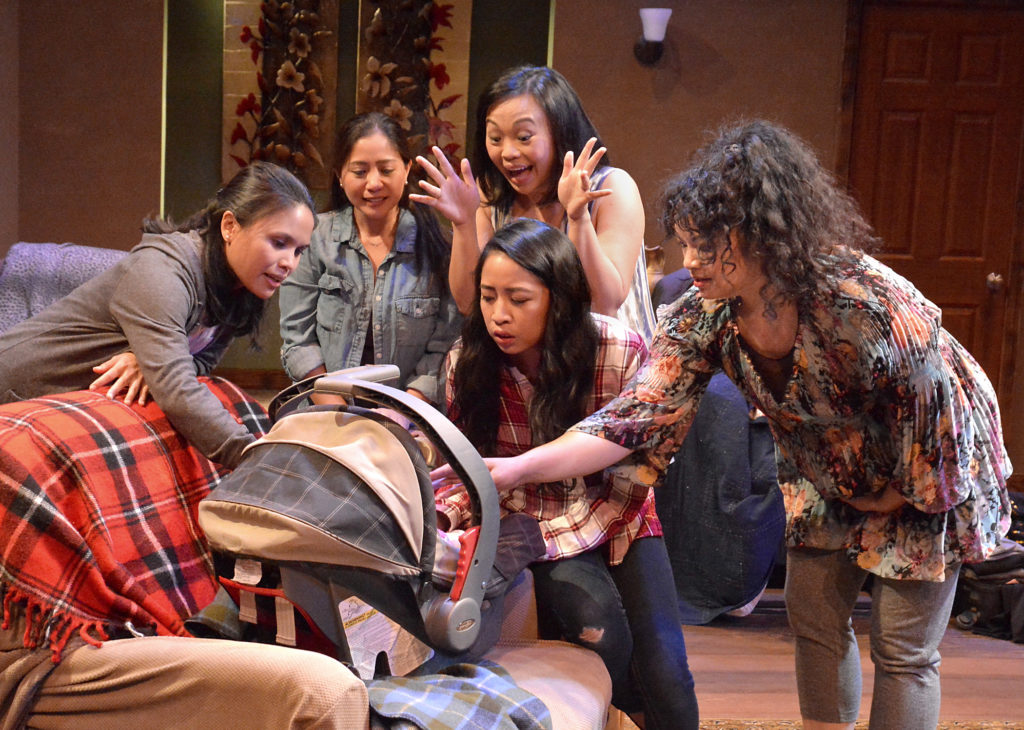
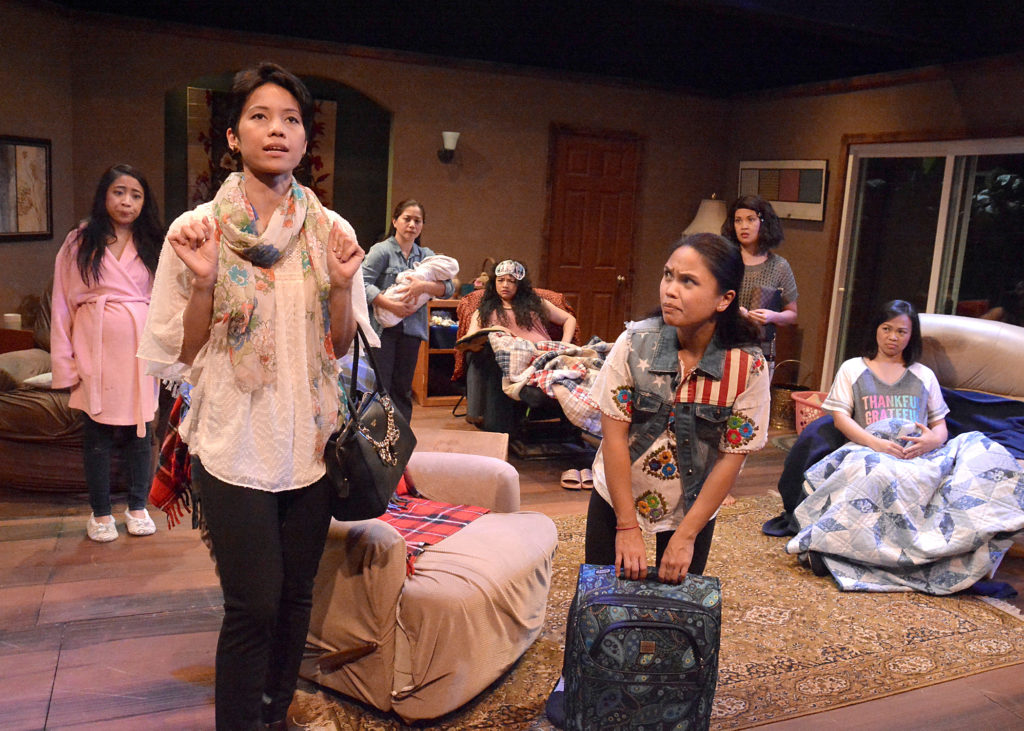
Samantha Valdellon, Angela T. Baesa, Sandy Velasco, Arianne Villareal and Toni Katano star in “America Adjacent” at the Skylight Theater in Los Angeles. | Photo by Ed Krieger
The man who is ‘fighting for his rights’ is working in the wrong way. The only way to be sure that we get our ‘rights’ in life is, to ‘plug in’ and let the divine activity of light and love express through us to do things in the right and perfect way at the right and perfect time. The artist, the composer, the scientist, the researcher – all demonstrate this attitude of meekness toward the law, toward the inner source of ideas. Einstein said that great ideas came to him after he had relaxed and ceased from the strenuous stretch for his objective. The meek or receptive mind invites God-ideas. The meek consciousness is not self-centered. It is God-centered. It is humble in the recognition of human limitations but confident in the conviction of divine resources. And it is not afraid of public opinion nor of resistance – not even of failure. Because success to this person is not a matter of public-acceptance but of God-acceptance.
Eric Butterworth, “The Amazing ‘Be’ Attitudes” in “Discover the Power Within You,” 1989.
Light within and from the audience
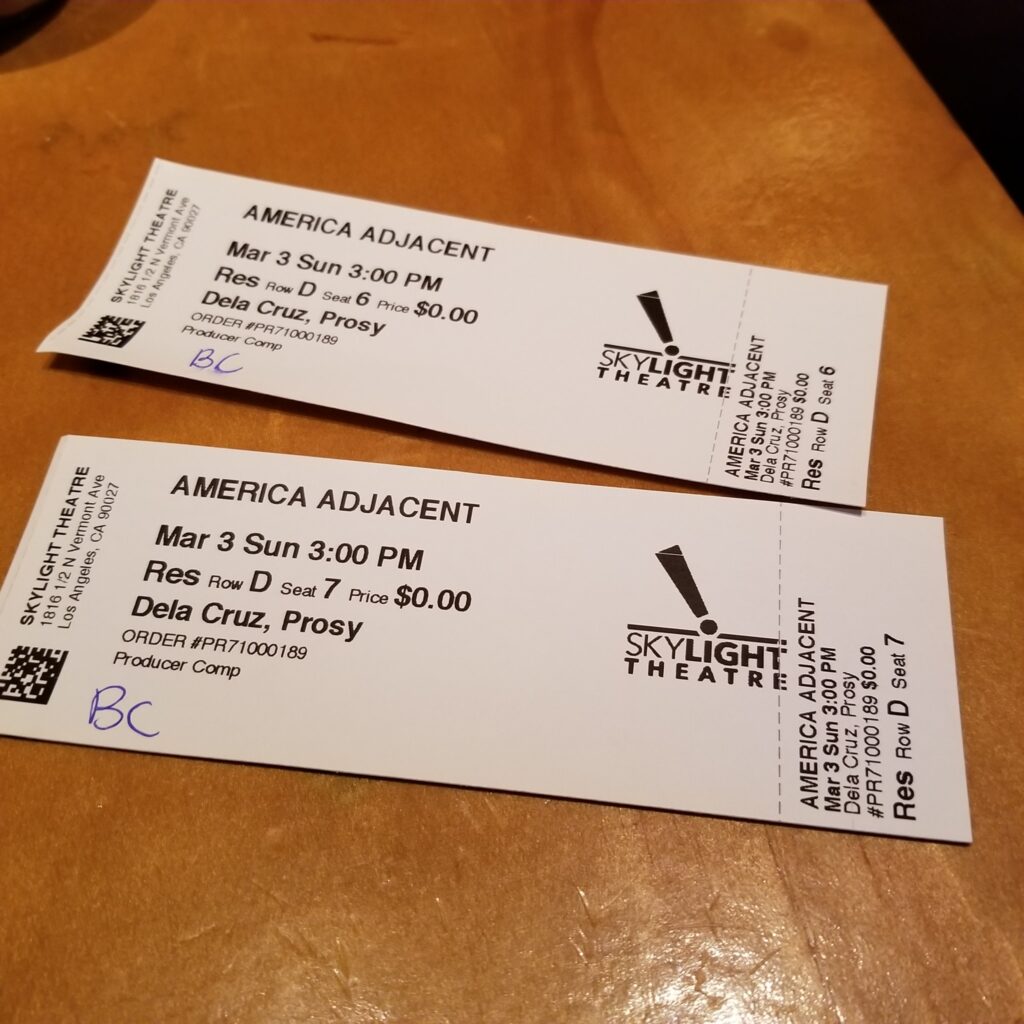
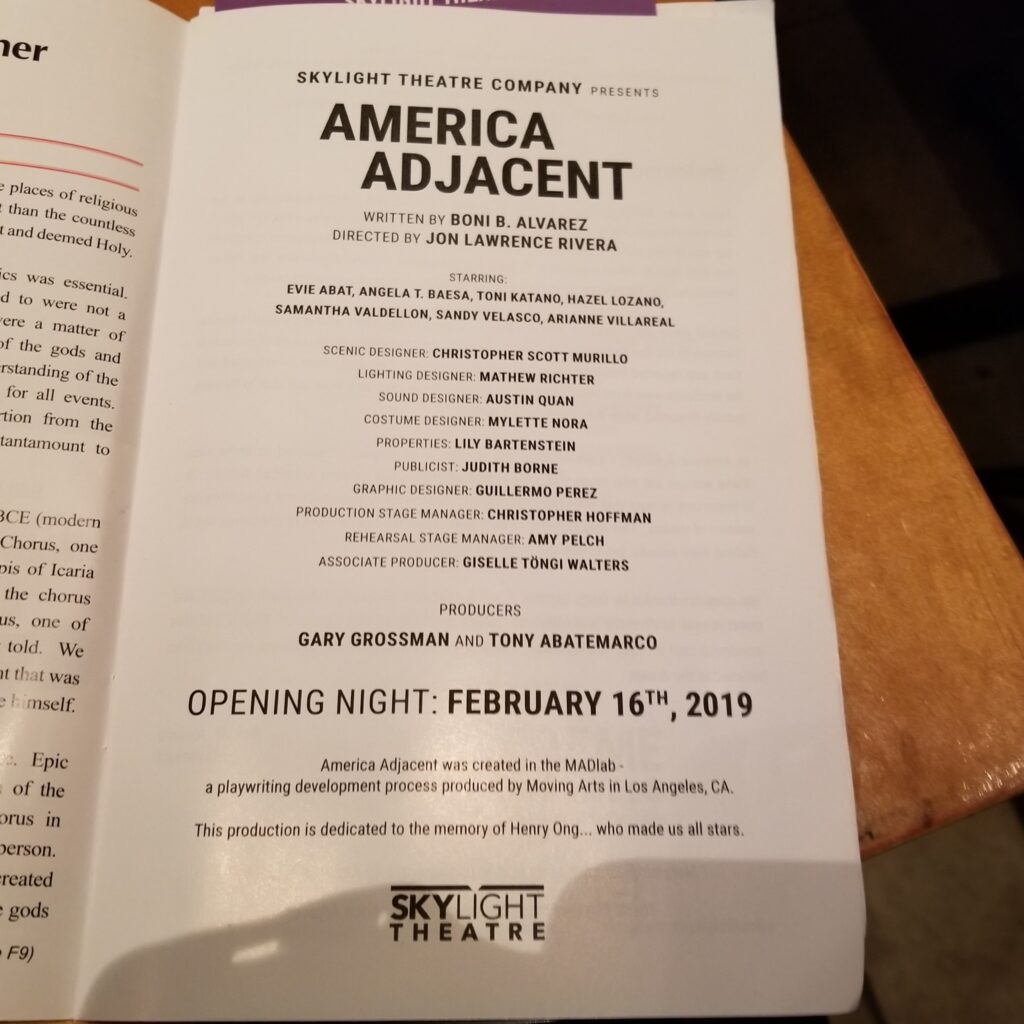
There is a certain confidence displayed by the all Filipino-American cast of “America Adjacent” at the Skylight Theater in Los Feliz, as well as by the play’s director and playwright. It is as if they are bound by an invisible spiritual linkage that “all are enough,” and a high level of respect and a warm welcome are the codes of conduct.
It is perhaps why I am quite relaxed in watching a play directed by Jon Lawrence Rivera and written by playwright Boni B. Alvarez. I expect excellence and I usually get that from their plays.
There is no pretension in staging, there is no anxiety in the pacing of the play, there is simply a stage made fertile by the countless hours of preparation and theatre experiences that when and if conflicts ensue as part of the scenes, the exchanges and tones evolve naturally and without screaming from nowhere.
On preview night as another evening that I went, scene changes progressed organically from one to the other, by this well-prepared cast. There was a natural rhythm to their stage movements. You don’t get annoyed from a disconnect of characters or from ill-timed props removal, just when an audience is just getting engaged in the characters.
In fact, one evening, a blackout occurred in the middle of the play and said power failure would take hours for DWP to repair, that the management offered a refund for another show. Surprisingly, the audience, eager for the ending, offered to light up the stage with their cellphones. How about that for a true dramatic collaboration? Would you not give it your all under those circumstances?
Could it be also from Rivera’s skillful direction, as much as the dialogue credibly developed by Alvarez, the playwright, who stays true to discovering his Filipino community’s sensibilities as well as his own craft of writing?
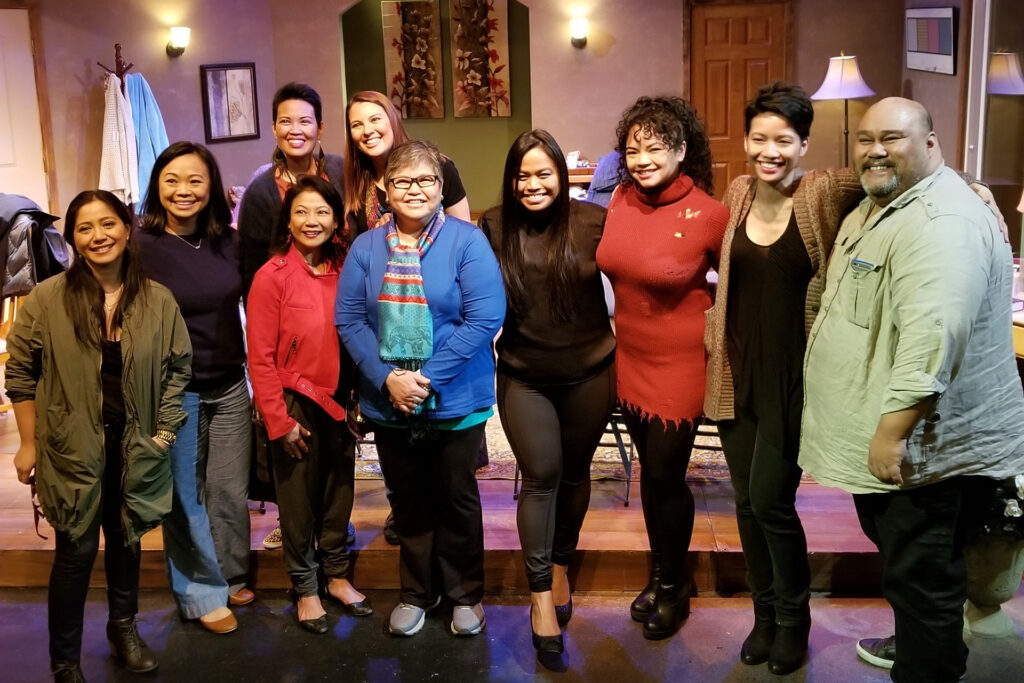
There is a sweetness and charm to their personalities that even though accolades are given, they accept them with smiles and a demurrer from Boni at times who confides that he “does not feel” that success. Even as we were taking photos at the end of the play, we had to coax Boni who was hiding in the back to join us.
Maybe it is that constant self-critique that keeps this duo moving forward such that may their last play be the measure of excellence and the next one to echo that level of quality and even exceed it.
Tackling issues onstage Of the play’s inspirations, Alvarez wrote, “I read an article about a birthing house filled with expectant Chinese mothers in San Gabriel Valley that had been raided. Neighbors complained of excessive trash and reported heavy traffic in and out of the house. The authorities investigated and the landlords were fined and cited. The women who were still able to fly were quickly deported, while others were detained. In ‘America Adjacent,’ I have adapted the women to be Filipino.”
In “America Adjacent,” the women are not poor, they paid thousands of dollars to come to the U.S. to stay in a cramped apartment, whose living room was converted to have four lazy-boy recliners as sleeping spaces until these women give birth to their babies.
“I wanted to know who these women are who made this journey and what they risk to birth American babies,” Alvarez wrote.
At least the stage presents a bit of comfort, though it still feels like the pregnant mothers are on house arrest, prevented by the administrator from discovering the neighborhood, as she confiscated their passports and cellphones.
Can you imagine solitary confinement, even if with five other women? Does it not feel like they are without freedom and yet the irony is that all these expectant women came to give their children “everything for their future consideration?”
What a beautiful line in the dialogue which captures the essence of what it is to be an American vs. what it was in their homeland – familiar, comfortable, but confined to one’s economic class status.
Hazel Lozano, Samantha Valdellon, and ensemble in “America Adjacent” at the Skylight Theater in Los Angeles, written by Boni B. Alvarez and directed by Jon Lawrence Rivera | Photo by Ed Krieger
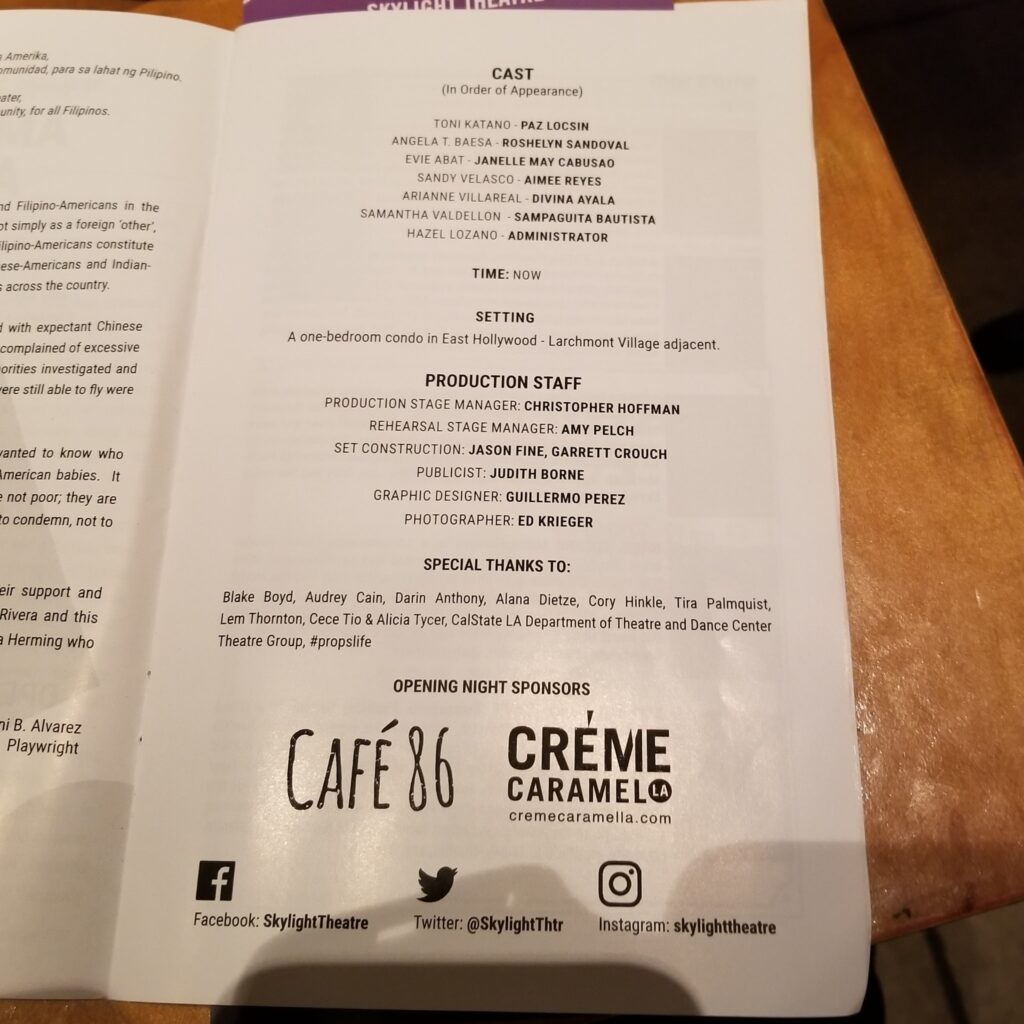
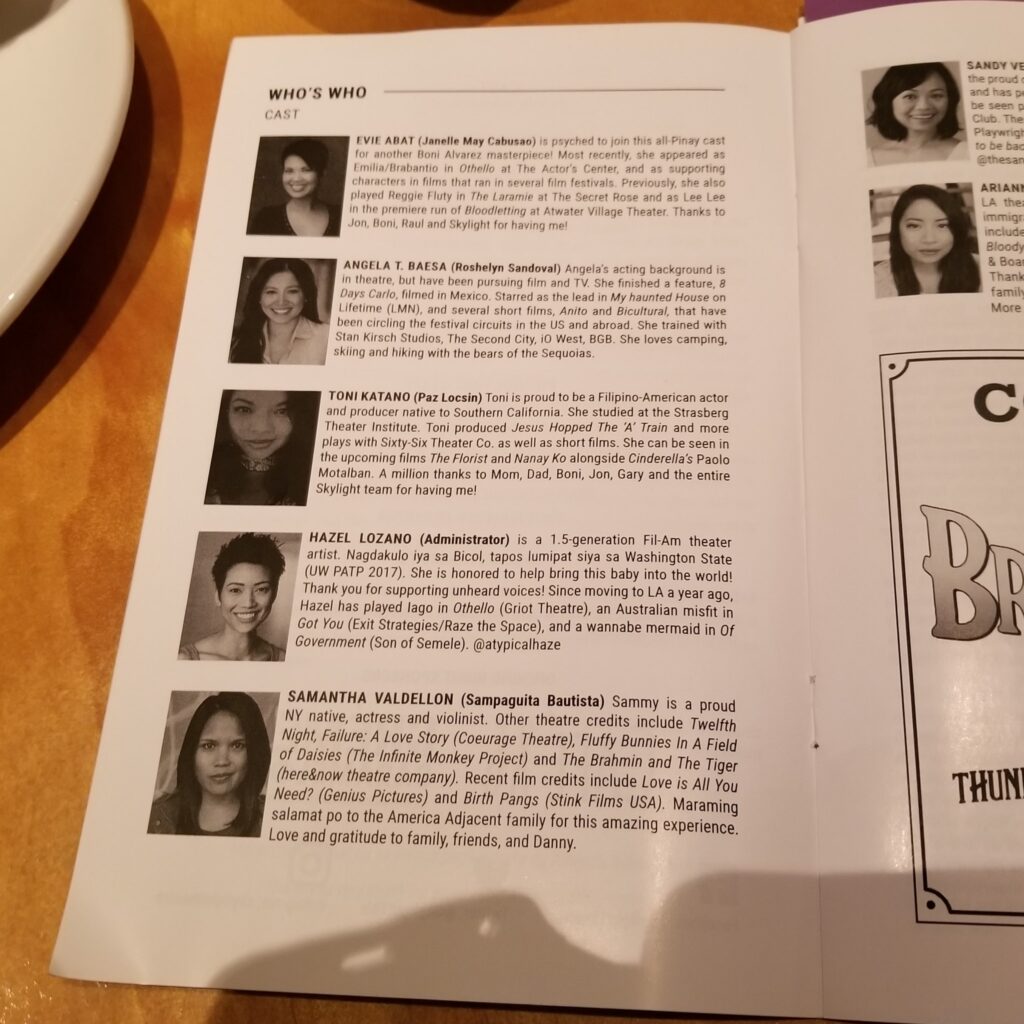
“America Adjacent” involves a cast of actresses honed in theater: Evie Abat as Janelle May Cabusao, Toni Katano as Paz Locsin, Hazel Lozano as Administrator, Samantha Valdellon – cast as Sampaguita Bautista, Sandy Velasco – cast as Aimee Reyes, though one is quite new to LA Theatre debut, Arianne Villareal- cast as Divina Ayala.
Angela Baesa is cast as Roshelyn Sandoval and she has also been pursuing film and television. She has finished a feature, “8 days Carlo,” filmed in Mexico and several short films, “Anito and Bicultural.” So versatile is also Toni Katano, playing Paz Locsin, whose upcoming films include “The Florist” and “Nanay Ko” alongside Paolo Montalban. Samantha is a familiar face having appeared as Lee Lee in the premiere of “Bloodletting,” another play written by Alvarez and directed by Jon Rivera in Atwater Village.
The play’s richness is in the simplicity of its credible, easy to understand, fast-moving dialogue that belies the multiple social issues it tackles. At times, the audience is laughing, amused by the women’s adept memories of home, but is also moved by the sacrifices they went through.
One memory recall stood out for me that was well acted by Sandy Velasco who played Aimee Reyes – it was the love-making experience with her partner. She made it quite hilarious and the audience laughed with her. This is worth seeing for both its comedic and acting values and how she demonstrates it further. It is both funny and endearing as Filipinas in sisterhood do when they hang out with one another – no holds bar conversations.
Another is the Administrator’s tenderness switch on and off, played well by Hazel Lozano. She vacillates from being the strict, in your face administrator, who has to extract compliance from these pregnant women, and then becomes tender and gentle when she persuades these women as she was about to take the infant of Janelle May Cabusao (played adeptly by Evie Abat) into a relative’s home, after Janelle May abandons her baby. Her movements showed how privileged she was, quite selfish and self-centered as her roommates would say, yet also caring in how she treats some of her roommates. Find out why she hugs her high heels to sleep in a Lazy-Boy recliner.
There were many memorable scenes that were giveaways and gifts to those who are part of the Filipino-American community as they are universal conversations in many immigrants’ homes.
As first generation immigrants, we are daunted by the memories we recall, the tenderness of our childhood experiences in contrast with the harshness and the shock of an inhospitable culture layered with fear of enforcement authorities and the uncertainty of what the future offers.
It is not in the birthing of their babies that the suffering is detected, but it is in the displacement from being surrounded by what is familiar: language, community, going to mass in the same church, even watching Tagalog movies. The play depicts these familiar memories with humor, including the simulated celebration of the Eucharist on Easter Sunday.
I like the play’s treatment of difficult women’s issues of postpartum, mental disorder, fear including who the fathers are to these babies about to be born, with a surprise twist and a detour to an orphan’s journey, and the difficulties that came with an unsheltered childhood and being vulnerable to an uncle, and being “dark-skinned and unwanted.”
Beyond our home provinces and birthplace cities’ churches in the Philippines, the beauty and strength of our homegrown Filipino-American communities come from being loyal followers of our churches here in the U.S., but also that we are connoisseurs of good Filipino restaurants and in the last few years, giving birth to a vibrant Filipino Food Movement. In Los Angeles alone, there are 18 restaurants to choose from.
With cultured sensibilities of our palates and caring for our souls by prayers and faith rituals, can we perhaps show similar loyalty as well to our live theatres? After all, if you check the listing of 102 live theatre venues in Los Angeles, we have one of those to be proud of: “America Adjacent” at the Skylight Theatre in Los Feliz. Can we show some love for this play as it will be ending Sunday, March 24?
With “America Adjacent,” a special bonus awaits the audience – on special days, you get to hear from Giselle Tongi, associate producer, moderating a panel of women speaking about their experiences here in America, with American children born here in the U.S. and the gaps in language, terminology, accent, cultural norms and even different expectations. This panel is quite informative as our daily grind schedules gloss over these gaps and conflicts usually arise.
If only for a few hours, we get to examine and reflect on how far we have grown and even evolve as a Filipino-American community here in the U.S., finding our safety net here by engaging our creative spirits, and in support of one another, to nurture those creative sparks of light.
Can we make this play another resounding success with our active presence and support? I thank you in advance.
Pope Francis has declared a Jubilee Year of Mercy. From the Vatican’s website, “The Church is celebrating the Holy Year of Mercy, a time of grace, peace, conversion and joy. It is meant for everyone: people of every age, from far and near. There are no walls or distances which can prevent the Father’s mercy from reaching and embracing us. The Holy Door is now open in Rome and in all the diocese of the world.”
On Sundays and weekday masses, priests talk of mercy in their homilies. The gospel on March 2 was on forgiveness, and how many times a person must forgive — not just seven times, but seven times 77, or 539 times.
March 3rd’s homily spoke of applying one’s knowledge, filtering what we know, and using what we know to spread God’s love and forgiveness. I cried listening to the last homily for I was struggling with how do you forgive and show mercy to predator priests, after watching “Spotlight,” not for myself but for numerous folks who have been abused in their teenage years.
I once had a chance to meet one of these predator priests, as part of a dinner, raising awareness and funds to help urban poor communities in the Philippines, which includes a chapel, a child care center, a school, and a pharmacy.
When I invited him to join Simbang Gabi in an East Hollywood Church, he demurred and said he was “persona non grata.” It struck me as weird, as it was a self-detrimental conclusion, not borne out of practice.
While researching, his name was listed on Bishop-Accountability.org. His victim, now in her 60s, was paid $100,000 by the Archdiocese of Los Angeles (perhaps the reason for “persona non grata”) as this Catholic Irish priest had sex with a 15-year-old debate team member at the school he served as principal. He wrote an apology letter and described it as “consensual sex” decades later.
If you were the victim, would you be able to forgive this priest, and show him God’s mercy?
After a full declaration of wrongdoing and witnessing the perpetrator’s remorse, can you now be part of a healthier Catholic Church, forgiving more than 539 times?
Can you still forgive and ask for God’s mercy knowing that it was not just you, but you are part of a much bigger sector of thousands in 108 cities in the United States and 51 cities in 21 countries?
What if you discover that this pattern of conduct has reached back to two centuries before?
Would you now use your persuasive powers to prevent the “acting out of these psychosocially and emotionally immature priests?”
Will we ever have accountability to these breached sacred trusts, committed by priests? Will we have accountability from bishops and cardinals who hid these harmful behaviors, robbing minors of their dignities, sense of peace, emotional security and freedom from harm, with their trauma lasting for decades?
Spotlight’s revelations
During the 88th Academy Awards, “Spotlight” won the Oscar for Best Picture for 2016. It also got Best Original Screenplay, written by Tom McCarthy.
The film is about Marty Baron, a new editor of the Boston Globe, who assigned the Spotlight team of four investigative journalists (Michael Rezendes, Matt Carroll, Sacha Pfeiffer and Water “Robby” Robinson) to look into John Geoghan, a priest whose title had been removed, a.k.a defrocked, after molesting more than 80 boys.
The reporters made it their collective mission to provide proof of the cover-up, uncovering the pattern, policy and practices, which systematically hid the wrongdoings in the Boston archdiocese, headed by Cardinal Edward Law.
One dialogue line in the film resonated well: “If it takes a village to raise a child, it takes a village to abuse one.”
The Spotlight team went through a painstaking process of digging facts, interviewing victims, lawyers, fact-checking, including a process of deduction, which led to a compiled list of 87 priests, from the church’s directory of priests, who were classified “on sick leave, unassigned or emergency status.”
Speaking of priests on sick leave, I interviewed a healing priest who led two churches in the Valley, years ago. After a three-hour interview, he gave me a “spooky feeling,” particularly upon observing how he gave chest-suffocating hugs to women, normally reserved for couples who have not seen each other for a long time. My heart told me to stay away, while my mind decided not to write his story.
Fast forward to today, he is no longer a pastor and is shuffling papers in the Archdiocese. His blogs, which spoke of his healing abilities, have disappeared from the Internet.
Back to “Spotlight,” the film showed how a list of 87 priests came about, who were either on sick leave, unassigned, on emergency status or were transferred in less than three years. The list was verified by the Archdiocese’s defense counsel, and another reliable third-party source, a lawyer who settled cases on behalf of 45 accused priests. The film showed how verification was arrived at, using two independent sources.
Included in the process of investigation was filing a motion to unseal court documents from John Geoghan’s case (a priest who molested 80 boys, including seven boys in one family), while also interviewing victims and accused priests.
The start of transparency, perhaps?
In the film, we heard the voice of Richard Sipe, an 82-year-old psychiatrist who is now married after previously serving as a Benedictine monk and former Catholic priest. He shared his conclusion that only 50 percent of the priests are celibate, leading to a culture of secrecy and hiding pedophilia.
One would expect the Holy See perhaps to keep folks from seeing the film; instead, the Vatican Radio, official radio service of the Holy See, was quoted as saying, it will help the U.S. Catholic Church “to accept fully the sin, to admit it publicly and to pay all the consequences.”
End-film credits showed 600 stories written by the Boston Globe’s Spotlight Team in 2002, about 249 accused priests and brothers and over 1,000 survivors.
As to Sipe, who headed the Department of Family Services at Seton Psychiatric Institute from 1967 to 1970, his research findings concluded: “1,300 priests and religious have been treated for psychosexual disorders in 25 years, at the cost of over $50 million.” The Seton Institute has been closed since 1972.
Will the Catholic Church be able to purge its internal demons, its sins of sexual abuse with minors? Recently, Pope Francis headed a four-day summit involving the hierarchy of bishops and cardinals focused on the protection of minors and a rehabilitation movement away from sexual abuse. He described the priests doing this as extensions of evil and Satan’s evildoers.
Will the summit of 2019 stop the Church’s pervasive practices of reassigning accused priests to different parishes, managing settlements in secrecy and sending them for psychiatric treatment, “they are our priests, so it is our problem to cure them?”
Can the Church perhaps lead “institutional confession” to their flock, regionally, and to all their parishioners around the world, recognizing their psychosocial problem happened in 51 cities in 21 countries and 108 cities of the United States (as “Spotlight” revealed)?
When I wrote that question, the summit of 2019 has not been convened. We now find Pope Francis leading the public confession for this worldwide problem of sexual abuse. How did the Catholic Church become this secretive institution hiding these human behavioral problems?
Certainly, the Vatican knows how Archdiocesan reserves have been affected: the sale of a Mid-Wilshire high-rise building in Los Angeles, the sale of an all-boys high school in Hancock Park (now a Jewish School) and even the bankruptcy filing of Diocese of San Diego to pay for these settlements.
Will this institution, who “thinks in centuries,” consider a more comprehensive treatment of the problem?
Or will these ghastly secrets die with them, much like the late Archbishop Robert Sanchez, who while in New Mexico had sex with teenage girls for decades, which was subsequently exposed on 60 Minutes in 1993?
TheNew York Times described how Archbishop Sanchez apologized to the Native Americans for “grievances reaching back to the days of colonization” and created an Office of Native American Ministry. The publication detailed that, “In a report to the World Synod of Bishops in Rome in 1980, Archbishop Sanchez called for renewed efforts to eliminate ‘all forms of racism’ in the church. ‘Although great numbers of a particular ethnic or language group may be present in a parish,’ he wrote in the report, ‘often little or no effort is made by the local parish priest to welcome these newcomers into the parish family.’”
Mercy can be embodied
“What is the name of God, “ a priest asked in his homily? To which worshippers answered, “Mercy.”
It is imploring God not to judge us but instead, to be forgiven for all our sins and to be cleansed from them.
As Holy Week begins, would it be reasonable to expect the Vatican to do a more rigorous institutional review of its practices in disaffirming these life-harming activities?
Instead of focusing the Church’s attention and offering prayers for the wombs of women (which are attached to women’s bodies to control, while exercising their endowed, God-given free will to guide them), would it not be merciful for victims who have been harmed by defrocked priests and others still active in their ministries to be monitored in their healing process? Also, might the Church also come to terms on how nuns were defiled as comfort women, some of whom were kept as sex slaves?
In the light of mercy, must we not seek to remove errant priests, from the milieu of children, whom they can harm again? And seek improved emotional maturation and human formation for these priests?
“Spotlight” uncovered a systemic pattern and administrative policy of secrecy, necessitating that the Vatican demonstrates, as well, an effective and systematic pattern of dismantling criminal wrongdoings, done under the cloak of respectability and garbed in priestly vestments, aside from the VIRTUS training given to lay volunteers. The hierarchy must, in fact, train seminarians and priests that these behaviors are predatory crimes against man-made law, punishable by jail sentences.
In the form of spreading God’s good news, now I understand why a Caucasian priest said at a Lenten retreat, “Had it not been for the Filipino clergy and its laity, the Catholic Church in America would have perished.” These immigrant Filipino and Filipino-American priests became the guardians of faith and anchored the laity, deeply on values of pakikisama and seeing God in others, with a deeper intimacy with God through Mama Mary.
After this 2019 summit, I pray that the Catholic Church moves away from secrecy, which made these crimes more predatory and into the justice measures they deserved. May these predatory priests meet justice in their lifetimes and may the lingering victims who have not received justice be rehabilitated in their lifetimes as well and lastly, may the seminaries that form these priests do their jobs of fuller human formations and much more scrutiny in transitioning these young men from deacons to priests.
This upcoming Holy Week, all of us have the duty to make sure our Catholic Church returns to being animated by the Holy Spirit and may we become truth seekers and truth tellers when we see predatory and abusive behaviors from the Lord’s stewards who were formed to take care of the sheep and not abuse them!