The many stages of her eating, choosing how to partake of them and when: yogurt chips, mandarin orange and last, blueberry and buttermilk with kumquats cake and blood orange zest.
After, she fills up a bowl of nuts and hands to her lolo. When we are done washing hands, she scoops up water to her mouth then, wants her lola to have some water, too. Not only is she empowered, loving, but also affectionate towards her caregivers. What an awesome God’s gift to our family.-Prosy Delacruz
My very very dear friend, Hydee Abrahan who helped execute the book cover designed by Ysabel Grace Simon and who took most of the vibrant photos in the book.
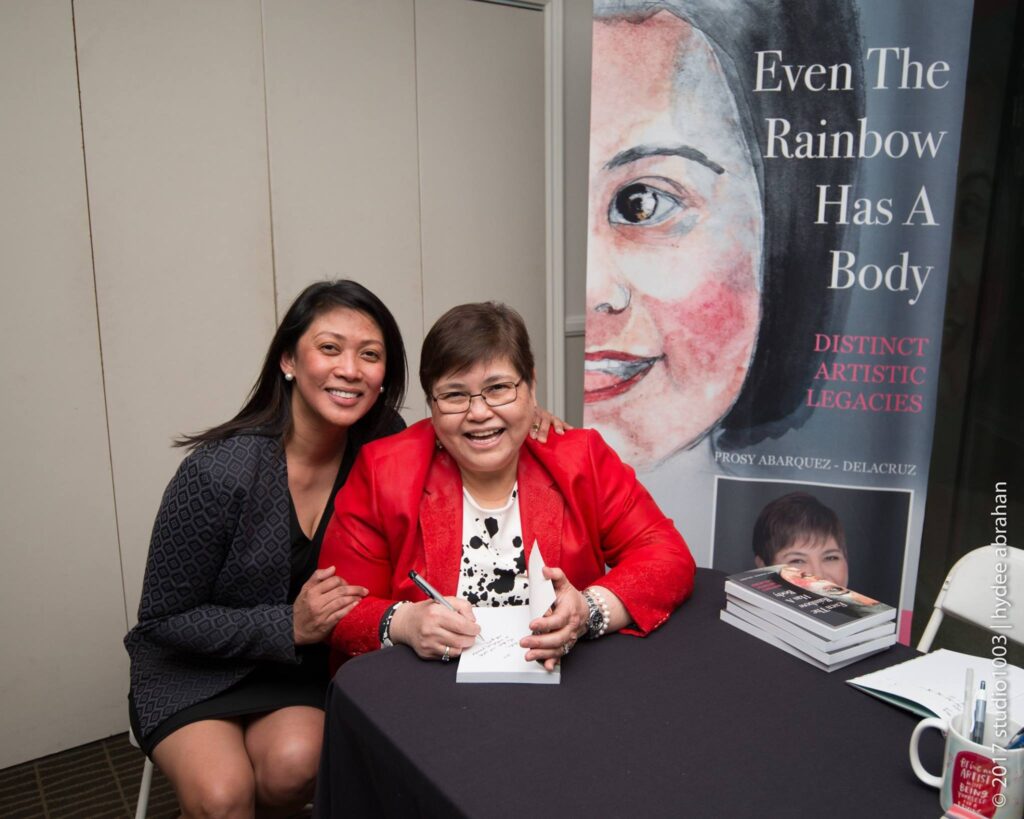
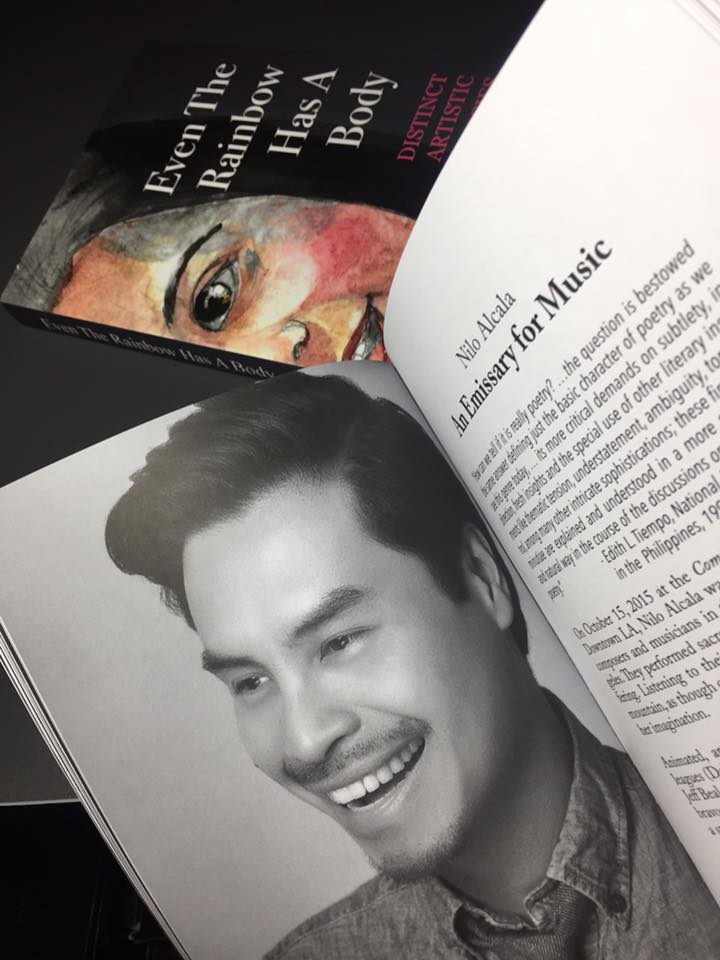
EVEN THE RAINBOW HAS A BODY—Distinct Artistic Legacies. by Prosy Abarquez-Delacruz. Squid Printing Company LLC, Los Angeles, CA. 2016. 225p. Softcover.
This book is compilation of essays on Filipinos and Filipino-Americans who have put the arts in the center of their existence and made it their life’s mission to help others achieve their goals in different artistic fields. It attempts to share the stories of exceptional individuals who took the extra mile to show their commitment to the arts against all odds.
The book consists of six chapters, with each chapter featuring individuals in various fields of art—from theater and film to art and design, with most of the featured artists falling under Chapter 3–Music.
In the first chapter, one of the artists featured is Ted Benito, considered a cultural visionary. He is credited with bringing the manongs’ story into the theater and raised awareness of the sacrifices of Filipinos in America of the 1920s to the 1940s. Ted’s vision for The Romance of Magno Rubio was to expose the audience to a different experience and subject matter. The play ran for six weeks at the Ford Theater in Hollywood where over 1,600 people saw it in its English, Tagalog and Spanish versions. This was the first time that Filipinos came in droves to see the play—since Filipinos were never “identified as lovers of theater or the performing arts.”
In Chapter 2—Photography, the artist Hydee Ursolino-Abrahan stands out as one who takes photographs with a “perfect triangulation of emotion, timing and moment,” where she is able to capture the emotional peak of the moment. In each shot she attempts to tell a story without the use of words.
There were 15 artist featured in the chapter in Music, and the most visible, or most known is Ryan Cayabyab who is associated with the history of OPM or Original Pilipino Music. He is credited with developing 23 film scores, 15 OPM songs and several albums. In addition he is the author of 11 musicals and produced albums for artists such as Smokey Mountain, a singing group consisting of teenaged performers back in the 90s—such as Geneva Cruz, Lea Salonga and Julio Iglesias. He also had a television show for years called Ryan Ryan Musikahan which garnered various awards. Despite his staggering output, he makes time to teach young people, going around the country giving workshops in songwriting.
Chapter 4 is devoted to the culinary arts and Chef Romy Dorotan is one of the culinary artists featured. Romy Dorotan and Amy Besa used to own Cendrillon located in SoHo in New York. Eventually the owners closed the restaurant and opened Purple Yam in Brooklyn, which was named one of Michelin’s Best 133 New York’s restaurants in 2016. Purple Yam, which has a minimalist interior design uses touches of bamboo throughout the restaurant, complimenting its Filipino-inspired food.
In the field of literary arts, the writer NVM Gonzales is one of two artists featured in Chapter 5. When asked with the question—“How do you write”? He answered, “Write like a lover, but edit like a serial killer.” The author, who was his student during his days in the US describes him as “an 83-year old literary icon who has written 14 books and has significantly influenced the lives of Fil-Am youth in their search of identity.” A distinguished scholar, NVM Gonzalez is one of the central figures of Philippine literature. His works has been translated in several languages and is recognized internationally.
Benedicto Reyes Cabrera, also known as BenCab, is one of the featured artists in Chapter 6—Art & Design. He has built a museum in Baguio to house his eclectic collection of indigenous art. He also advocates for the preservation of the Cordilleras and the environment. The land area around the museum is planted to vegetables that are served in Sabel Cafe located within the museum. He also grows his own coffee, raises ducks and chickens and has created a haven that integrates art and nature.
The author, Prosy Abarquez-Delacruz, writes feature stories and a weekly column for Asian Journal and is also a contributor for Balikbayan Magazine. She received her undergraduate degree from the University of the Philippines and a law degree from Whittier College of Law in California.
An interesting collection of interviews, the anthology provides a window to the minds and hearts of artists of Filipino ancestry. It is a timely book about artists and the processes they adapt in creating their art. It is also a testimonial to the creative spirit of the Filipino.
Thank you, Tita Prosy, for sharing our stories: “…stories of Filipino Americans — brave and bold individuals, who took the extra mile to integrate and show their love for the arts, against all odds.” (from “Even the Rainbow Has A Body” — Prosy Abarquez-Delacruz).
A true honor to be part of this.
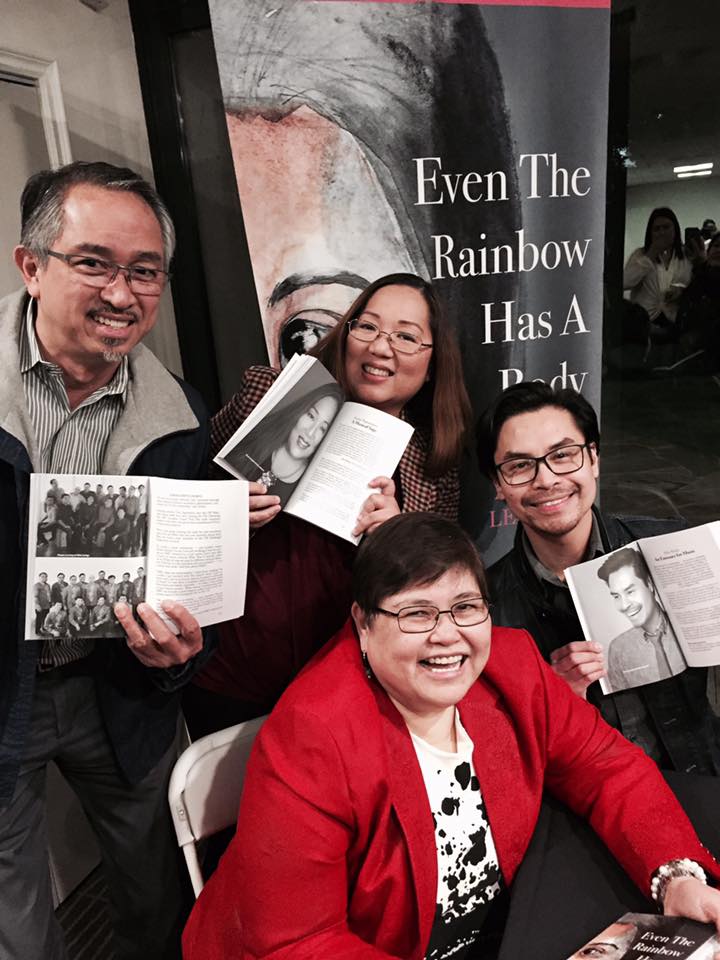
Ted Benito, you are a very special man to have thought of all the various folks to be part of the program. Thank you very very very much for all the advance planning and executing the very first book launch of Even the Rainbow Has A Body. You are indeed our community’s cultural visionary.
Oh my, and the introduction was so special, I did not know that Cora Oriel brought all these good folks together Becca Godinez, Carol Ojeda-Kimbrough, Asuncion A Ferrer, and Cora, you got me down to a T! The story of your paper, Asian Journal is our American immigrant story, mimicking the growth of our Filipino-American community.
I cannot thank you enough, Mon David, and Nicole David Yalong, for coming to give us the appropriate rainbow songs!! Maraming maraming salamat Ann David for your special role in anchoring their lives as well as ours!
Oh, Catherine Oriel, you are teaching us lessons on brevity and impact, using Spanish words, and then, the translation in English was not just poetic, but also bringing the language of poetry sounding like music to our ears! That was so powerful, no wonder you became Archer School for Girls’ Poet Laureate and Newsletter Editor.
Thank you Christina Oriel for the foreword and for inspiring me to be a better writer with your personal examples and for treating me with such kindness and gentleness.
Thank you to Miko Zuñiga for helping with the book signing, and Cynthia Bonta for your unconditional love, friendship, and support – so so wonderful to have you!
Oh my, Hydee Abrahan you traveled in traffic to get to the book launch, thank you for being our official photographer. My dear dear Lem Balagot, Raye, and friends for such a wonderful, artistic spread from LA Rose Cafe. I cannot believe how beautiful the spread was! The special treat — the egg salad caviar which we still feasted on post-book launch.
Most of all, my muse, my apo who came with her superlolo Enrique de la Cruz, my daughter, and my son, thank you very much for making it special with your attendance.
Thank you Fr. Rodel G.Balagtas, Fritz Friedman, Abigail Zelenski, Cecile Ochoa, Lydia V. Solis, Ana Burog Philippine Chamber Singers – Los Angeles (PCS-LA), Harana Men’s Chorus, Don Martin Sagarbarria, Lillian Tamoria, Benel Se-Liban, Alvin H. Reyes, Dino Padallan, Janet Susan Rodriguez Nepales Ruben V. Nepales, Christine Oshima, Prime Note Ensemble, Pete Avendano and Venice R. Bernabe-Avendano and family; Dennis and Paola Brown and many many more folks who came.
A big shout out of thank yous to all of you who came, you know who you are, and it meant so much to me to be surrounded by your loving support and genuine friendship! Thank you very much!!- Prosy Delacruz
“This is a large order! But then we are dealing with a large and wonderful principle, the divinity of man. If you remember who you are, and keep your inward contact, you will not let yourself be drawn into experiences on another’s level of thought. You will meet them on your level for your thought is your life.”—Eric Butterworth, “Discover the Power Within You”, 1992.
“What is your definition of beautiful,” I asked.
Smiling, Nicole Ignacio Cordoves shared her perspective: “It is a woman with a good life story who rose from [her] tragedy, but you can’t trace sadness in [her face], there are no lines. And you just know this woman can just conquer anything. When I went to a women to women weekday fellowship, I even brought a friend. Hindi mo akalain may pinagdaanan (You would not think they went through challenges), you can’t believe their testimonies, you don’t just look at them, you want to be with them, everyone is glowing.”
Born in the Philippines, Nicole’s name means the people’s victory. Cordoves was a surname bought by her Chinese grandparents so that they could be naturalized and own properties in the Philippines. Her great grandfather came from Fujian, China, the southeast coast of mainland China.
Nicole granted a one-on-one interview with the Asian Journal, days after she competed in the Miss Grand International on October 25, 2016, held in Las Vegas. She became First Runner-Up.
Miss Grand International is a pageant with a mission to end war and violence: “wars exist on many layers, from full-scale confrontations between nations, to violence in the home. All of these wars must be eliminated if we are collective to achieve true happiness. In an age where we are capable of reaching out to touch the stars, we have forgotten to reach out and touch the lives around us, it is time for us to look inwards and use our combined ingenuity to make the world a better place for all humanity. Our ideal objective is an end to all forms of violence and hostility.”
During the Miss Grand International competition, she was booed during the controversial Q and A portion.
The controversial Q and A
From 75 participants around the world, the process whittled them down to five finalists: Puerto Rico, United States, Thailand, the Philippines and Indonesia.
“Question: If you had to choose one of these two people [to] help you to stop the war and violence, who would you choose between Donald Trump and Hillary Clinton and why?”
Answer: “Promise me you would react after my first sentence. I would choose Donald Trump. [Boos were heard] If we convince Donald Trump to switch to our side, then there won’t be war and violence anymore! I will also make sure he would read my speeches to stop the war and violence because imagine someone who could bring so much madness and emotions from these people, what if we use his voice to actually do good for the world? What if we use that to our advantage? So let’s keep the peace and let Donald Trump switch to our side to stop the war and violence,” Nicole responded confidently.
Nicole’s prescient (predictive) and wise response flew over the crowds’ heads. They booed her. Her smarts were unappreciated. The crowd did not want to hear Donald Trump’s name.
Had the audience understood, perhaps her wisdom, including her compassionate view that we can change, would have been apparent. Her optimistic view on transformation fits the pageant’s mission.
But, the pageant also leaned towards women power, that women are smart and capable.
United States’ Michelle Leon chose Donald Trump, drawing louder boos. Puerto Rico’s Madison Anderson chose Hillary Clinton, as did Thailand’s Supaporn Malisorn.
Indonesia’s Ariska Putri Pertiwi chose Hillary Clinton, “So it is a very hard question for me, but I will choose. If I have a chance to choose, I will choose Hillary Clinton, because I know she is a very smart, independent woman and a brave woman. That is why I will choose her to walk together with me. I believe that if I and Madame Clinton walk together, I believe that I can stop the war and I ask the people to join us to stop the war and violence, so I choose her to stop the war and violence. Thank you.”
Her response showed decisiveness and her belief that she is a change agent. By stressing “walk” in her answer, it suggested motion and efficacy. She took home the crown.
Her reflections about inner beauty
I asked Nicole to define a woman of grace and substance. She responded with ease, suggesting intimate self-knowledge.
Woman of grace means: “When I think of grace, I think of my grandmother. I don’t know how mothers acquire the ability to raise good kids and at the same time endure what women go through as wives, mothers, as grandmothers, what they do to take care of husbands, their children, all their heartaches. I think of my grandmother who even if the family is falling apart, holds on to her values, and does not think of running away. She knows how to stay with her pain, unafraid, to keep the family name intact, not thinking of the years she might lose and she has held onto the family. You see her [journey] physically: the traces of white hair on her head, the wrinkles on her hands, [matching] the heartbreaks she has gone through, we all know that.”
Growing up, Nicole did not live in a bubble, nor with a silver spoon in her mouth — which is why she really hung on to God in those times and it is in suffering that she actually feels closest to God, one thing she would always cherish. She realized early on that she wants to be more than the circumstances given to her, “God will always catch me. I am not afraid of falling anymore.”
One key word is “ready” as that comes from one’s mindset, either we are ready to win or fail. To Nicole, her thoughts created her life.
A woman of substance is “one who has fought to be relevant in the world. She looked for and found that role. She has set her mind and heart to perform her purpose. No one is born of substance or grace, you choose to become it. You need to wake up every morning and decide what kind of woman you want to become.”
She excuses herself to check on laundry, washing the bed linens and towels she used at her hosts’ home, that of Hydee Ursolino-Abrahan and Akima Abrahan.
Her thoughts became her life
She graduated from Makati Hope Christian School. Failing math in the first-year high school, she tutored herself and became the most improved student, even an honor student. That gave her the realization of her self-worth and her potentials.
She played badminton, patintero and basketball games with the neighborhood boys, sell them my toys, including drinks made of black gelatin (in cans) with sago [boba], sugar and water, including the passersby.
“I earned a lot,“ not realizing she pioneered recycling.
“I was always the head of the group, organizing trick or treating, my own birthday parties, including bible studies. I remember even giving them quizzes about biblical passages, including King Nebuchadnezzar, the king of the Neo-Babylonian period.”
She took up economics, so she can look at the world trends to help others. She took a minor in development management and “got obsessed including, photocopying the Asian Development Bank’s book on rural farming as well as the underground economies, just like Muhammad Yunus in Bangladesh.”
Her thesis was on how information technology affects economic growth. Her thesis uncovered “the use of information communications technology (ICT) appropriately in developed countries, e.g. Singapore, where they build institutions to regulate ICT and to develop programs for its productive use. In the Philippines, ICT is misused, as there are no institutions to encourage exploration, proper productive use, and improperly utilized as social media trolls,” she said.
In Ateneo de Manila, she obtained her economics degree but also, on how to be a woman for others.
“In Tondo, we had a small room where we held bible studies. I remember Kuya Rey, the only man amongst 8 women who slept in corrugated metal and thought of suicide until he met a missionary, Ben from Hongkong. Ben decided to live in Tondo and became a pastor. Ben offered Rey lodging and now, Rey is a minister, a strong man who speaks with confidence,” she continued.
After college, she worked as a speech writer for Secretary Cesar Purisima. She remembers doing her first draft, for Hong Kong to invest in the Philippines, “I made three to four speeches with dramatic prose and the feedback was that the boss likes data points, loves anecdotes and [he is] not a dramatic person. He is very functional, gives the best jokes, all that I learned from him.”
It was during this period that she got recruited by Aces and Queens. After rigorous weekend training, she joined the Bb. Pilipinas pageant and won the title, Bb.Pilipinas-Grand International, and later competed to become First Runner-Up.
Nicole reflected on her journey and growth, from being Miss Chinatown, a college student in Ateneo, to her exposure to bible studies in Tondo: “When I became Miss Chinatown, I wanted to set up STROKES, a Filipino-Chinese organization for high school students, an umbrella philanthropy group that would allow students to share about their advocacies and together, implement them and do outreach. I wanted a curriculum on social enterprise and the ethics of serving others. People are always looking to help, but children do not know how. In Ateneo, I had a ‘terror professor’ in Fr. Dacanay, who gave me 3.5 out of 4.0, for my oral exam. I was studying very hard. I went from home to school back to home. I took LRT 1, LRT 2 (subways), then a tricycle.”
“Do you consider yourself a beautiful woman of grace and substance?” I asked. With certainty, Nicole replied in soft hushed tones, “I do, I do. That realization changed my life.”
During the pageant, she gave a head-turning speech, excerpted here: “Tonight I will tell you a story about our world. One day I was conducting a storytelling session in Tondo, which is an area in the Philippines where the poorest of the poor live. So I asked the kids to fold their papers into half and then inside it, I asked them to draw who they want to be when they grow up and where they want to go, like a dream destination. But out of the ten kids sitting on the floor, only three of them knew what they wanted to be when they grow up and only two of them knew where they wanted to go. These kids – They do no need us to win wars for them. They need us to build a world for them that will allow them to grow, to dream, to live. Let’s build a world where children do not have to wake up to the sounds of bullets and bombs…where women and children do not have to face a battle the moment they take one step out of the door. I stand here tonight refusing to tell the same story to our next generation. Children do not need to risk their lives in war for us. They need to fight for their dreams, not their lives so I ask all of you tonight, let’s all write a new book about our world and our common humanity – one that could finally give the next generation the happy ending they deserve.”
She now works for Manila Bulletin Rundown and MB Discussion, a recap of breaking news stories each week and select guests’ interviews on human interest stories.
As a good friend said to me, “Not all beauty queens are empty heads. Nicole is interestingly a triad of beauty, smarts and gentle positive spirit.”
The alphabet of grace is full of sibilants (hissing) —sounds that can’t be shouted but only whispered: the sounds of bumblebees and wind and lovers in the dark, of whitecaps hissing up flat over the glittering sand and cares on wet roads, of crowds hushed in vast and vaulted places, the sound of your own breathing. I believe that in sibilants life is trying to tell us something. The tree, ghosts, dreams, faces, the waking up and eating and working of life, are trying to tell us something, to take us somewhere.
Frederick Buechner, The Alphabet of Grace
Grace is unearned blessings from the Higher Being, where doors are magically opened, and through others. By listening to Him, you walk into these doors, accept God’s will in your life, and you do your best at being the best in your craft. Ryan Cayabyab shared his Alphabet of Grace: how he formed his identity, decided on his chosen path with the help of his mentors and his current advocacies.
“I am not in awe of people per se because we are all pilgrims, we are given everything and bakit ako nandidito (why am I here?) At bakit hindi nila nakikita ang path nila, bakit hanggang ngayon hinahanap nila? (Why can’t they see their path, why are they still in search of it?) Medium lang ako, the supernatural gift comes from the Higher Being, bigger than all of us. Kayo na ang bahala, kayo naman ang mayari ng lahat ng ito. (I am medium in talent. The supernatural gift comes from the Higher being. I surrender my fate to Him, as He alone owns all these.) I am a human being still learning in life, how to be loving and how to be caring for others. It is important for me to teach as much as I can – bahala na kayo magpalaganap nito (It is up to you to spread this [body of musicality] and grow this),” Cayabyab said in an exclusive interview with the Asian Journal on Monday, Oct. 17.
The quote above captures his life’s mission. He had just flown into Los Angeles, from San Francisco, yet he amiably did the interview, forgoing lunch until later. I learned the meaning of these words, “patay gutom” (suppress one’s hunger) and “huli sa kainan” (last to eat) by his examples.
Even though his mother discouraged him to take up a musical career, music became his life’s path.
How many of us can say our life coincides with the history of a music industry in a country? Considering that his mother did not choose this path for him, he has achieved so much to deserve the title, “Mister C” or “Maestro Ryan.” His career success is also his legacy to one of his children, who graduated summa cum laude at the University of the Philippines in choral conducting, and is now taking her master’s.
The measure of a man is not just in his life’s success, but how he affects others. In Mister C’s case, in thousands of students, he has taught and in millions who have heard his songs.
In 2013, Maestro Ryan received a Papal Award, Pro Ecclesia et Pontifice for his body of work in sacred music. Do you get to sing his arrangement of the original Tanging Yaman at Communion of Catholic Masses – do you feel the unleashed divine energy, watch how each worshipper has tears in their eyes, as they move closer to the altar, to receive the eucharist? Or even Lead Me Lord, and Lift Up Your Hands, all his arrangements of original recordings?
The very mention of his name is an expectation, a level of quality —matched by a level of mastery and proficiency — where excellence is the end-product. It is a high level of quality, achievable by consistent practice, of teaching musical theory for two decades at the University of the Philippines and after 2003, consistent advocacies of mentoring students to harness their innate talents in writing songs, composing, and performing them.
Ryan was first taught music by his mother, Celerina Venson Pujante. He lived in Area I, in a sawali (woven bamboo strips) house, with a silong (crawlspace). His mother was an opera singer, who taught at the UP College of Music, with 10 lady boarders learning music who stayed with them.
One day, Celerina sat next to Ryan, played the piano, and sang to him. At 3 years old, Ryan played accurately what he heard.
Later, he came to know that experience more fully when one of his mother’s students became the Dean of Music in San Agustin in Iloilo, and she wrote him : “You were my thesis in music education when you were 3 to 4 years old – you gave signs of your extraordinary musical talent and you easily picked up melodies.”
Ryan was taught how to play the piano by “ouido,” using one’s ear to hear the melodies.
He surmised that when his mother was single, she got together with other musicians at the “tambayan ng mga musikero”(a supply marketplace for musicians) in Quiapo, near Platerias, parallel to Raon. When folks needed musicians for their tertulias or some events, they were taken on an open flatbed, transported to the fiestas where they sang or performed.
As a cantor, she became part of that group. Given her hard life as a musician, “his mother’s dying wish was that none of the three children pursue a music career.” She made Ryan’s father, Alberto Austria Cayabyab promise.
Ryan lost his mother at 6 years old. From the time his mother died to high school, he did not perform, but he learned to read the music sheets, left behind by the boarders. At age 8, 9 and 10, he developed his sight reading skills.
When he graduated high school at 15 years old, he asked for a peso allowance from his father to go to Rhapsody Music House in Platerias. For lack of a budget, the Music House could not give him a job. He asked to demonstrate his piano skills for free, instead, until he was discovered by a relative who told him to audition as a pianist for the Development Bank of the Philippines Choral Ensemble.
He got the job as the pianist of a choral group which supported him through college for three years, taking up a bachelor of science in business administration and accountancy at UP Diliman. He felt more at home though at UP College of Music, where he met Andrea Veneracion who asked him to arrange pieces. The Madrigal Singers and Concert Chorus were also his friends. She asked him to train with the Madrigal Singers.
In one of his pit chorus performances, he met Victor Laurel, the son of Senator Salvador Laurel and Celia Diaz, who invited him to their family gatherings and events. He would come early before the ‘official practice’ at the Cultural Center of the Philippines (CCP.)
After the official show, some artists would rally against martial law in the early seventies, like Behn Cervantes, later joined in by the Philippine Madrigal Singers, the Karilagan and the Manila Symphony Orchestra.
One day, Senator Salvador Laurel asked him, “Why are you taking accounting?” He shared his mother’s wish, to which he said: “We all serve a purpose. Just like the laundry woman, who with newly washed clothes, newly pressed, you feel good about her work. Or the janitor, who cleans the school. We appreciate his work. We are all connected. Our jobs are to make lives better. As long as you are the best in your chosen field, you affect someone.”
The Laurels offered him a full scholarship in music at any college, noting his passion is music. In 1973, he entered the College of Music and after a ten-year journey, he finished. Why? The gigs kept coming to travel and to perform.
His musicality: the highest level of personal best and excellence
Nothing fazes Ryan Cayabyab, when it comes to music, whether he has to play at Carnegie Hall and Lincoln Center in New York; Kennedy Center and Washington DC Convention Center in Washington, DC; the Shrine and Plaza del Sol-CSUN Northridge in Los Angeles; The Orpheum in Vancouver; Caesar’s Palace in Las Vegas, or in major cities of Southeast Asia, Australia, Germany, France, United Kingdom, Netherlands, Japan, or even in the Middle East.
Nonoy Alsaybar, Ph.D, a four decade-strong master violinist/teacher, said: “We like working with Ryan, as we find him approachable, calm, and easy to work with.”
Nonoy described working with Ryan, as the musical director of the 42-member Philippine Philharmonic Orchestra.
Nothing fazes the maestro, even as he performed for the King Hassan II of Morocco, Prince Fahd, now King Fahd of Saudi Arabia; not even when he performed for King Juan Carlos and Queen Sophia of Spain in Manila, Queen Beatrix in the Netherlands, and U.S. President Bill Clinton in Boston, Massachusetts.
Nothing fazes him as he regards these musical events as grace, doors opened for him by fellow musicians, and venues for self-expression, “where I enjoy doing it,” he said.
When asked what is his music’s message, Ryan responded, “my pride in my heritage, pride in my Philippine music, growing up with kundimans (courtship songs) and balitaws (Visayan folk songs that are meant to be danced).”
Later, he got exposed to genres of pop music. He stressed the importance of having an ear for music, the “arbiter for what is beautiful or not” and also being formally trained.
“It is important that musicians learn to communicate first using the mother tongue, first with the ‘sounds of music’ then, the reading of the notes. Understand the importance of the educated, formally trained musicians, as well as the non-formally trained musicians, who are talented and play music by ear, the likes of Bobby Enriquez,” he added.
Watch Ryan Cayabyab’ s televised concerts and you feel his grace, serenity and equanimity, and recently, ABS-CBN Television gave him an entire evening’s tribute.
Just how long has he been traveling and performing?
“46 years, including 20 years of teaching music theory,” he said, and now, his latest advocacies are mentoring students how to perform, how to compose and how to write songs take him to all parts of the Philippines.
For his program on Sunday, October 23, at Plaza del Sol Performance Hall at Cal State Northridge, the first part is devoted to all of Ryan’s songs, to be sung by seven singers: two full songs and 16 excerpts, which contain sacred songs genre to R&B music to a cappella.
While the second part will showcase 100 years of Original Philippine Music (OPM), starting in 1917, with Francisco Santiago’s Madaling Araw (Dawn) and ending with a new song from a CD that was just released a month ago.
Can you imagine a body of work of original music dating back 100 years?
About 188 songs are listed in Ryan’s bio in the areas of film scoring and CDs, but it does not include the television jingles and songs he created for station identifications or ads.
This prolific composer has been responsible for 23 movie scores, 15 Great OPM songs, several CDs: Great OPMs (13 songs), Pasko I (12 songs), Pasko II (12 songs), Spolarium: the Opera (12 songs), The Sacred Works of Ryan Cayabyab (14 songs), Beauty and the Beast (five songs), Great OPM in the Movies (15, which includes Tanging Yaman), Dancing in the Rain (14), One (10 songs), One X’mas (10 songs), One More (10 songs), Roots to Routes (Pinoy Jazz II with 14 songs), The Silver Album (14 songs).
At Christmas time, do you get to sing “Pasko na Naman” or “Mano po Ninong, Mano Po Ninang?” Or “Saan Ka Man Naroroon?” Do you get a sense that our universal sentimentality as Filipinos has been captured by Ryan’s original compositions, and even punctuated?
Can you appreciate Ryan’s body of work sings aloud “Glory Be to God?” How so? He has completed 11 musicals, an opera in Spolarium performed in New York, and even a musical on the Life of St. Lorenzo Ruiz, which was staged in 2013 and 2014.
His success of close to 50 years coincides with the vibrant history of OPM, to which he composed, arranged and contributed to.
[A special thank you to Annie Nepomuceno for sponsoring this exceptional group, Nonoy Alsaybar for welcoming the Maestro, classmates of St. Rita College, Batch ’67 and Toni Rodriguez, (Berklee College of Music graduate) for their contributions and insights about the Maestro, and the Chens for providing the interview venue and lunch. Part II – a concert review of Ryan Cayabyab and his singers and the Maestro’s advocacies and how he keeps himself relevant and interesting to his global audiences.]
It is nice to see Singgalot exhibit. It was curated by Fil-Ams, from all sectors, around the US, who coordinated with then Smithsonian staffers Franklin Odo and @ Gina Inocencio. It is now housed in FANHS museum in Stockton.
We also coordinated this exhibit to be in LA, and was launched on August 2, 2008, at @Remy’s on Temple with Joselyn Geaga-Rosenthal, Prosy Delacruz @ Carol Ojeda-Kimbrough, Carina Montoya, Edgar Jonathan Geaga Yap and critical leadership of now Ambassador Mary Jo Bernardo Aragon, who all collaborated.
Special Thanks to FANHS and fundraising efforts of Prof. Dawn Bohulano Mabalon to make this museum come alive. Great to see this happen in my lifetime!
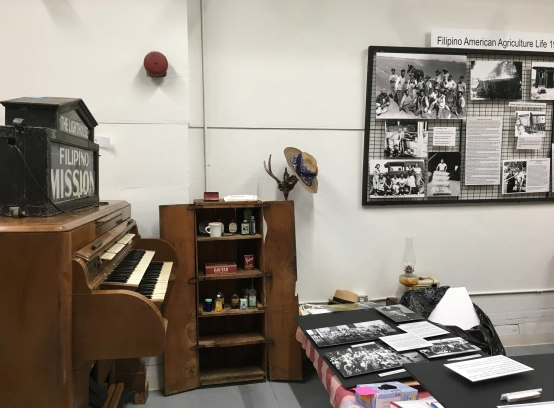
A picture of an FANHS exhibit with the Lighthouse Mission and early Trinity Presbyterian Church on the left and the labor camp exhibit on the right.
“In 2006, the Smithsonian Filipino American Centennial Commemoration marked 100 years of Filipino migration to the United States with insightful exhibitions, special programs, and an extensive curriculum guide. Singgalot celebrates Filipino Americans as they share their struggles, challenges, and achievements with the rest of the nation.
This exhibition toured from 2008-2012.”
Tour Itinerary
Remy’s on Temple Art Gallery, Los Angeles, CA Reynolds Gallery, University of the Pacific, Stockton, CA
Kansas City Public Library, Kansas City, MO
Odegaard Undergraduate Library, University of Washington, Seattle, CA
Filipino-American Historical Society, Chicago, IL
San Francisco Public Library, San Francisco, CA
Intercultural Center, Drexel University, Philadelphia, PA
Missouri History Museum, St. Louis, MO
California University of Pennsylvania, California, PA
Charlotte Museum of History, Charlotte, NC
Sonoma County Museum, Santa Rosa, CA
Charles B. Wang Center, Stony Brook University, Stony Brook, NY