Let no more children fall victim to an atomic bombing.
Children’s Peace Monument, Hiroshima, Japan
Based on their own experiences and carrying in their hearts the voices and feelings of those sacrificed to the bomb, the hibakusha called for a world without nuclear weapons as they struggled day by day to survive. In time, along with other Hiroshima residents and with generous assistance from Japan and around the world, they managed to bring their city back to life.
Peace Declaration, Hiroshima, Japan, August 6, 2011
Here and now, as we offer our heartfelt consolation to the souls of those sacrificed to the atomic bomb, we pledge to join forces with people the world over seeking the abolition of the absolute evil, nuclear weapons, and the realization of lasting world peace.
Mayor Matsui Kazumi, City of Hiroshima, August 6, 2014
I have had an interest to visit Hiroshima Peace Memorial, since I heard the stories of Carlo Delacruz, my unico hijo, when he was about 11 years old. He visited Hiroshima, Japan, along with his teacher and classmates from Los Angeles Center for Enriched Studies. His stories stayed deep in my memory chambers, as they touched my heart with conveyed sadness, but also transformative hope and aspirational actions for sustained worldwide peace. I too visited Hiroshima on April 3, 2015 with my college classmate, Remedios Baclig on Good Friday.Janet Rodriguez Nepales and I were at the film premiere of “The Little Boy” on April 14, 2015 at LA Live’s Regal Cinema in Los Angeles, when the horror of Hiroshima was re-lived for me. The film showed cultural artifacts from the Hiroshima Peace Memorial, which I just visited barely two weeks ago: a red globe (bomb initiator) on scorched-city concrete debris, with statues of families burnt to death, the bomb code-named Little Boy.
“The Little Boy” is a film about a young boy’s resolves to bring back his father, a US soldier who fought World War II in the Philippines. The little boy’s faith was activated and strengthened by doing acts of mercy: feeding the hungry, sheltering the homeless, visiting the sick, burying the dead, including befriending Hashimoto, a Japanese-American, who bore America’s prejudices of that WWII period. The film beautifully chronicles how the biased prejudices of diseased minds can be changed through immersion in another person’s life, curiosity, and sharing a genuine friendship. The film garnered an enduring applause and bravos from the Los Angeles’ audience.
Seventy years ago, on August 6, 1945 at 8:15am, the United States of America, dropped an atomic bomb on Hiroshima, wiping out the entire city. The United States, according to the Hiroshima Peace Memorial brochure, decided to drop the bomb on Japan to bring the long World War II to an end (started in 1939 and ended 1945, shortly after the atomic bomb was dropped). An order was issued to bomb Nagasaki, Niigata, Kokura and Hiroshima. Hiroshima became a target, as it did not have an Allied prisoner-of-war camp.
When the bomb hit Hiroshima, families died instantly. Some were riding the bus on their way to school, while other school children were demolishing buildings, to make room for fire lanes and air bomb shelters. Others had seared flesh on their backs, torn limbs, missing body parts. Some developed leukemia and radiation diseases, including protruding black fingernails. Black rain poured down from the skies.
A total of 350,000 Hiroshima residents died. Few survived, while inside the basement of a rest house, now a souvenir shop.
The absolute evil that robbed children of loving families and dreams for the future, plunging their lives into turmoil, is not susceptible to threats and counter-threats, killing and being killed. Military force just gives rise to new cycles of hatred (I came to know that war breeds at least five cycles of hatred, or five generations).
Peace Declaration, August 6, 2014
My college classmate and I went to the children’s memorial, where we rang the bell and said a prayer for all 6,000 young boys and girls who were gone too soon, robbed of their tomorrows. Soldiers die, but also, innocent children become casualties, and survivors laden with guilt are preempted from living healthy lives.
The somber gray clouds accompanied heavy rains with strong winds, as we walked the perimeters of the Peace Memorial Museum. It was as if the heavens poured out its sorrows and its blessings for the survivors of Hiroshima.
In the 2014 Peace Declaration, a 12-year-old boy in junior high said, “Even now, I carry the scars of war and the atomic bombing on my body and in my heart. Nearly all my classmates were killed instantly. My heart is tortured by guilt when I think how badly they wanted to live and that I was the only one who did. Having somehow survived, hibakusha still suffer from severe physical and emotional wounds.”
At the Hiroshima Peace Memorial, I too publicly shed tears, along with others from many different parts of the world, who viewed the museum artifacts, aka cultural properties: a toddler’s torn pink sundress, a rusted tricycle, a bombed-out helmet, a frayed canvas bag, eyeglasses with a broken eyepiece, bombed-out armoire, melted roof sheets, and paper cranes folded by Sadako Sasaki, who was exposed to the A-bomb when she was 2 years old.
Ten years later, Sadako was hospitalized at Red Cross Hospital for leukemia. At the hospital, she learned of a 5-year-old girl who died from leukemia. She wondered if she too would have the same fate. A thousand paper cranes folded by school students in Nagoya were delivered to her hospital to uplift her spirit. When she received them and heard about the legend, “fold 1000 paper cranes and your wish will come true,” Sadako kept up with folding paper cranes. “Let me get well,” and with each paper crane, her desire to live and prayers were folded in. Even as she felt pain and suffering, she folded paper cranes. After an eight-month hospitalization, she died. Her classmates decided to memorialize her and other children who perished. Their efforts spawned a movement and over 3,000 schools around Japan sent money and letters, saying, “Please use this to help build the monument.”
“Let no more children fall victim to atomic bombing.” And perhaps, we can update their wish to our world’s aspiration, “Let no more families fall victims to nuclear bombings. Let there be worldwide peace.”
Japan, once a colonial empire builder and an aggressor of WWII, is now a global peacemaker.
Must we become war orphans of nuclear bombs and lost tomorrows or must we build friends around the world, promote cultures of peace, where thousands of origamis in color can be folded by children, in harmony?
Mayor Matsui Kazumi wrote: “We will do our best. Mayors for Peace, now with over 6,200 member cities, will work through lead cities representing us in their parts of the world. We will steadfastly promote the new movement stressing the humanitarian consequences of nuclear weapons and seeking to outlaw them. We will help strengthen international public demand for the start of negotiations on a nuclear weapons convention with the goal of total abolition by 2020. Japan is the only A-bombed nation. Precisely because our security situation is increasingly severe, our government should accept the full weight of the fact that we have avoided war for 69 years thanks to the noble pacifism of the Japanese Constitution.”
That Good Friday was a memorable day of empathy for the suffering of Hiroshima’s 350,000 residents and its 6,000 young children robbed of their futures and Jesus Christ’s death on the Cross for us all. May we learn to deliver global peace from Hiroshima, Japan, with Christ-like hearts and minds!
Believing mirrors are believers, first of all, in the basic good of life. Setting aside chic skepticism, they are upbeat and encouraging. They believe in the college try. What’s more, they believe in trying again. They are realists. They expect good things, they know good things take work. They assume you will do the work because your dreams are good and worthy. They will help you if they can. What they cannot know is exactly how much help they already are giving us simply by existing.
Julia Cameron, Finding Water: The Art of Perseverance, 2006
Bravos. Claps. Enduring. When the 100-member Amor Symphonic Orchestra and Choir accompanied Matthew John Ignacio, on his trusted, handmade reeds’ accordion, drama was created halfway into the Suite from “Cinema Paradiso,” on Feb. 13.
Matthew John walked from the side to the center stage, on his trusted accordion, once a toy to him, now creating magic alchemy, transformative artistry, a quality of soul-memorable experience. The mesmerized crowd stood up for an enduring standing ovation.
Anticipating the artist to come out, Andrea Morricone passionately moves his baton. Matthew John makes it to center stage, with his hands on the accordion’s treble keyboard, efficaciously, effortlessly, and with such ease, activates the bass and bellows, that at the end of the standing ovation, both Andrea and Matthew shook hands and after, an exchange of encouraging words.
The Maestro was delighted, so was Matthew. The drama was a convergence of unintented circumstances: a side door that would not open, yet, the Generous Universe provided, as the pianist signaled Matthew to play on cue, and the dramatic thug at our collective souls, happened. “I thought you would never come out,” said Andrea. “Me too, “ Matthew responded. Together, they shook hands in contentment.
“Andrea’s music is something else. You just add yourself to it as his music has its own soul and history,” said Matthew.
“It was magnificent, said Dr. Marilou Dichoso, “I gained new respect for the accordion as part of the instrumentation and Matthew did an appropriate accompaniment.”
“It was a great, amazing experience, “ said Stefan Sookdeo, a Certified Nurse Assistant, “I like it when he walked from the back to the front, the drama worked well.”
“It was excellent. Playing sounded so natural. There are a lot of emotions besides playing the instruments,” Arnold Ferrer, an LVN, observed.
“You hear these familiar film scores. Then, you wander, wait, what is going on? You then realize, yes, these are familiar tunes, but he deconstructed it, then, he puts it back, with a twist of his own, “ said Dr. Enrique de la Cruz, a fan of Ennio Morricone.
Ennio is Andrea’s father. Valeriano Viale, journalist of Little Americano, the Italian newspaper that serves the approximately 100,000 Italian Americans in Los Angeles, shared that Ennio is elegance and how difficult it must be to be Ennio’s son. Yet, Andrea, the maestro of magnificence, has clearly demarcated his space in the Universe.
The Maestro and Masterful Artists with Perseverance.
“Andrea Morricone has composed 25 film scores for Italian and international films including Capturing the Friedmans by Andrew Jarecki, nominated (2004) for Best Documentary. He has received multiple awards for G. Montaldo’s film L’Industrialein 2012. His recent composition was selected as the official theme for EXPO MILANO 2015, with lyrics by Andrea Bocelli. His remarkable “Hymn to Faith,” the official anthem of Foundation Pro-Music, and Sacred Arts in Rome Italy, is now available for download on his website.”
He is a professor and a musical genius who is in constant search for that elusive sound, perhaps a level of excellence, where the impossible is made possible. Make no mistake, as the genius creates, he is warm, magnanimous and consistently encourages.
19 new arrangements and compositions were completed on Monday, by Wednesday, the musicians had two days to learn them, prior to performance on Friday.
To the logical minds, he may seem disorganized, with sheets of music on the floor of the mainstage. But, can anyone plan for the creative winds to come? For the musical breezes to be felt? For the spring of imaginations to bloom, much like wildflowers? Do we not see the beauty of magnificence unexpected, and for its own virtuosity to unfold, just like Amor Orchestra?
Amor Symphonic Orchestra is “an ensemble of LA’s finest musicians, who have worked with distinguished conductors and international composers.”
Matthew John Ignacio was 14yo when I first watched him, as a cellist onstage. He persevered in his craft and at a tender age of 17yo, he arranged Piazzolla for his Colburn School Orchestra bandmates and organized a fundraiser to benefit Typhoon Ondoy’s displaced families. Trained by Priscilla Martinez, he won first place in the American Federation for National Accordionists Competition in 2012. His evolving perseverance at creating, arranging, and performing classical music and Philippine Music has made him an extraordinary artist as others, on stage.
Matthew John won 1st place in the National Competition of the American Federation for National Accordionists in 2012.
“Matthew John was great. He is passionate and comfortable doing it [accordion]. He’s so much into it,” exclaimed Sharisse Manabat, a medical assistant.
Immaculate Heart of Mary School’s Choir, who had won 2 silver medals at the World Choir Games (2012), also joined these extraordinary artists. They placed 1stin the A Capella Scholarship Festival (2014). At Andrea Morricone’s Christmas Concert in 2014, they sang with their musical director Christopher “Pete” Avendaño, and in Dec. 2015, they will sing for Pope Francis.
The crowd favorites, gauged from their applauses, were The Good, The Bad and the Ugly, Tango Forte, You- “Love Theme” from Cinema Paradiso with Soprano Amanda Squitieri (Lyrics by Paola Lorenzi), The Pink Panther, The Godfather, Schindler’s List, and the Sheltering Sky.
Color and textures of the orchestra were evident, as sounds from the piano, strings, trumpets, the drums and the electronics could be distinguished. The flute was as significant as the enduring, lasting bass at the end was flawless. It created such a tension that any false note can change the aura, but the orchestra held its own with such a distinction.
Although the soprano sang too fast, to be fully appreciated, and even though the Maestro failed to bring the accordionist back with the soprano and introduce him to audience’s acclaim, the audience was visibly satisfied. In the audience were the Italian Consul General Antonio Green, the Chair of the Italian Cultural Institute’s Valerio Rumori, Little Americano’s journalist, Valeriano Viale and a predominantly Caucasian audience with a group of Filipino American classical music aficionados who all gave standing ovations.
There is never a completed piece of art. A masterpiece is always a work in progress. Even as the rehearsals unfolded, the Maestro made subtle changes to tweak perfection in place. He is constantly arranging, composing, looking for that elusive sound, a sense of perfection as one might say, or a soul in search for that enchanting connection to one’s Higher Creator, a language of one’s heart that bonds him to his audience, a signature distinctly Morricone’s.
Andrea Morricone’s musical creations took the audience from one end of the spectrum of emotions to the other, from down below of feeling sad, to an exhilirating high of passionate intensity. Amanda Squitieri, soprano, sang You, “Love Theme” of Cinema Paradiso, not just once, but twice as the encore. A member of the LA Grand Ensemble, Amanda is known for the role of Beatrice Russo in Daniel Catan’s Il Postino at the LA Opera and world premiere performances.
Cinematic Visions grabbed the soul’s pathos, dumped the melancholy somewhere, and opened up many hearts to make room for peace, drama, ecstacy, joy, lightness of energy, and the intensity of passions of creativity and musicality to be felt. We all felt one with Andrea Morricone’s music, ever innovating but also, respectful of traditions of what were once created.
You simply want to say Magnifico! Believing mirrors indeed reflect the good of life!
If you have never gone completely insane because of love, you haven’t yet reached the most intense corner of your soul. If you haven’t swallowed the bitterness of loss, of loneliness, of the total annihilation of self for your beloved, you know not the true meaning of loving: The surrender of self to make true the union of hearts that can never be destroyed by death. If your heart remains intact after your beloved dies, your soul is incurably diseased. Give love its due. Dare to face the loneliness. Because this is the end of the measure of love that will not fade, not even when you have returned to dust and all that exists has ended.
Alma Anonas-Carpio, 2015
If there was a silkscreen through which your whole life is passed through, would it have love curdles? Or would it be like a drop of water, without anyone noticing? Have you live a life that matters to a person, a community or an institution?
In Parker J. Palmer’s Let your Life Speak, he wrote of Rumi’s observation, “If you are here unfaithfully with us, you’re causing terrible damage.” Palmer continues, “If we are unfaithful to true self, we will extract a price from others. We will make promises we cannot keep, build houses from flimsy stuff, conjure dreams that devolve into nightmares, and other people will suffer—if we are unfaithful to true self.”
Faithful to one’s self as a teacher
Each time an organization or an institution succeeds, it is primarily because the leadership at the top is mission-driven, compelling others to service, before self.
I have witnessed this sterling example at Cal State University Northridge, from a full-time professor who lives frugally, saves, then donates a significant endowment to his institution, to support the needs of future students.
When the Glenn Omatsu house was dedicated at CSUN on April 30, 2014, Professor Rashitta Brown-Elize, a former EOP student (Equal Opportunity Program at CSUN, for low-income and underperforming students) and now EOP and AAS (Asian American Studies) Professor gave a moving account about almost dropping out of CSUN in her first year. She worked two jobs then just to support her biological family, while going to college.
When she was hospitalized, she realized her family could still go on, even without her support. That lesson was not lost to her. She now has a Bachelor’s, a Master’s and a doctorate from the University of Southern California. She credits Prof. Omatsu’s perseverance in making her realize her potential, underappreciated by her at that time.
When she got married two years ago, she asked Prof. Omatsu to walk her down the aisle, a fitting tribute to “being my surrogate dad who saw the goodness in me.” She gave him a framed wedding picture, an endearing gesture of “microaffections,” popularized by Presley Kann, and mentioned by Prof. Omatsu, during his lecture.
She paid tribute to Prof. Omatsu’s selfless mentoring, without expecting anything in return.
It is quite inspiring to witness this tribute to a college professor by a former mentee, now a colleague at teaching at CSUN, affirming their common humanities to reach for our dreams.
Faithful to one’s self as a cellist
Matthew John Ignacio was 14 years old when the first door to his dream was opened by Bob Shroder, flutist and conductor of Filipino American Symphony Orchestra (FASO). FASO was the brainchild of Roger and Cora Oriel and Lito Cruz. Matthew played for FASO for four years, facilitated by the sponsorship of the Asian Journal Foundation. Fast forward to now, Matthew is 20 years old and recently shared his gratitude as more Hollywood doors are opening up for him.
“Six months ago, Lem Balagot (a celebrity caterer for the Oscars and the Grammys) watched me play for the Binibining Pilipinas USA. He really believed that music could take me worldwide. He called me an ‘Artist’ and wanted to help me. When Lem catered the screening sessions for the 2015 Grammy nominees at the Village Studio, he showed my YouTube videos to the producers. Jeff Greenberg, Los Angeles chapter governor of the Grammys, asked to meet me at the Village (Fleetwood Mac, The Rolling Stones, B. B. King, Bob Dylan, Lady Gaga, Coldplay, Taylor Swift, John Mayer have recorded at this place). After playing for an intimate group, Mr. Greenberg offered his studio for my CD recording.”
Matthew’s gratitude continues: “Jamie Hartman, a British songwriter/producer then requested me to come to Electric Feel Studio in West Hollywood (this studio is known for collaborating with the likes of Lady GaGa, Bruno Mars, and Owl City). After I played for Jamie, he asked me to collaborate with Conrad Sewell, a singer currently number 5 in the world of Spotify Chart. His ep, where I played the cello, is coming out mid-2015. Andrea Morricone, Grammy and Golden Globe-winning composer of “Cinema Paradiso” watched my videos. I then got a call from him to play cello at his 2014 Christmas concert. God is calling and wants me to use His talent now!”
On Feb. 13, 2015, Matthew John Ignacio shared the stage with Andrea Morricone, along with Immaculate Heart of Mary Children’s Choir (mentored by Pete Avendaño) at the Santa Monica College’s Broad Stage.
Faithful to one’s self as Christian Catholic musicians
Joseph Cruz is a classical tenor graduate of UST Conservatory of Music, with a degree in Bachelor of Arts in Music Education, Major in Voice who taught in Assumption College, Makati for several years and then joined Mr. Ryan Cayabyab’s San Miguel Master Chorale in 2000. He migrated to the US in 2002 and taught at Montessori schools in Orange County. Even with a hectic schedule, he joined Irvine Valley College University Choir, St. John the Baptist Church Choir, Pacific Chorale and John Alexander Singers. He became part of the Philippine Chambers Singers Choir-Los Angeles, where he met Mike Zuñiga and Harana Men’s Chorus), travelling every weekend to LA, from Rancho Sta. Margarita, where he lived for seven years.
He went back to the Philippines in 2013 to care for his ailing mother and he now teaches music at Pasay City North High School-TRAMO campus.
Joseph shared how he created a band: “Pasay City, compared to other cities in Metro manila, is poor. Many families are in the low-income bracket, if not, below poverty. My school is located in Tramo, where I believe most of these poor families live. I was the only music teacher when I joined the faculty in June 2014. I handled 21 sections of 50 students per class. There is no music room and there are no music equipments at my school so I brought my own system. The principal wanted a school band, but no budget for the instruments. Yet, I accepted the challenge. I was so excited to handle the DRUM and LYRE Band and the school choir.
But, I got sick for a few months. Although I am happy with what I am doing, my body could not handle the teaching loads and ended giving up the school choir.” Harana Men’s Chorus (HMC) helps in actualizing his dreams of forming a band: “Thank you to HMC for making us the beneficiary of their latest concert. Your donation made thousands of students happy with [the] brand new classroom TV, portable keyboard, marching drums, and cymbals. You made our NEW YEAR [2015] happy and blessed. We will continue praying for your success, more concerts and to make more audience happy with your beautiful music.”
We all have dreams. Yet, we become more humane, as we help others reach theirs. Much like the selfless examples of the love speaking in the lives of FASO founders, Roger and Cora Oriel, Lito Cruz; Bob Shroder, Glenn Omatsu, Pete Avendaño, Lem Balagot, Harana Men’s Chorus and Joseph Cruz, many more students like Matthew John Ignacio in Los Angeles and Pasay City students in Manila, got their dreams to come true. Let love speak loudly in your common lives! Happy Valentine’s to all of you!
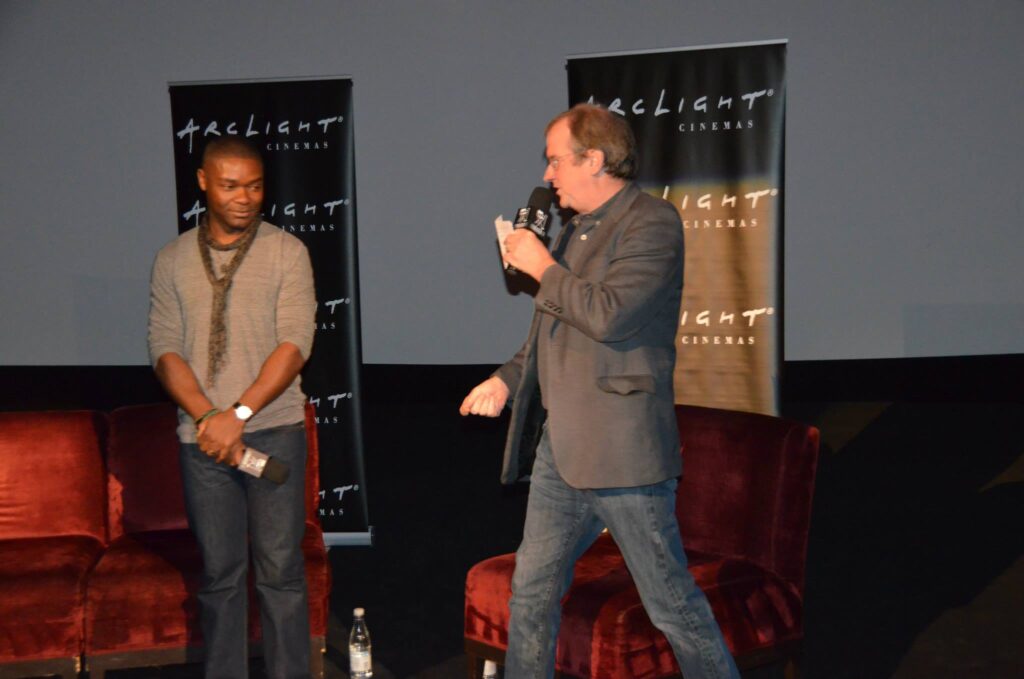
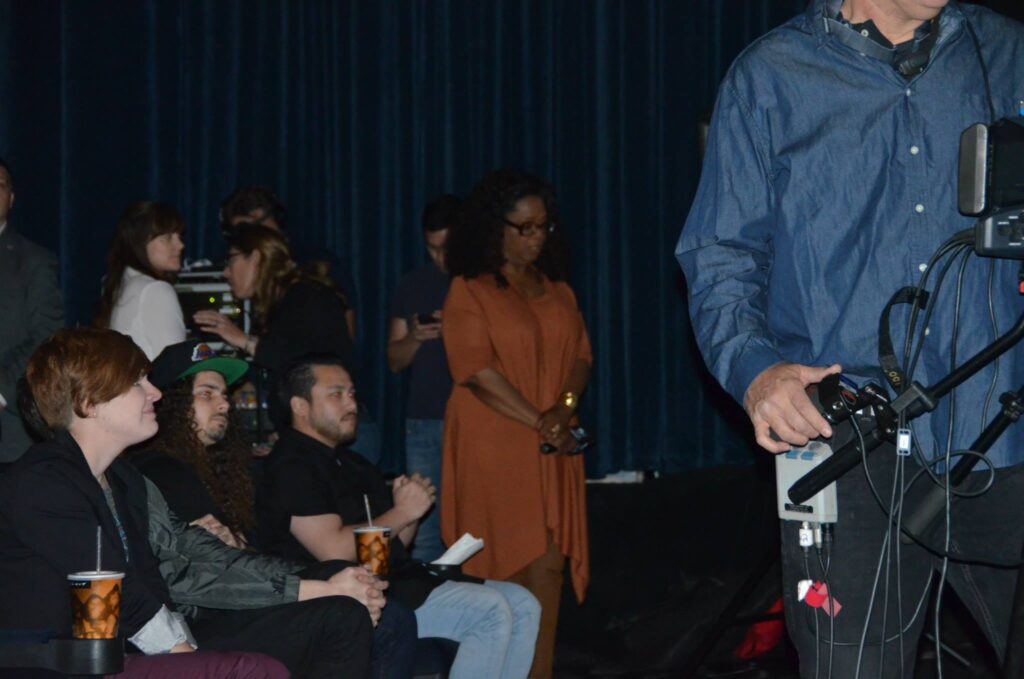
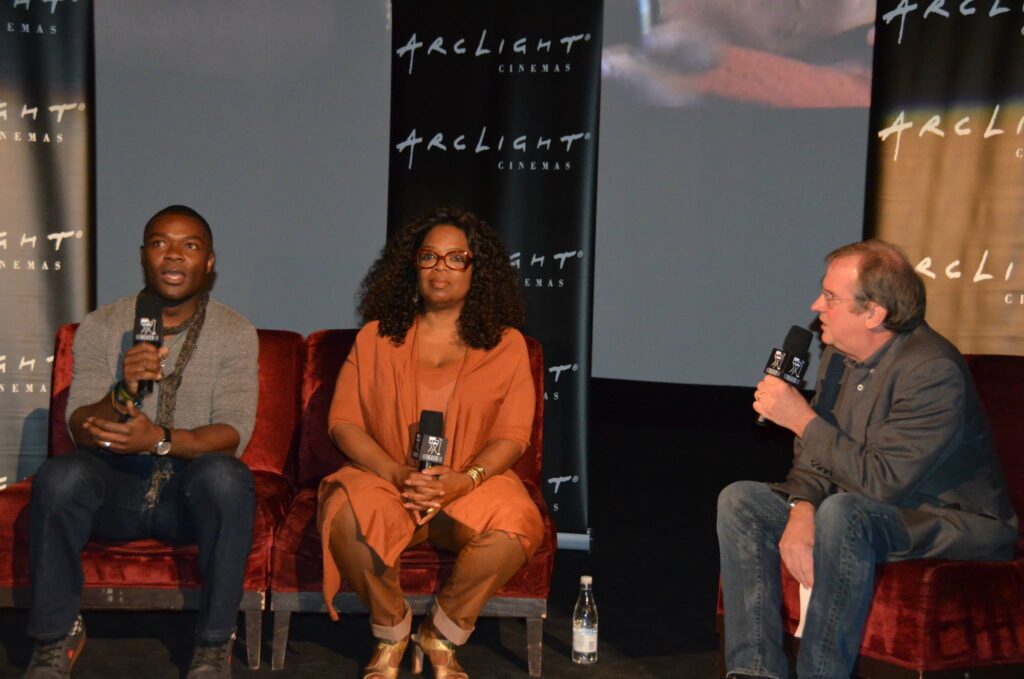
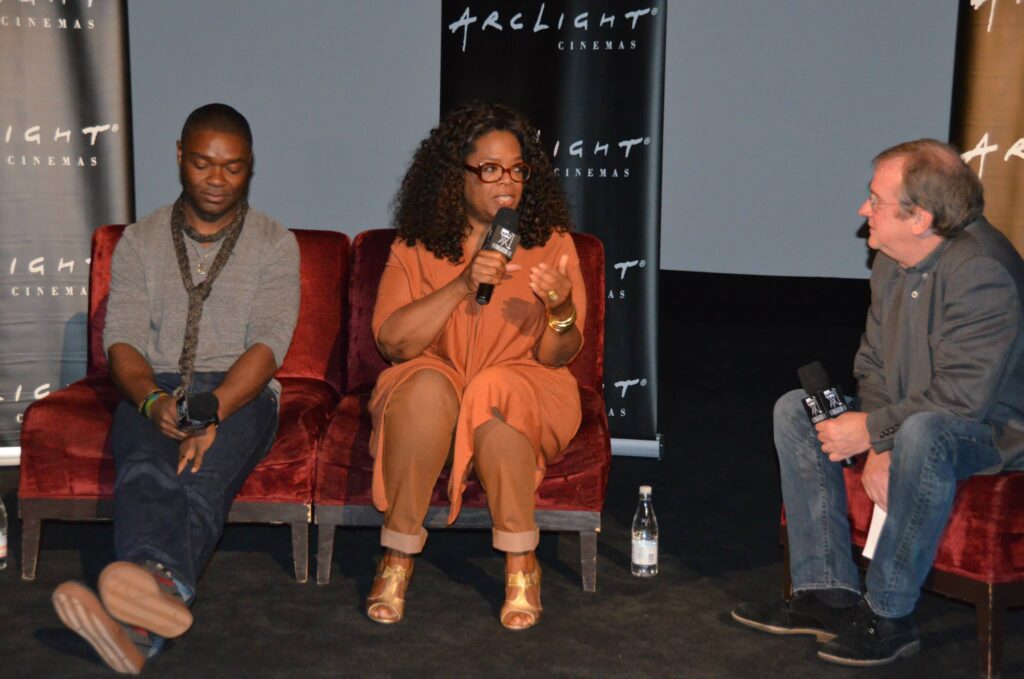
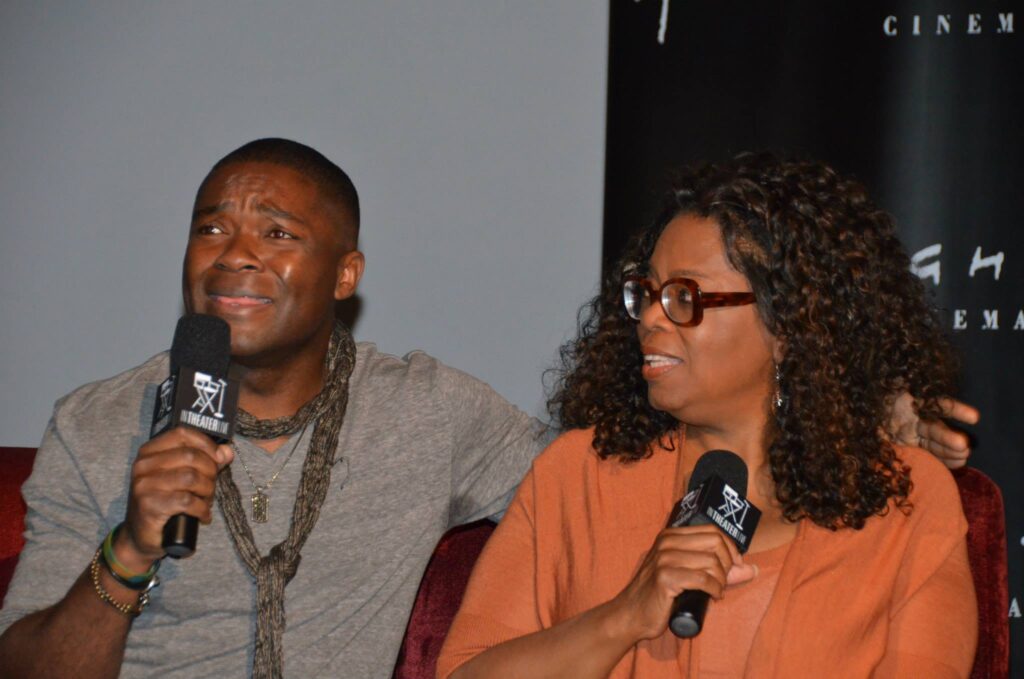
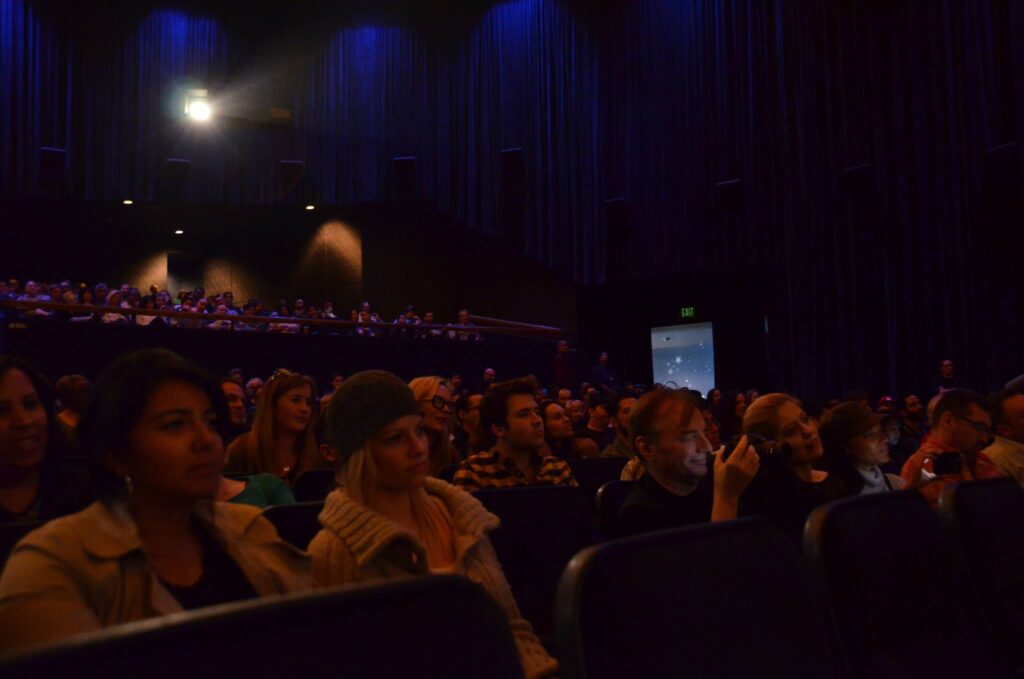
The third time is a charm, as the saying goes. Indeed, seeing Selma a third time is a charm!! My daughter knows how much I love Oprah, and so do friends of mine. My daughter called to ask me what I was doing today, Saturday, 1/24/15. “To see Selma a third time,” I said. “I got you and dad tickets to see Selma at Arclight because Oprah will do a Q and A with David Oyelowo.” What a coincidence, or was it serendipity? I was ecstatic. I asked a friend to use the ticket I had just bought ( within seconds of my daughter’s), and off we all went. Just when the credits were rolling, I went to sit in the front row.
Front center with Oprah, my idol, my most cherished mentor on television, just within feet of me. Thank you, dear Oprah Winfrey, OWN: Oprah Winfrey Network, it was so lovely to see you in person. I was the person who said, “Me, too,” in watching the Oprah Winfrey show daily, and you acknowledged me by saying, “She did too.” You are more lovely in person, as your radiant spirit matches your words and your gestures, a solid alignment of seeing authenticity in person. Your choice of words is so precise and uplifting, it was worth seeing Selma a third time.
Selma Movie has its own legs, and I predict it will move people all over the United States to rekindle the true American spirit of standing up for justice and human rights for all. May it rekindle folks to use their power to create lives of meaning and service to others, and in the same space of where they are in the world, make room for others to grow and to create their own lives of meaning too.
Thank you for this beautiful experience, and thanks to my wonderful daughter, who gave me the treasured gift of a lifetime. Next on my bucket list is to be at the Oscars to see Oprah win Selma as best picture, may it be so, Lord! Thank you, too, Ted Benito, for posting the announcement on Facebook. Copyright Prosy Delacruz, 2015.
“His music is current. It contains a sense of tradition with an edge. It is not boxed in, and it has a current writing style.” —Nové Deypalan, D.M.A.
John Middleton Murry once said, “For a good man to realize that it is better to be whole than to be good is to enter on a strait and narrow path compared to which his previous rectitude was a flowery license,” as Parker J. Palmer quotes him, in “Let Your Life Speak: Listening for the Voice of Vocation” and amplifies in “The God whom I know dwells quietly in the root system of the very nature of things. This is the God who, when asked by Moses for a name, responded, “I Am who I Am.”
It is with a sense of certainty that Andrea Morricone describes who he is as “perhaps already swimming in music, conceived in the womb of his mother, Maria, listening to the music of Ennio, his father, a trumpeter.”
I feel blessed that Andrea Morricone — a world-class composer of “L’Inno All Fede” (Hymn of Faith), a Vatican acquisition; “Anthem for Russia” performed for the Russian elite, in “The Musical Seasons at the Constantine Palace at St. Petersburg, Russia in 2014; and “La Forza del Sorriso,” a theme song to be sung by Andrea Bocelli at the Expo Milano 2015 — would reach out to Filipino-American talents.
I was generously brought into Maestro Andrea Morricone’s life orbit by his colleague and effervescently cheerful assistant, Salpy Kerkonian, and tenor par excellence Christopher “Pete” Avendaño. I then invited Dr. Nové Deypalan, who graciously attended the dress rehearsal of Andrea’s Christmas Concert 2014 and gave me a mentoring session on Andrea’s composition notes which I took during the interview.
Andrea Morricone created original compositions, including new arrangements for these hand-picked Filipino American artists: “Canzona Filipina,” “Ave Maria,” ” YOU” for Pete (tenor), and a choral accompaniment from the a cappella winning champions and silver medallists Children’s Choir of Immaculate Heart of Mary School and their companion Holy Family School (chorus) and “Adagio in C Major” for Cello, Harp and Strings for Matthew John Ignacio (solo cellist) and a graduate of Colburn School of Music.
On Dec. 9, 2014, Andrea Morricone shared his timeless theory of musical composition, which is perhaps an exquisite synthesis of an entire history from traditionalists composing classical music, to the romanticists, to the Germans, to today’s composers.
He walked into the offices of the Asian Journal, en punto, and greeted us: “I am honored to be in your presence.” It was such a reversal like an avowed world-class artist and an Oscar award-winning film scorer when one is greeted, not with the aplomb of snobbiness, but with humility and gracious warmth. It was unexpectedly disarming.
For this writer’s sense of bearing and certitude, Ding Carreon, the Asian Journal’s photographer/videographer, videotaped this historical gift of encounter.
“What does it feel like to compose music for God’s representatives in the Vatican, Russia, and a world-class artist, Andrea Bocelli,” I asked the maestro. “That would be for the musicians who play my music to answer,” he humbly responded. Instead, he articulated his wish to do a concert in Manila and conduct an orchestra of highly skilled musicians.
“I am very happy and thrilled about the music itself! What happens to me is this big work, music that comes from far away, in the sense of time, in the sense of information, [the] result of a long process, [of composing, of creating,] even if it takes only two to five minutes a piece. It is a piece that is meant to be.”
The elements of his musical composition: concepts of necessity and madrigalism
Much like the “Canzona Filipina,” which Andrea composed in only an evening (the night before the Christmas Concert of 2014, in fact) based on Felipe de Leon’s work of creation, “Payapang Daigdig,” which was inspired by waking up to the morning after the destruction of Manila during World War II. He arranged Felipe de Leon’s piece from a “deceptively simple, yet complex and created by a person who is well versed in music” into a piece of virtuosity that defies description of words, other than to witness the Amor Symphonic Orchestra members (mostly LA Philharmonic musicians) give life to Andrea’s beautiful arrangements, that made the packed St. Mark’s Church clamor for another encore, to which the maestro obliged, with “The Theme in D minor.”
Imagine Andrea’s self-restraint in considering his impact and opting instead to talk about three elements of classical music composition: the concept of necessity, the concept of madrigalism, and the shape of a melody which shows up as a question mark, unanswered. It is like any piece of art, with enough ambiguity, vagueness, or even metaphors to allow the reader or the viewer’s interpretation to come forth.
But the concept of necessity, as described by Dr. Nové, is similar to when cooking with too many spices, one loses the dish’s essence. Much like music, each note has to serve its purpose, “if it is necessary, put it there.”
Andrea describes that in his music, it is important that there is order. That ultimately, the musical composition has to have a good sound. But it also has aesthetics, an order, organized art verse, a refrain, a chorus or a climax, a sense of arrival, a descent, and an ascent to the summit, before the descent.
I interviewed a young composer who shared her original compositions from her dreams, on-demand, or inspirations.
This piqued the maestro, who quickly said: “I do not believe in dreams, I prefer to sleep. But music comes to me all the time. In music, I choose.”
It was as if he was describing all of his inner molecules are made up of music, his heart, his mind, his soul, and his entire spirit breathed in and exhaled music.
He drew a half a heart symbol, with rugged tips at the base of the heart and a smooth apex, and wrote, “eight times of question marks” and its title, “Madrigalism.”
He illustrates more by writing peroration, where most composers create at C Major 7/ over B, and that tune would last a bar, forming four tips of a Septima chord.
Dr. Nové explained that during the 19th century (Liszt), there was an interplay of music and landscape. Musicians told a story through their music or described it as their music shared their life stories, there is a strong madrigalism.
“The shape of the melody shows up as a question mark” in Andrea’s compositions. Perhaps, this is the signature Morricone sound that Enrique de la Cruz, Ph.D. (this writer’s husband), describes after listening to Andrea Morricone’s Christmas Concert in 2014.
Andrea continued, “It is a big question mark that everyone has to deal with by himself. The melody appears four times, it is the same question mark, and eight times question marks become infinity. The oboe starts high (when the maestro at rehearsal calls it a crescendo), and then it curves down, where the oboe is now reacting to the question mark. There is no piece in the known history of music making by men, according to me [referring to himself, Andrea], there is no chord C Major F, over B lasting over a bar. It is difficult to find a Septima of four or four types of Septima chords.”
“The tension it creates keeps going up and up, it is huge, and the oboe keeps going up, it is, I believe, something unique.”
The closest composer coming to what Andrea has done is Ludwig Beethoven, in his “Sonata Al Chiero de Luna,” according to the maestro.
I validated Andrea’s statement by interviewing Dr. Nové Deypalan, another music conductor and arranger who has a D.M.A. (Doctorate in Music Arts) from USC, and he, too, affirmed that the maestro’s statements are historically true and accurate.
During the medieval period, circa 1150 to 1400, Gregorian chants were created. For 300 years, the rules were about one music line, monodic. Recall hearing Lamentations by Thomas Tallis or works of Giovanni Pierlugi da Palestrina’s Adoramus te –in early Latin masses that we were steeped in as Catholic Christians?
I might be losing you by now, my dear readers, but stay with me as it gets better.
After being constrained for 300 years, i.e., creating music using one music line, Renaissance artists started their own ways of composing music, flexing their creative muscles of freedom.
From 1400 to 1600, Renaissance musical composers created movements called “harmony” and “polyphony, “ organizing them into major and minor music scales.
Recall Leonardo da Vinci, who did an exquisite synthesis of face and landscape with a timeless classic painting of Mona Lisa, which to this day, attracts an admiring pilgrimage of travelers? That was the period of 1503 to 1506, as the freedom in music grew, so too were the paintings, art, and architecture.
The likes of Johann Sebastian Bach, Handel, and Vivaldi also paved the way for their Renaissance compositions to be played by a modern orchestra.
During the Baroque period, circa 1600 to 1750, these artists gave birth to more musical genres: chorus, sonata, opera, cantata, and even bolder strings of a violin, viola, cello, and harp. Color and textures were used to describe their distinct sounds.
The classical period of 1750 to 1830 gave the world the likes of Wolfgang Amadeus Mozart and Joseph Haydn, followed by the Early Romantics composers of 1830 to 1860: Verdi, Liszt, Mendelssohn, Schumann, Chopin, and Berlioz.
“If Baroque music is notable for its textural intricacy, then the Classical period is characterized by a near-obsession with structural clarity, “ according to Naxos, while the late Romantics made music “often pacing their compositions more in terms of their emotional content and dramatic continuity rather than organic structural growth, “the likes of Mahler, Tchaikovsky, Puccini, Strauss, while the post-war periods gave us diversity, experimentation of styles, the likes of Gershwin, “THE RHAPSODY IN BLUE,” and of course the diabolical sounds of Stravinksy.
Mahler#8, if you recall, was conducted by the exuberant musical genius Gustavo Dudamel, with 1,000 musicians in the Shrine Auditorium. This writer wrote of the participation of the Philippine Chamber Singers-LA in that vast, historic collaboration.
Exquisite synthesis of traditionalist and modernist composers.
Now fast forward to the 21st century, and here comes Andrea, who captivates us with his work, now eloquently described as influenced by traditionalists, with a signature sound of his father Ennio Morricone, yet, distinctively Andrea’s, with his own creative edge, and educated by the music of the early classical musical composers.
Andrea likened his music to approximating Ludwig van Beethoven’s “Sonata al Chiaro di Luna” in C sharp minor, and he said, “look at his bar #2,” and Andrea writes in his own handwriting, “C sharp minor over B which lasts one bar, a Septima of two kinds.“
“This is incredible, also an unknown in the history of classical music,“ and “even more unique than what I did,“ Dr. Nové Deypalan admitted to this writer.
“There is a stronger emotional point of view when this is done,” Andrea continued, with a high sense of assurance as to who he is in the context of the timeline of composers. There is not a single person I have interviewed who has this sense of certainty about who they are in the context of history, the now, and the future.
Andrea underscored his theory: “It is very important to consider the Septima, in both of these examples, it is in the bass of the composition.”
He signed his four pages of explanations in his own handwriting with descending ripples of half a heart.
Pete Avendaño described Andrea Morricone’s timeless theory of classical music composition, “Who knows if 100 years from now, his theory might be the preferred art form for other composers to use? It is a clever use of dissonance to highlight and emphasize the harmonic blending.”
Frances Marie Noble-Ignacio described Andrea’s music as: “Dazzling talent, penetrating brilliance, and relentless innovation is the hallmarks of Andrea’s music and musical history. And, it is no surprise that his works, like those of his father, from classical compositions to scores for film and television, have been duly recognized worldwide by some of the most prestigious music industry organizations. Andrea’s unwavering, enterprising commitment to composing and conducting and his repertoire of compositions that pulsate with ingenuity are inspiring, and yes, award-winning.”
If I kept you hanging in this piece, remember the genius mind is like that of an ocean; we cannot contain the ocean waters into a hole in the sand.
Much like our interview with Andrea Morricone, who left us with priceless pearls of wisdom, you are simply left with “Morricone sound,” “Beautiful,” “Exquisite,” “Very Expressive,” “You cannot touch, nor see, but you feel it, the only art form, triggering one’s emotions, one’s tears, one’s knees to drop in prayer to God, to thank the gifted maestro, who is so generous in giving his creations away, gifts coming from his heart.”
“After 15 years of starting again on my own in America, much like Arnold Schoenberg did in relocating from Europe to Los Angeles, I am now a well-prepared conductor/composer, that from a spiritual point of view, I can tell you that music is all my life and those who are around me belong to me in a very deep way. That man, Goffredo Petrassi, [the grand old man of Italian music, a leading Italian modernist composer] was fascinated by my mind. He felt what I could become in music. Music is all of my life, people who are around me deeply belong to my life. I can say this about Salpy, she plays my music so well, she becomes part of my life, my heart, she is inside here, “ and gestures to his heart as he repeats, “she is inside here.” For me, music is easy. It comes to me all the time.”
As if to underscore he is accessing the collective mind, the intelligence of the collective subconscious, he said, “ What I am living now will be bringing me to another now. I will be in another now, always in the now. My soul is moving into the now. We are made of nows.”
I responded, “the collective nows, our collective intelligence.” Yes, he responded, “I am always now.”
“Your soul is moving into eternity,“ and he nodded his head to my reaction and said, “My life is a big perspective, I can see many images like they all have spaces in my heart. Like all those I have loved before, I still love them.”
My house used to be a gathering place of an American family whose grandfather served to defend America during WW I. The house seems to be buzzing with good energies each time I am hosting dinner with family and friends. I call them family as in my ripe age towards the end of a life’s chapter, chosen friends become your extended family while your grown up children grow their own families. Posting this photo as we were non-stop laughing, though there were a lot of back stories that became preludes for wonderful beginnings. Happy Thursday, Sept. 1, 2016 to you all! I am the one reminiscing, instead of Facebook randomly choosing for me.