Cover Photo by Enrique B. de la Cruz
[Editor’s Note: A version of this column was previously published in June 2012]
Bryce National Park in Southern Utah is known for its red rock spires and amphitheaters of columns. It is described by the Paiute Indians as “bad men turned into rock by coyotes.” The true story of this place began 60 million years ago. Oh! Ranger described it as “famous for its unique geology of red rock spires and horseshoe-shaped amphitheaters, located on Utah Route 63, south of Utah Route 12 (a National Scenic Byway).”
Photo courtesy of Bryce National Park’s Facebook page
The history of Bryce Canyon began at the end of the Cretaceous period. The Claron Formation has been deposited, uplifted and eroded by ice, snowmelt, thunderstorms and the roots of plants and trees. As billions of tons of ground rock moved out of Bryce Canyon and into the Colorado River, amphitheaters of colorful temples, pillars, domes and spires were left standing.
The park ranger (whom I spoke with) reported 3,300 visitors on June 21, 2012, and the Hoodoos (the park’s newsletter) reported 1.3 million visitors a year.
Two decades ago, we visited Bryce Canyon National Park. On the way, we stopped to buy a bucket of fried chicken. All patrons glanced at my son and I. It was as if their eyes measured us from top to bottom, and their penetrating glares revealed their aghast feelings, as if conveying: “who are you to come to our place?” or simply, “who are they?”
Our young son (who was about nine that time) quickly got inside the car and told my husband, Enrique, to head back to Los Angeles. He felt that this state is inhospitable to folks like us, unlike California.
Fast forward to 2012 — everyone we met was so friendly.
At camp, a father struck up a conversation with my husband. He narrated that he once lived in Northridge, and now lives in Carlsbad.
Hazel, a graduate of environmental science, grew up in West Hills, Pennsylvania. She loves the adventure of being outdoors at Bryce, while volunteering with interdenominational services at Bryce Canyon on Sundays. She is part of the Christian ministries, working with 40 national parks and deploying volunteers like her to serve at the lodge restaurant.
At a pizza place where we ate, a world map is on the wall, with stick pins clustered on different continents: Europe, North America, Australia, Japan, and 20 folks from the Philippines. Another server asked me where I am from. She said she wants to go to Boracay because she saw pictures shared by J1 foreign exchange students from the Philippines and she fell in love with the place.
That afternoon, we took a scenic drive from Rainbow Point, ending up in Bryce Point. At Bryce, the vista spanning 100 miles was awesome. I held my husband’s hands and thanked him for driving us both to this magnificent place. The route he took got us through many scenic viewpoints: Rainbow Point to Black Birch Canyon, to Ponderosa Canyon, to Agua Canyon, to Natural Bridge, to Far View Point, Swamp Canyon and finally, Bryce Point.
But first, a trip to the visitor’s center, where we watched an orientation film. It becomes a guide as to what viewpoints to cover and which viewpoints were promising for photographs.
At sunrise, around 6:15 a.m., we went to Bryce Point. Here, the columns and spires appeared lighted from the inside, as if candles were hidden behind them, yet it was the sun reflecting on the red rock, giving a warm glow to the red rock columns.
It contrasted with the deep green forest of bristlecone pines and the bleached white soil in some areas. While walking the trails, I heard different languages spoken: Japanese, Chinese, Spanish, French, German and East Indian language.
My husband described what he saw at the viewpoint: a father pushing the wheelchair of his young daughter, who was holding a camera and was being kept alive by a cacophony of life support machines.
My husband and I held each other, as we felt gratitude for what we have and said a prayer for the sacredness of duties that both these parents have, to give their child the best of experiences, for how many days she has on earth.
That is how we feel — gratitude that we are able to travel and be outdoors with Mother Nature, that we are able to walk, to put one foot ahead of another, and to keep heading for the trails.
The last trail we took, Queen’s Garden, was advertised as an easy 1.6 mile-roundtrip walk.
But it was hardly easy. The mountain air zaps out the oxygen, leaving you with just 70 percent. The scorching heat of the sun is at 98 degrees Fahrenheit and two pints of water are not enough.
As I walked uphill, I took cover in every shade of a tree I could find. I saw figures which resembled a teddy bear, the Santo Nino, Miss Piggy, and Queen Victoria.
My husband, Enrique, held my hand at the last few yards and at the end of the trail, he went ahead. On the way back to meet me, he offered me a cold pint of bottled water, which I drank halfway in seconds, to revive my wilting body’s energy. One drawback of heat is some bodies lose energy quickly, draining electrolytes.
Water not only sculpts the red rock columns, it also restores a body to its normal capacity and cements a love bond between a couple.
On the trail, I offered to take a picture of a young Asian couple. As I took a shot, I asked if they were married. The guy said yes, but the woman was not smiling.
I imagine she wilted in the heat, just like me. “Smile, like you are in love for the very first time. See that guy over there, I have been married to him 33 years,” I said.
The young husband smiled and said: “We will keep doing the trails then.” The wife managed a smile.
The murmur of the winds, the sweet tweeting sounds of brown stellar jays, the sounds of flute played by the Paiute Indians (one resort guide hushed us to stop and to listen, but I could not hear), with car sounds traveling on the highway, interrupted by the happy voices of tired cyclists, announcing hot showers (that includes moi), and the bliss of doing laundry at the general store (after wearing dusty clothes and smelly socks from hiking the trails), all seemed at peace, so serene and perfect with Mother Nature!
I sat under the shade of the bristlecone pine trees with such bliss — a whole forest in front of me. I noticed the sweetness of the tweeting birds was matched by the rapport of a man with a squirrel, which posed long enough to have the animal’s photos taken. Happy Summer vacation to all of you!
Photo by Enrique B. de la Cruz
“Mother Nature is at its best with no makeup, just lighting! All you need to do is discover it,” said Enrique.
[Author’s note: The stares I referred to in this article happened two decades ago, yet somehow, these remnant bigoted practices have been revived, renewed and resurrected virulently under this Republican president’s administration, in June 2018, and at its worst form, separation of young children, as young as toddlers, from their parents. More on this at the next issue.]
“When you are seasoned with the salt of Truth, your own body of knowledge suddenly reveals a new dimension. The principle of relativity is mad practical in a new concept of unitivity. You will come to see that even as the subatomic particle has no existence outside of the electromagnetic field that holds the atom together, but is the field expressing as a particle, so man has no existence outside of God, but is the activity of God expressing as man. All your scientific facts suddenly come alive, they become dynamic potencies. And with this keener insight, you become a seasoning influence in the world. You become a peacemaker.” —Eric Butterworth, Discover the Power Within You, 1989.
31 days of camping, juicing, of cooking nutritious meals. What did I cook today – salmon in tomato broth, oregano, basil, and olive bread with garlic and sautéed mushrooms in butter – all tasted good but weariness is all I could taste. Even the bees sensed my restlessness, they hovered around me, buzzing, teasing me as if to bite me, yet, I managed to calm myself down.
I do not sleep like a log – I move about and when there’s skimpy space to move inside the van, I wake up and I wake up my husband as well. Then, it is about falling asleep again, which as one ages, grows more gray hair, is not as easy to do.
But as difficult and taxing it is to my physical body, the rewards are priceless – seeing the sunset – a blue line, a gold line, intersecting with white clouds, and then receding golden sun’s rays; a deep blue lake from a mountain that blew its top – a metaphor for blowing one’s top off, releasing all one’s toxic energies accumulated from past hurts/trauma to reveal a magnificent purity within, where good energies can be channeled back and forth and not stopped.
I call it an open heart, allowing others to influence you, to persuade you, to see it from their perspective, not just my own. My husband calls it a deeply rooted tree without rocks to stop the inflow of nutrients from the soil, after watering.
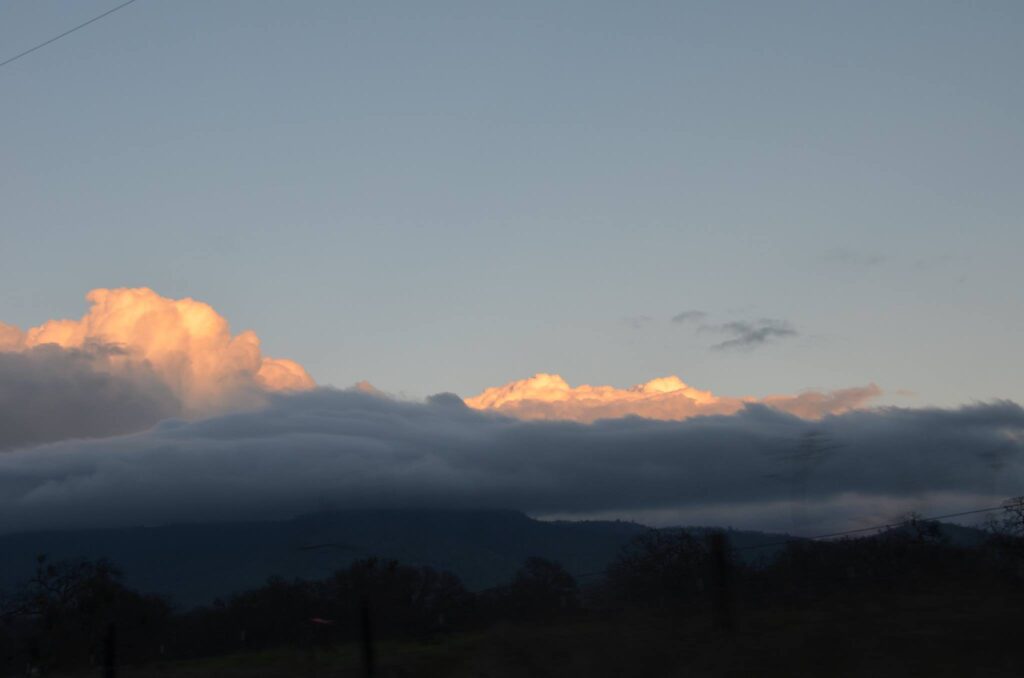
And just when I am about to give up camping, my husband hurries us both to see Watchman lookout at sunset. How gorgeous it is – blue, gray, gold, white bands, and then a blue backdrop – and my weariness evaporates with the howling music of the winds. Howling, haunting, but also soothing, and liberating for one’s spirit to join with the winds.
Seeing my husband so happy, so relaxed, so comfortable is enough to know he found his bliss. As to me, rustling of the winds, leaves of trees and violin music with a good sleep and hot showers at the camp store energize me, a new being no longer remembering the 31 days with only 4 days of hotel nights to break the routine, or to politely say, to restore my civilized ways of using the bathroom.
How do we exactly use the bathroom, as any other campers do. Ask them the next time you meet them, we all have devised our ways of dealing outdoor life. Ask middle school girls and they are more upfront, “After three days, you start not caring anymore. You start enjoying nature and what it can offer. Then, you just look around.” They have more uncommon sense than this writer.
As we walked up the Watchman trail, this uphill climb is for strenuous serious climbers, whose calves have been pre-conditioned to take the wear and tear of climbing and walking. As we climbed, I was huffing and puffing, catching my breath. I wish I were home. But not quite, as it is described as “the Watchman Peak Trail in Crater Lake National Park, Oregon is a moderately steep 1.6 mile out and back climb to a 360 degree view on the west side above Crater Lake from a historic fire lookout. This key vantage point offers spectacular views of the lake and Wizard Island, especially in the afternoon. Also night hikes with a ranger are available for some awesome star gazing,”AllTrails.com wrote.
But as the sunset glow disappeared, a canopy of twinkling stars appeared. With a roaring fire, a glass of red wine, the crackling sounds coupled with fragrant smell of cedar logs gave a balm to my tired spirit, my weariness became contentment and happiness that we, seniors, are still able to do this.
The canopy shrouded the trees as if Christmas lights, which instantly brought me joy: Jupiter, Mars, Procyon, Rigel.
I reflected on the lessons I learned:
1. Convenience is not the easy route. Taking a short cut on the trails can prolong your walk and can take you to the mountains that you must climb to get you back. Nature is meant to be enjoyed at a leisurely pace, to be still, to absorb what it brings, and not to hurry to reach the end of the trail.
2. Struggle through your inner demons. In doing so, you find your characteristic strength and somehow you realize you have acquired endurance.
3. Gourmet cooking of nutritious meals is so doable, so is juicing. Planning is key and when unplanned, creativity makes you develop new recipes. Like I did not have meat to go with my okra, eggplant and bittermelon, so I made my soul dish, pinakbet using mushrooms, as if meat. Husband raved about the dish as he likes to eat mostly vegetables.
4. Essential sanitizing and personal grooming can be sustained by creative means – the essential tabo, a makeshift shower stall, and taking your shower at 2pm, the peak of the afternoon, allowing your water basin to heat the water the natural solar way. The key is to respect your present capacity to endure nature’s burdens and rewards. The rewards are to be appreciated and the burdens are to be endured without complaints, but with creativity.
5. Remember to pray, start your day with prayers, keep praying all the time, as in prayers, you are connected with the Divine, and surprise miracles come your way. Like meeting good folks, fellow campers, who live in Washington and share their secrets of going to Mount Rainier, bypassing the 2 mile long traffic and getting the last camping space. That is when you know God is reserving that spot for you, a miracle for that season.
6. Listen to your instincts. Road guides are good, but smarts and instincts are much better than google maps. My husband has saved us being lost by following his radar about direction. On the other hand, google maps located repair shops and hotels for us.
7. Connect with praying to the spirits of the place for eternal protection and guidance, it is always there for the asking, whatever country you find yourself in. It protects you and it guides you to meet positive adventurous folks.
8. Cultivate your friendship circles, they are your safety net, ones you text to while on the road, they provide you easy routes known only to locals, they steer you away from long waits that tourists go through, and they give you local tidbit of news that you could not get from newsletters, books or newspapers.
9. Trust your common sense, your uncommon wisdom that you have derived all these decades.
10.Teamwork is essential. We got tested in our patience with one another only once. I quickly behaved as I wanted my showers, he behaved too as he wanted his hot meals. Camping in the outdoors can make you rely on one another.
11.Strange, spontaneous norms of locals is okay – honey bucket for toilets, road names, beach numbers and forest service roads. Learn the culture of the place and you will be accommodated well.
12.Accept kindness and be kind to others as well. Karma is a full circle. Plant honesty and later, you harvest honesty. I received a book of poetry written by a woman survivor of cancer and I excerpted a quote from her book and sent the essay to her by email. I also took a picture of soldiers climbing Mount Rainier, summitting it as antidote to suicides. I learned that soldiers after duty service in war zones suffer post traumatic distress. Without their soldier buddies, recovering is difficult and they resort to suicide. Now, psychological services are available to them and folks stay connected and do summit trails together.
You can be the tree that shoots upward, breaking a wedge on the limestone, growing upright to the sky. All you need is patience to receive God’s miracles, resilience, openness to the challenges and accepting them as lessons to be learned and guidance from divine teachers you meet, in the form of strangers.
Thanks be to the core
For you helped me
Be in touch with my inner core
And to hear my husband say
Prosy, you found your rhyme within
To get a big hug from my 20yo
Daughter
Mom, you entered our world
To have the space to write
To have the space to be
Thanks be to the core
You helped me grow myself once more!
Happy Thanksgiving to you all! My profound gratitude to Asian Journal’s readers for your letters and dialogues on facebook and reading Rhizomes. A profound thanks to Christina (my editor) who inspires me, and to Roger and Cora for trusting me with this column space, now on its 10th year. My profound thanks to my husband, Enrique who drove us one summer, from LA to British Columbia, for 31 days, August to Sept. 2013.
YOSEMITE Park is a place of rest, a refuge from the roar and dust and weary, nervous, waiting work of the lowlands, in which one gains the advantage of both solitude and society. Nowhere will you find more company of a soothing peace-be-still kind. Your animal fellow-beings, so seldom regarded in civilization, and every rock-brow and mountain, stream, and lake, and every plant soon come to be regarded as brothers; even one learns to like the storms and clouds and tireless winds. This one noble park is big enough and rich enough for a whole life of study and aesthetic enjoyment. It is good for everybody, no matter how benumbed with care, encrusted with a mail of business habits like a tree with bark. None can escape its charms. Its natural beauty cleanses and warms like fire, and you will be willing to stay forever in one place like a tree. Government protection should be thrown around every wild grove and forest on the mountains, as it is around every private orchard, as the trees in public parks. To say nothing of their value as fountains of timber, they are worth infinitely more than all the gardens and parks of towns.
John Muir, “The Wilderness World of John Muir
That first impression of the Valley—white water, azaleas, cool fir caverns, tall pines and stolid oaks, cliffs rising to undreamed-of heights, the poignant sounds and smells of the Sierra, the whirling flourish of the stage stop at Camp Curry [renamed to Half Dome Village as of March 1, 2016] with its bewildering activities of porters, tourists, desk clerks, and mountain jays, and the dark green-bright mood of our tent – was a culmination of experience so intense as to be almost painful.
Ansel Adams on his first visit to Yosemite
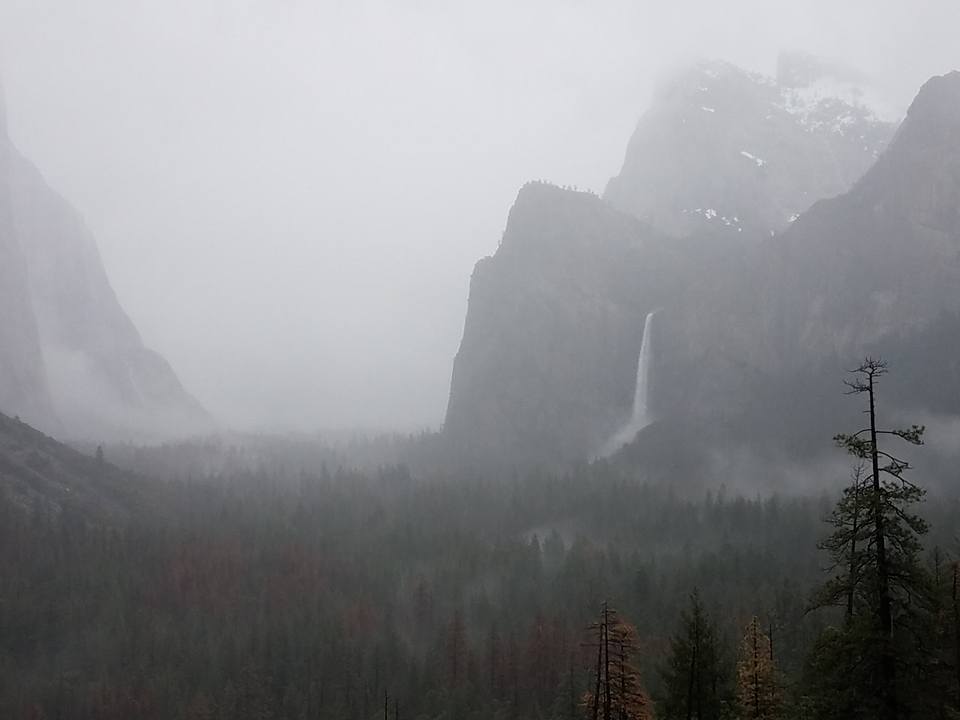
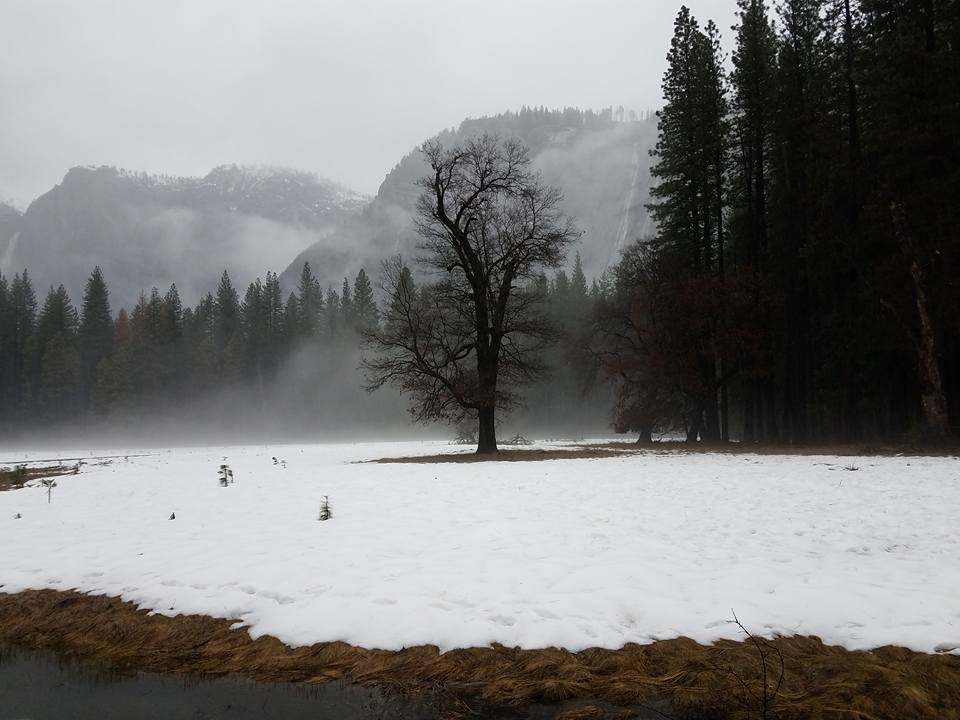
Yosemite National Park was established on October 1, 1890, a magnificent array of towering granite, waterfalls, meadows, rivers, creeks, redwood forests, spanning 747, 956 acres. Once inside, one feels serenity instantly. From the snow, covering road shoulders, to white snow understory surrounding the trees, snowflakes shimmering in pine tree leaves and branches, a morning circuitous drive of 33 miles to the inner rim of the national park allows you to breathe in God, with every breath you take.
There is no mistaking God in this magnificence.
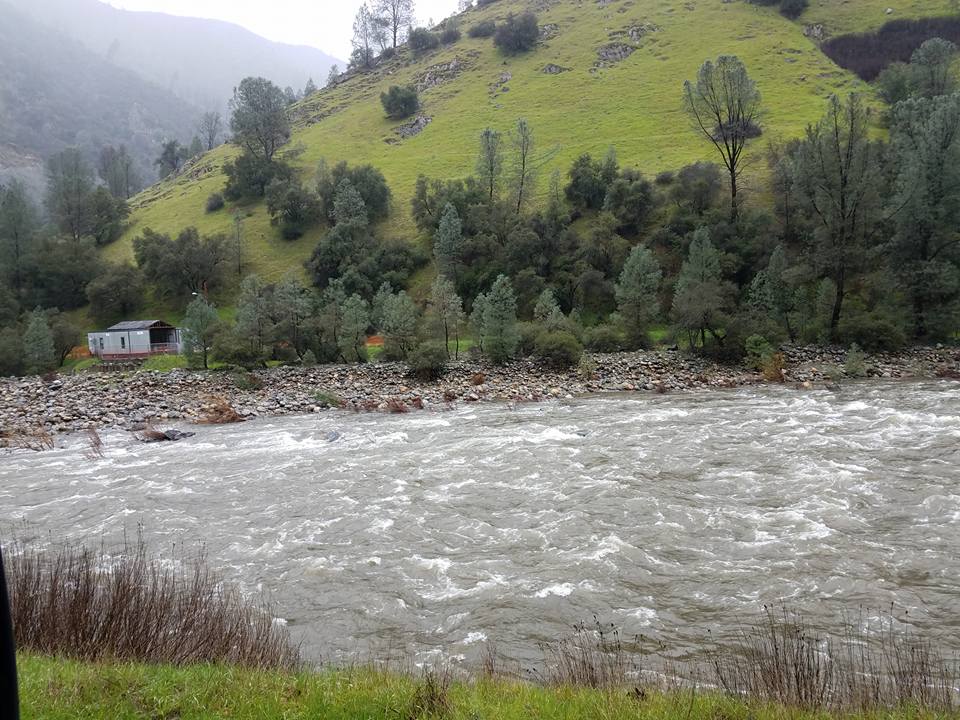
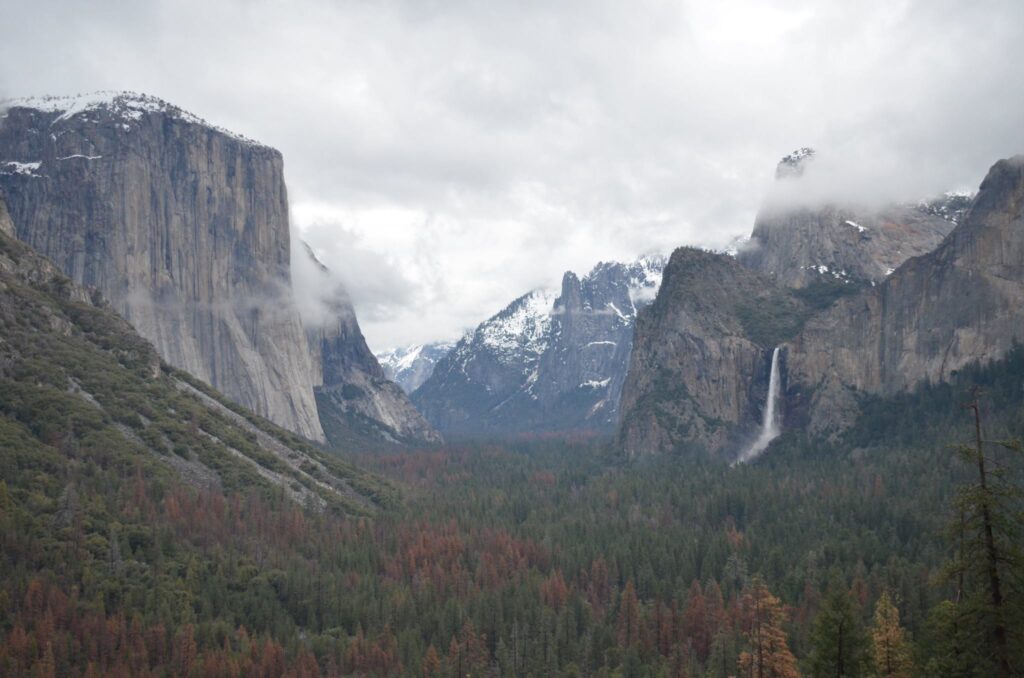
Last year’s visit in 2016, marked by drought, gave my husband Enrique and I, a shy display of water in trickles. It took a trip up to Glacier Point, with a commanding view of Half Dome, Yosemite Village and the Sierras (greeting us with a magical surprise of double rainbows) after gray clouds had cleared a bit. With showers to cool us down, we did not mind it at all, as the rainbows beckoned us to capture God’s magic.
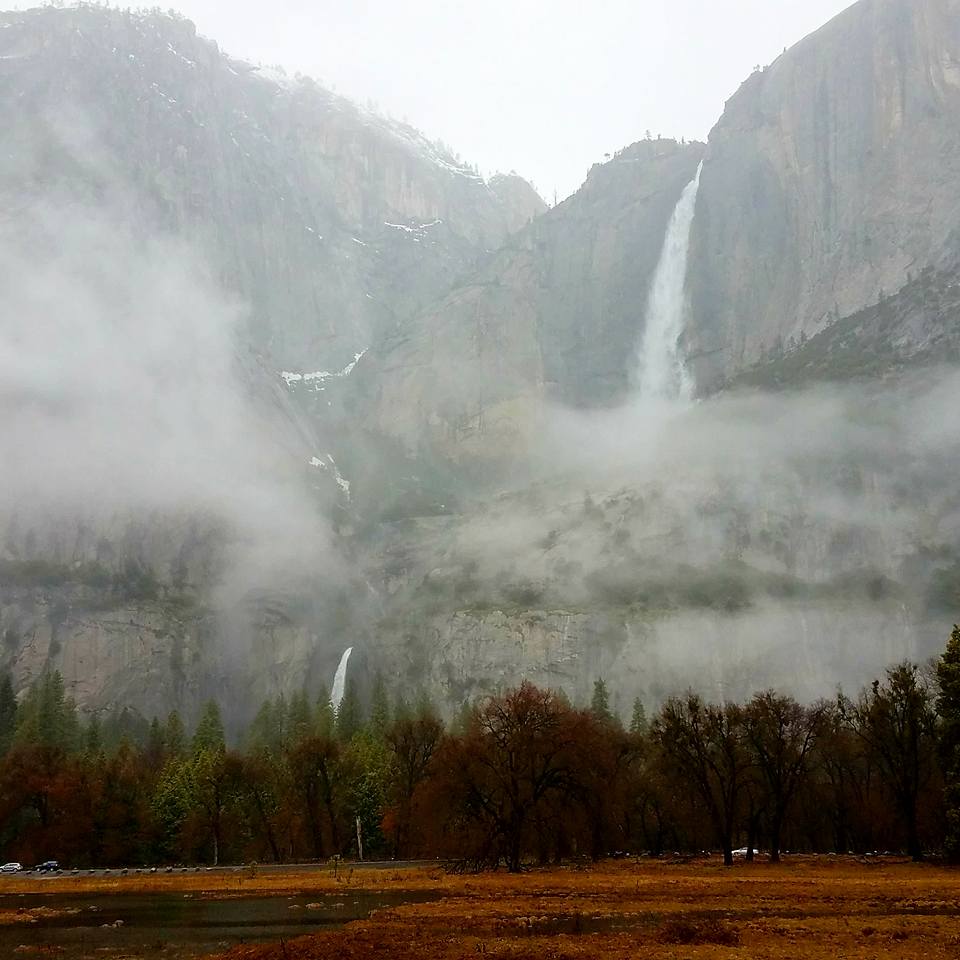
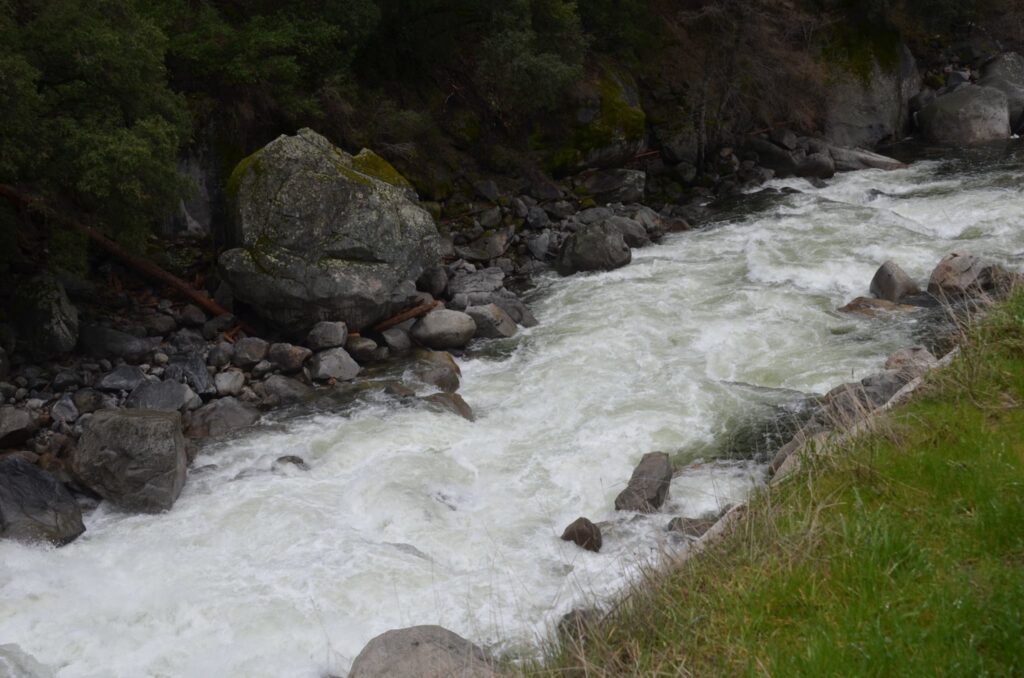
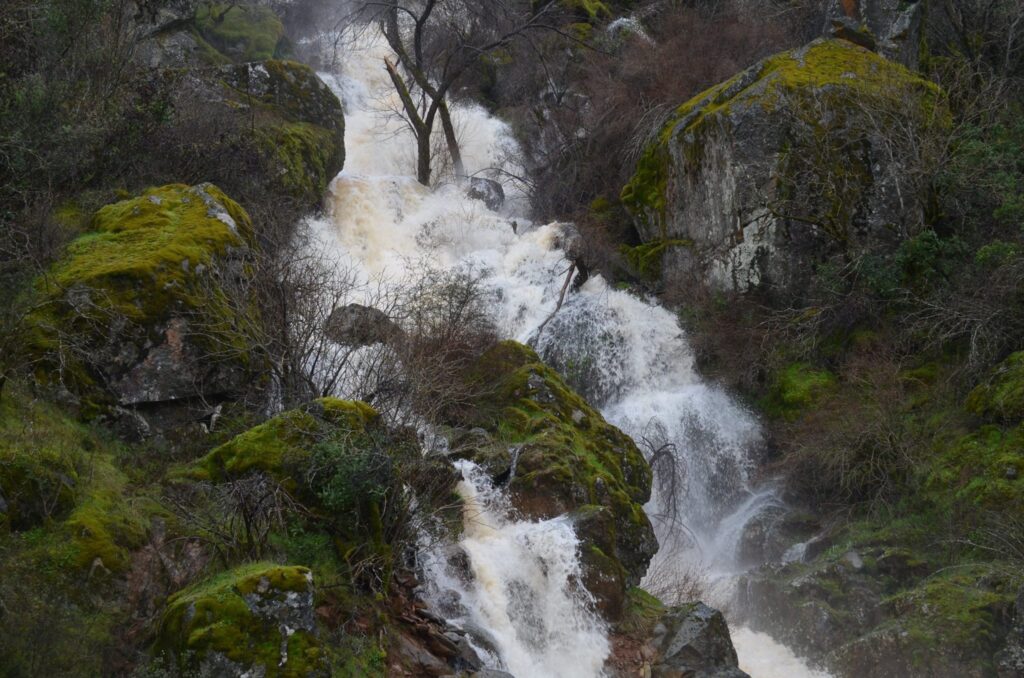
As you get into Yosemite Lodge, the Upper Yosemite Falls rises up to meet you, with its strong flows, as if not enough, a Middle Yosemite falls, and Lower Yosemite Falls, with much stronger volumes, now flowing after several snow storms.
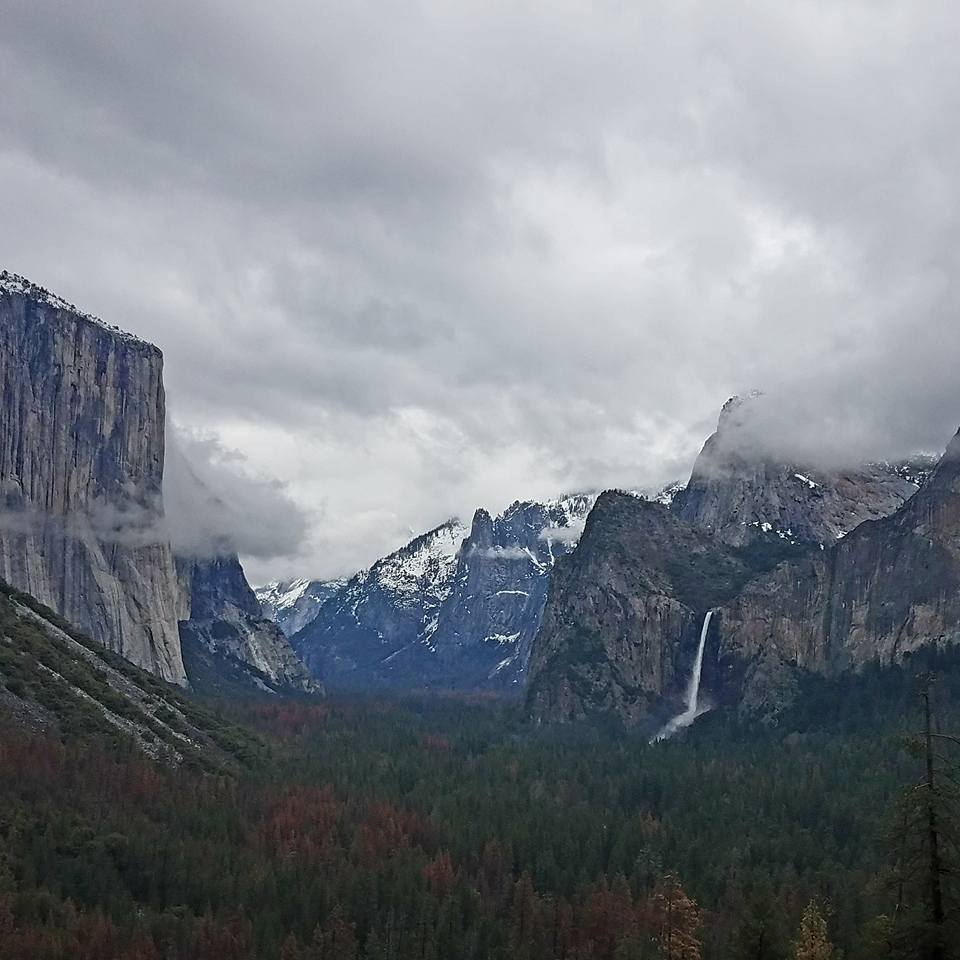
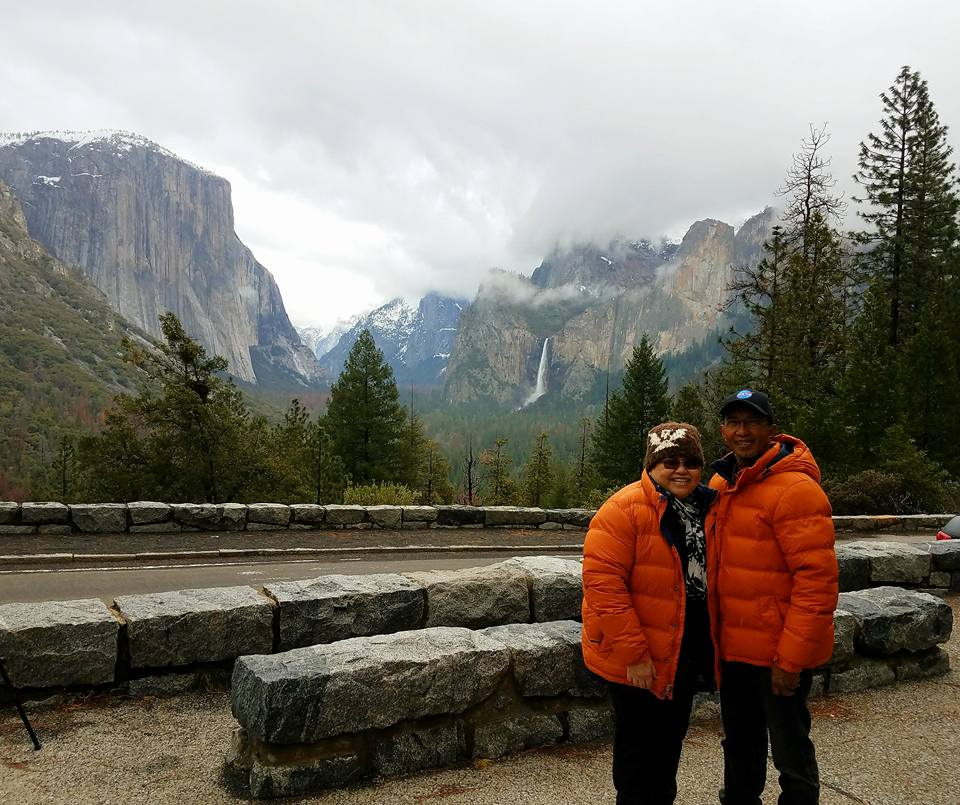
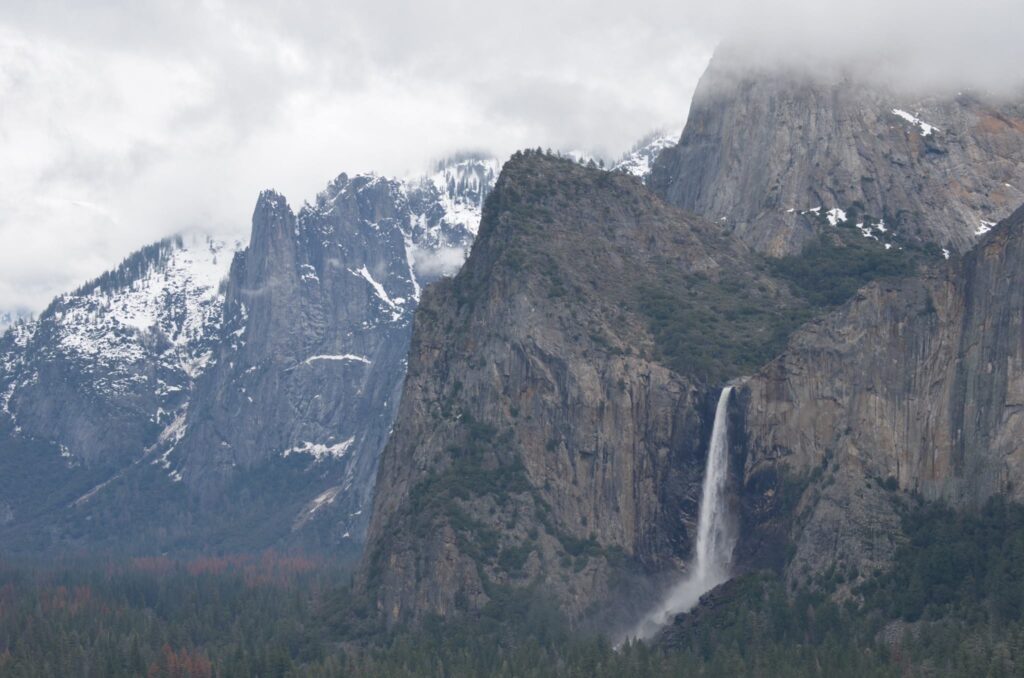
In February of 2016, a snow-dusted Half Dome greeted us with robust water flows at Bridal Veil Falls, causing folks to stop at a viewpoint by the tunnel. I wanted to write snowcapped, but as with each day of warmer weather, the snow had diminished to dusted Half Dome. Yet, its grandeur, and that of Bridal Veil Falls, which we got to hike and be with, up, close and personal, did not diminish.
John Muir’s apparent love for Yosemite is recalled, “No temple made with human hands can compare with Yosemite,“ and his famous quote,” I only went out for a walk and finally concluded to stay out till sundown for going out, I found I was really going in, “ emblazoned on the storefront of Nature Shop in Yosemite’s Lodge.
Firefall and thousands of photographers.
“Firefall was an old Yosemite tradition,” National Geographic’s Kenneth Brower wrote, “Every night a bonfire of red-fir bark was built on Glacier Point. From Camp Curry below came the cry, “Let the fire fall!” And down it poured, a slender cataract of lava splitting the dark cliff. It was a bad idea, probably – no current management plan calls for a rekindling of the Firefall-but it certainly was spectacular. There have been no [man-made] firewalls since 1968, yet a pale scar still shows where the fire burned away the cliff’s lichens.”
Michael Frye, a photographer who took photos of Yosemite for 25 years, now 26 years in 2017, described Firefall at Yosemite National Park, as a convergence of three: “The perfect Horsetail Fall photograph needs three things. First, there has to be enough water. Second, the sun has to be low in the sky when it’s still hitting the fall to give it that orange glow. Third, the cliff behind and to the left of Horsetail has to be in the shade when the water is on fire; the contrast between the backlit waterfall and the dark background is what makes this event so dramatic.”
This 2017, the magic is even more enchanting as the winter rains have created rip-roaring waterfalls, so robust that we can just imagine what sunset would bring, perhaps golden showers so magnificent that would induce tears in us, the photographers. Tears in awe of God’s magic!
We became part of this magical gathering of photographers in Feb. 2016, where Canon lovers stood next to Nikon enthusiasts, exchanging tips. Others had telephoto zoom lenses with a range of 650-1300 mm, while younger photographers with limited resources, applied their creativity instead, using binoculars with iPhones to produce decent enough shots.
Stan Moniz, in a red jacket, became the unofficial mentor to women who admitted their first adventure with Firefall. “Ah a virgin,” and everyone laughed.
For four days, we waited for sunset when the exact moment of God’s magical sun rays would hit the waterfalls, first as mist, then increasing in volume with sunset. By 5:37 to 5:48 pm, the sun would set and give us flashing colors and each day, sunset got later.
On Friday, a gilded vertical yellow water flow and framed by dark shadows, it assumed the shape of a heart or a teardrop. On Saturday, thousands showed up. Sunrays fell on the waterfalls, creating a distinct yellow and framed by orange on its sides. By Sunday, a light yellow on the waterfalls, with a hint of orange flashed and just in a snap, the sun disappeared.
I was ready to go home but Enrique requested one more night for Firefall watching, to which a photographer said, “Make him pay dear.” He took me to Ahwahnee Hotel’s buffet breakfast, now with a new name, The Majestic Yosemite Hotel.
That Monday, we were gifted with yellow, orange and even pink on Horsetail Falls, God’s magic manifested.
The conflict between right and wrong.
During the Firefall watch, many photographers shared their indignation at the renaming of park’s icons: Ahwahnee Hotel to The Majestic Yosemite Hotel, Curry Village to Half Dome Village and Wawona to Big Trees Lodge, “I care that my national parks are national treasures. They are America’s assets. I care that their Indian names are preserved.”
“The first tribe for which we know the name—the last to call the valley its own—was a band of Miwok who named it Ahwahnee, “the Place of the Big Mouth,” for its shape, and called themselves Ahwahneechee, the people of that place,” Kenneth Brower wrote.
Delaware North, once a concessionaire that run these facilities for years, had lost its concessionaire’s privilege. In an effort to squeeze the federal government, it claimed compensation for its alleged trademarks and filed a lawsuit to claim monetary gains for these iconic names: The Ahwahnee Hotel, Curry Village and Wawona, which they pegged the value at $51 million, while the National Park Service counters that the dollar value of the trademarks Yosemite names at $3.5 million.
How can they file trademarks for something that never belonged to them?
The Ahwahnee Hotel was commissioned by the National Park Service’s former first director, Stephen T. Mather, to be built by a private company, Yosemite Park and Curry Company for public use, even if priced to attract only those with money. For example, Bracebridge Christmas event is priced at $1,000 per ticket, while lunch buffet is affordable at under $50.
During World War II, this hotel hosted the US Navy, and in 1943, the Navy converted this into a hospital, “In two-and-half years, 90,000 service men and women relaxed in Yosemite National Park, while 6, 752 patients were treated.”
No written contracts will ever erase the fact that this magnificent acreage belongs to all of us, America. Ahwahnee Hotel might be fictionally regarded intellectual property by Delaware North, but this particular site never belonged to Delaware North, not its name, as it belongs to the Native Americans who lived in this place, regardless of Delaware’s erroneous filings of trademarks, and erroneously decided upon by US Patent and Trademark Office.
We hope these series of wrongs can be righted now by first, a withdrawal request of trademark privileges for Delaware, second, by an appropriate ruling of a judge to return these iconic names to the public and third, due diligence by National Park Service that these public treasures are #NeverforSale, much like in the tradition of National Park Service’s principles in 1896. “The battle we have fought, and are still fighting, for the forests is a part of the eternal conflict between right and wrong, and we cannot expect to see the end of it. I trust, however, that our club [Sierra Club] will not weary in this forest well-doing. The fight for Yosemite Park and other forest parks and reserves is by no means over; nor would the fighting cease, however much the boundaries were contracted. Every good thing, great and small, need defense. The smallest forest reserve, and the first I ever heard of, was in the Garden of Eden; and though its boundaries were drawn by the Lord, and embraced only one tree, yet even so moderate a reserve as this was attacked. And I doubt not, if only one of our grand trees in the Sierra were reserved as an example and type of all that is most noble and glorious in mountain trees, it would not be long before you find a lumberman and a lawyer at the foot of it, eagerly proving by every law terrestrial and celestial that that tree must come down. So we must count on watching and striving for these trees, and should always be glad to find anything so surely good and noble to strive for,” as written in Anne Rowthorn’s compilation of “The Wisdom of John Muir.”
What justifies a private company to claim these intangible names, as if their Garden of Eden or their God’s Firefall, to profit from their alleged fictional sale of trademarks when it is a public asset?
Much like God’s magic in Firefall, so intensely beautiful, what Delaware is doing to treat Yosemite National Park’s iconic names, as if commodities on a fire sale, is so painful to the rest of us, including the 4,000,000 visitors to this park.
(C)2013 {E.DLZ Phototography}, all rights reserved
This two year old, Katrina Rose, taught me how to dance with the wood flappers. She said, “Dance, dance, lift leg” at the Paddle to Quinault Festival. I had the best time as it was spontaneous and she would not stop following me until I followed her by dancing.
90 miles of Wonderland Trail exists in Mount Rainier (it takes 10 to 14 days straight of walking to navigate the entire circumference of Mount Rainier). We walked 4 miles of it one day, and another 3 miles on another day. We crossed White River, and walked into the forest, climbing up and down.