Saturdate with Hubby



LIFE & STYLE, LIFESTYLE COLUMNISTS
‘The Man with the Muck-rake’: Common good requires truth and facts
by PROSY ABARQUEZ DELA CRUZ, J.D.
Previously published in Asian Journal
“In Bunyan’s ‘Pilgrim Progress’ you may recall the description of the Man with the Muck-rake, the man who could look no way but downward, with the muck-rake in his hand; who was offered a celestial crown for his muck-rake, but who would neither look up nor regard the crown he was offered, but continued to rake to himself the filth of the floor. The Man with the Muckrake is set forth as the example of him whose vision is fixed on the carnal instead of the spiritual things. Yet he also typifies the man who in this life consistently refuses to see aught that is lofty and fixes his eyes with solemn intentness only on that which is vile and debasing. Now, it is very necessary that we should not flinch from seeing what is vile and debasing. There is filth on the floor, and it must be scraped with the muckrake, and there are times and places where this service is the most needed of all the services that can be performed. But the man who never does anything else, who never thinks or speaks or writes save of his feats with the muck-rake, speedily becomes, not a help to society, not an incitement to good, but one of the most potent forces for evil.” – Theodore Roosevelt, 1906
That was 1906, and 2018’s muckrake is a Twitter feed from the 45th U.S. president, who has used his account to fire people and to advance his alternate view of reality, prompting sources like CNN, the Washington Post, and BuzzFeed to tally his lies at 5 ½ a day or 2,000+ lies in 400+ days in office.
CNN’s Chris Cillizza reported on the forced resignation of homeland security adviser Tom Bossert on April 11, the 32nd senior staff to leave since Jan. 20, 2017.
“There are only 65 ‘A-Team’ positions in the White House total. Which means that in the 445 days Trump has been president, he has lost 49 percent of his A Team staff. In Pres. Barack Obama’s first two full years in office, 24 percent of his ‘A Team’ staff departed. For George W. Bush it was 33 percent. Bill Clinton? 38 percent,” Cillizza wrote.
That turnover had demoralizing effect for staff that remains, but also, the attrition rate is above – average worrisome.
Yet, “Trump tweeted a defense on Wednesday morning. ‘So much Fake News about what is going on in the White House,’ he wrote, adding the mood at 1600 Pennsylvania Avenue is ‘Very calm and calculated,’” Cillizza continued.
“No” was the president’s reply
On April 6, 2018, CBS News and CNN broadcasted snippets of Trump responding to questions from the press pool while he was on board Air Force One, one of which was whether he knew about Michael Cohen’s payoff of $130,000 to Stormy Daniels.
Trump said “no,” but his hesitant facial expressions did not support his words. The press pool kept at it and asked why did Cohen make the payment, to which Trump said, “You’ll have to ask Michael Cohen, Michael is my attorney. You’ll have to ask Michael.”
Trump’s “no” essentially erased the “client” in the attorney-client privilege, which arguably one can say that the attorney-client privilege is now abdicated by that “no.” It may be a simplistic way of looking at it, that when a client disavows what his lawyer did, then, it can be argued that the attorney-client privilege was waived.
But what Trump did not think of perhaps was how his “no” laid open for the FBI to search his former lawyer’s premises, with a valid, signed search warrant by a magistrate. No longer protected by an attorney-client privilege, the search warrant can be executed.
Furthermore, Trump tweeted, on April 10, following the search warrant’s being served: “The attorney-client privilege is dead” at 4:07 a.m. Did it die when Trump said “no,” and later declared, “Michael is my attorney, you have to ask him”? Some say Trump’s statements threw his attorney under the bus, since basic to any attorney-client privilege is a constant back and forth consultation and communication between the client and attorney.
Cornell University defines it further as “the privilege is asserted in the face of a legal demand for the communications, such as a discovery request or a demand that the lawyer testify under oath.” In which case, the communications between client and lawyer remain a secret, unless it falls under an exception.
Crime-fraud exception to attorney-client privilege
But is this privilege absolute? Cornell University’s Wex Lax Dictionary defines the exception to this privilege: “The attorney-client privilege protects most communications between clients and their lawyers. But, according to the crime-fraud exception to the privilege, a client’s communication to her attorney isn’t privileged if she made it with the intention of committing or covering up a crime or fraud.”
Why would this exception apply in the Stormy Daniels case, the porn star who allegedly had an affair with Trump in 2006, but a week and a half before the 2016 election, was paid $130,000 in hush money to sign a non-disclosure agreement (NDA)? One signature appears on this NDA, Stormy Daniels, aka Stephanie Clifford, but no signature appears for Trump, the other party and only his lawyer, Michael Cohen.
Even though Trump asserted on Air Force One, “no,” and feigned ignorance of what Michael Cohen did, he and Donald Trump filed a $20 million lawsuit to enforce the NDA and to ensure the silence of Stormy Daniels.
The common good, public facts and truth
Why is Cohen an alleged violator of bank fraud, mail fraud, and campaign finance elections limits? What prompted that raid?
Cohen paid Stormy Daniels $130,000 a week and a half before the election, when the Federal Election Commission (FEC) limits campaign contributions to $5,000 per year per individual. The Washington Post’s Carol D. Leonnig, et. al, on April 9 reported: “Michael Cohen, the longtime attorney of President Trump, is under federal investigation for possible bank fraud, wire fraud and campaign finance violations, according to three people with knowledge of the case.”
Given that scenario, the fraud exception to the attorney-client privilege kicks in, including Trump’s denying knowledge of Cohen’s actions, both are dual factors to invalidating the attorney-client privilege that could have protected the president’s communications with his lawyer.
The Washington Post described what was seized: “Investigators took Cohen’s computer, phone and personal financial records, including tax returns, as part of the search of his office at Rockefeller Center, that person said.”
Was this serving the common good?
Recall the words of Theodore Roosevelt that we must undertake “the relentless exposure of and attack upon every evil man, whether politician or business man, every evil practice, whether in politics, in business or social life. I hail as a benefactor every writer or speaker, every man who, on the platform, or in book, magazine, or newspaper, with merciless severity makes such attack, provided always that he in his turn remembers that the attack is of use only if it is absolutely truthful. The liar is no whit better than the thief, and if his mendacity takes the form of slander, he may be worse than most thieves. An epidemic of indiscriminate assault upon character does no good but very great harm.”
Of late, the line between what is evil and what is good has been blurred by the use of the modern-day muck-rake, “Twitter,” whereupon the lies, repeated many times and liked many times, elevate the popular tweet to now a likely truth. Left unchecked, the lie is held to the same equivalence as truth, a very egregious form of intellectual dishonesty. It does not serve the common good — a principle that benefits the many — when dishonesty prevails.
Trump also characterized the attack on his personal attorney’s office as an attack on our country, prompting Senator Chuck Schumer on April 10 to say: “America has been around for over two and a half centuries, an investigation of your personal attorney is not an attack on our country.”
He also added, “In this country no man is above the law, not even the president. Mr. President, your comments were the disgrace.”
CNN reported that Cohen stated that the FBI was “professional, courteous and respectful” in the raids, counter to Trump’s depiction in his tweets. Following the Monday raid, the New York Times’ Matt Apuzzo reported Trump saying, “That is really now on a whole new level of unfairness.”
Was that unfair, as the president claims?
Not really, as there are search and seizure procedures to ensure that the search results are not tainted by improper actions. A “taint team” exists to examine what were seized during the three simultaneous raids, including what constitutes privileged communications between a client and his attorney and might still protected and this segregates the evidence into what is relevant evidence, specifically requested in the search warrant, and anything beyond the scope of the search warrant is returned back to Cohen, and within a specified time period, provided by the court.
But what about the president? Is he not tasked to “preserve, protect and defend the Constitution of the United States,” which includes defending against these felonies: “counterfeiting federal coins and securities, piracy and felonies committed on the high seas, and treason”?
Would he not be interested in making sure that if these federal crimes were committed under his watch, then, would he not promote the discovery of evidence and the resulting adjudication of these crimes, using our court systems or arbitration, and not the subsequent $20 million lawsuit to ensure silence against Storm Daniels, to enforce the NDA?
Robert Reich, the author of “The Common Good,” wrote, “Even before Donald Trump became president, comedian Stephen Colbert joked that the statements of politicians only approximated the truth – ‘truthiness,’ as he called it. The mainstream media, for their part, have occasionally slanted the news out of fear of offending major advertisers or powerful interests in government. New York Times reporter Judith Miller notoriously colluded with the George W. Bush administration in propagating its blatant lie about Saddam Hussein’s supposed weapons of mass destruction. All of this paved the way for Trump – his ubiquitous lies, his ongoing attacks on journalists, and his assault on scientists and researchers. They also served as prelude to ‘fake news,’ some of it coming from foreign sources intent on undermining trust in our democracy.“
I have always maintained that we all, as responsible and informed citizens, are the public guardians of American democracy. As long as we remain ignorant as not read, to discover the facts, from both sides of the political parties, more and more of us will be fed “fake news,” using today’s muck-rake, the tweeter.
On Tuesday, April 10, we watched how Mark Zuckerberg testified before the U.S. Senate while many of the Senators did not even understand the dynamics of Facebook. How may we expect these senators to regulate that which they do not understand to protect our privacy and what is disseminated during election time? To his credit, Zuckerberg admitted his team purged 400 Facebook accounts related to Russian operatives. But he was quick to add there are more that may have escaped their technicians’ scrutiny.
“We must not normalize public lying. The common good requires vigilance against it, and the summoning of public shame when we find it. It is a central obligation of politicians as well as journalists, researchers, scientists and academicians to inform the public of the truth, and to identify lies without fear of retribution. It is the civic responsibility of all of us to check the facts we read or hear, to find and depend upon reliable sources, to share the truth with others, and hold accountable those who lie to us or suppress the truth,” Reich wrote on resurrecting truth in his book, “The Common Good.”
As to Trump’s tweets that the FBI showed favor to Hillary Clinton and is being unfair him, it is hardly the truth. Why? Trump’s appointee, Geoffrey Berman, who contributed to the campaign, and the top federal prosecutor appointed on an interim basis by AG Jeff Sessions, recused himself from this investigation. The warrant was then signed off, as CNN reported, by senior Justice Department officials within Deputy Attorney General Rod Rosenstein’s office.
Rosenstein is a career public servant for the Justice Department for over 27 years, whose prior records included prosecution of public corruption cases as a trial attorney for the Public Integrity Section of the Criminal Division. Amongst the many programs he was part of included the credit card fraud coordination and international assistance programs, and tax enforcement activities of the Tax Division, the U.S. Attorney’s Office and the Internal Revenue Service. He is a career public servant reputed to be a straight arrow and a stickler for the “rule of law.”
If nothing else, Trump can be assured that the law enforcement officials will “cross their t’s and dot their i’s” to ensure they are doing everything by the “law enforcement book” on policy and procedures, to ensure his rights are protected, as well as Cohen, who some say is really Trump’s fixer.
* * *
Prosy Abarquez-Delacruz, J.D. writes a weekly column for Asian Journal, called “Rhizomes.” She has been writing for AJ Press for 10 years. She also contributes to Balikbayan Magazine. Her training and experiences are in science, food technology, law and community volunteerism for 4 decades. She holds a B.S. degree from the University of the Philippines, a law degree from Whittier College School of Law in California and a certificate on 21st Century Leadership from Harvard’s Kennedy School of Government. She has been a participant in NVM Writing Workshops taught by Prof. Peter Bacho for 4 years and Prof. Russell Leong. She has travelled to France, Holland, Belgium, Japan, Costa Rica, Mexico and over 22 national parks in the US, in her pursuit of love for nature and the arts.
“Religion begins in the sensation that your life makes sense within a larger one, that you and the animals have a bond, that the trees and rocks and rivers are to the body of the world as your bones and hair and bloodstream are to your body. You understand, at least in some primal way, that your happiness depends on the happiness of the beings around you. You may even realize that your soul participates in the world’s soul. One etymology of the word “religion,” re-ligare, to bind together, describes the bond between you and your world and ultimately with the hidden, invisible, yet pulsing, breathing, singing source of it all. You are part of that scene and have divinity flowing through you as well. You are what Nicholas of Cusa called deus humanus—a human-god or god-human. Paradoxically, without that divinity you have no humanity. – Thomas Moore, “A Religion of One’s Own,” 2014
SANTA BARBARA, ILOILO — Thomas Moore must have been a prescient witness to the 2018 medical mission by the Philippine Medical Society of Northern California (PMSNC) from January 22-26. It took place here in Santa Barbara, whose second-class municipality’s resources were planned for mobilization, with the help of Dr. Annie Hayag, a retired pediatrician from San Diego, California, and Dr. Marlene Cordero, from Atascadero, California, this year’s medical mission coordinator.
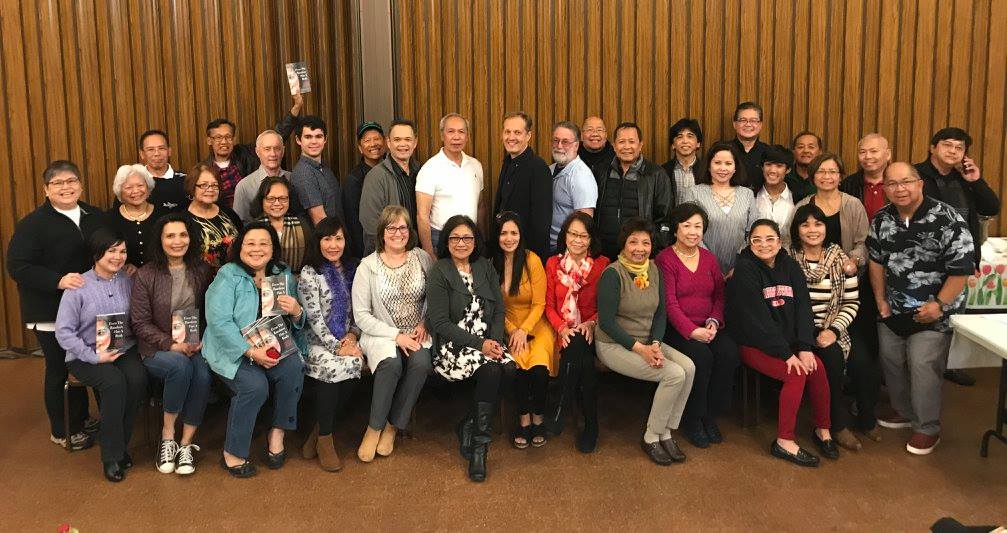
Santa Barbara, Iloilo is not yet a first-class city, but it is transitioning to become one, with its international airport which just opened, including a duty-free shop; mega-city developments by Global-Estate Resorts, a convention center, hotels and more; while its Western Visayas Sanitarium, its public hospital, is still in blueprint stages, for remodeling and renewals, right across an upscale development, called Santa Barbara Heights.

Though local structural resources fell short of what was needed, Cordero kept seeing what could be possible, perhaps because she has been a medical mission volunteer for 23 years and she coordinated this medical mission, complete with volunteers whom she personally knows.
Could it be the influence of her upbringing — two years of high school in Tabuk, Kalinga, exposed to the indigenous culture, which she found “invigorating to face the challenges from the forces of nature, celebrating whenever we can with singing and dancing, a unique culture where women were as equal as men,” as she recalled?
After five days, it would be ‘light-filled experiences’ for 5,283 patients, 175 volunteers answered the call to service, “39 physicians, two dentists, one optometrist, 54 nurses, nine allied health, 48 support & 22 student volunteers,” according to PMSNC’s website.
In surgery, while three rooms were promised, only one materialized on the first day. PMSNC’S medical personnel and volunteers spent the weekend cleaning the surgical room, with a full scrub down of all its walls; while others organized the medical supplies in another room. As days progressed, and with the greater need manifested, more surgical rooms were available.
With the help of Dr. Karen Francia, an ophthalmologist and president of the Western Visayas Ophthalmological Society, she secured the second hospital, Iloilo Doctors’ Hospital, to provide the medical mission with additional operating rooms for all the cataract surgeries. She even took an extra step of obtaining the necessary authorization from the Philippine Association of Ophthalmologists for eye surgeries.
The receiving portal for 5,283 patients to be triaged was in a partially covered gymnasium, and upstairs, the barangay health office where community education workshop was provided to manage chronic health conditions of diabetes, hypertension and other diseases of the aging population. In intense heat, the partially covered gymnasium could not provide adequate shelter to the patients and the families with children needing pediatric, respiratory treatments for asthma, and dental work.
It took Dr. Carmencita Abarquez-Agcaoili, outpatient director of PMSNC from California, who negotiated with a responsive local Mayor Dennis Superficial, M.D. (a surgeon), for tarps, huge electric fans and more lawn chairs to be provided for thousands in line, making Tuesday’s mission more organized.
Suffering existed on both sides, yet all were committed, to achieve, and to provide the highest possible level of medical care for 5,283 patients.
Imagine these patients’ resilience of enduring their pain, some a year and more for goiters and hernias, while medical volunteers endured long hours of work in intensely humid and hot weather (86 degrees Fahrenheit), made worse by cemented floors, oozing their accumulated heat, after sporadic rains.
Undeterred, these volunteer dentists, doctors, pediatricians, respiratory doctors, nurses, radiologists, biomedical engineers, residents, physician assistants and ophthalmologists worked with no fuss, set up what was required, including disinfecting stations for the dental department.
The ambulance had one seat for the driver, a torn passenger seat with sprung springs as if saluting the passenger who dared to sit down, along with a wood bench for the passengers to sit in the back. It had no stretcher or rescue equipment.
Even with this obvious lack, doctors and surgeons and nurses and allied health personnel rallied with cooperation and delivered their best efforts.
Two-hundred eight patients received surgery, which included, 40 for major (thyroidectomies, mastectomy, repairs of cleft palate, release of burn strictures, and herniorrhaphies), 139 minor and 49 ophthalmology procedures (39 cataract surgeries), as reported by Fred Acelar, who heads the IT department of PMSNC.
I witnessed volunteers approaching Cordero, some moved to tears by what they saw, with thousands needing medical care. Yet, she remained calm and resilient in problem-solving mode. She held their hands so to speak, and got them to reconnect with PMSNC’s mission.
Richard Samoranos, a first-time volunteer shared: “While on the mission, Dr. Marlene Cordero demonstrated exemplary leadership in the face of many challenges. She served as a model for me to keep focus and to commit to the mission’s mantra rather than letting my emotions cloud my judgments or competence. While shadowing the emergency room (ER), I encountered several stressful situations but it was Dr. Marlene Cordero’s leadership that kept me motivated and focused.”
Could it be that Cordero was drawing from her own teenage to adult development, “may bantay parati (I was always chaperoned), with limited exposure and then to experience social issues of having to stay in the dorm, nurtured by teachers and nuns?”
Teamwork to be proud of
Cordero recognized the volunteers: “Teamwork, I could not be more proud of,” at an Alameda-based appreciation lunch held in March 2018 at St. Albert’s parish hall.
One patient encountered a two-hour wait before she could be attached to the respirator; yet, the surgical team stayed to manually bag the patient to keep the oxygen supply going.
Cordero reported on the heroic efforts of a doctor who was going to catch a flight at 4 a.m., and stayed in the post-surgical recovery room with the patient and family, until 10 p.m., to see the patient recover.
Yet, one patient was lost, 15 days after the mission’s successful operation. That patient had a congenital heart condition that was not revealed, nor known before the operation. Somehow, someone snuck in solid food to feed this patient, who complained of hunger, creating post-surgical complications. Normally, after surgery, feeding is eased by IV, liquids, and not until after several days, solids. The patient passed away from his weak heart, 15 days after the mission.
The days of the mission always started with a prayer. Even the local folks complained about how the conditions were, compelling the locals themselves to provide bottled water to the medical mission volunteers. The locals also stopped the patients from coming in at 2 p.m., as it got too hot, while all were exposed to the sun and although receding, got more intense.
Ricky, a fourth generation Filipino-American, shared what the mission meant to him: “I felt instant connectivity to the land where my blood comes from. It is my first time to see the land, it was my first time to see blood, and it was my first time to travel internationally. I saw a patient who needed 800 cc. of blood. I was shadowing the family and I made the relationship with them primary. It strengthened my resolve to be a doctor, said a prayer for that patient, and to do better for myself.”
Another volunteer said, “This is a once in a lifetime opportunity by American doctors, used to having new technology. Now, it takes their smarts and creativity and will to help others, even without the technology.”
Dr. Carmelo Roco declared he will be a permanent volunteer, “We (his wife, his children came to the mission) will spend the money and time. What do I get? I become more humble, the way they live energizes me. It makes me more accepting as a person, to be content and happier with what I have, an energizing third factor. We all become better persons, and a better future perhaps. I worked with what I had. Patients were smiling and so appreciative. They trusted us, were relaxed, and looking to us to care for them.”
During the volunteers’ appreciation lunch this past March, which this writer traveled to go to Alameda, California, using her own funds, she witnessed PMSNC’s members recognize Cordero’s effective leadership, including the unseen burdens she shouldered on that required problem-solving as if no complications nor difficulties were happening.
Could it be that Cordero has been in active leadership positions, as chairs of California Department of Mental Health’s Psychopharmacology Advisory Committee; Atascadero State Hospital’s Department of Psychiatry, as president of PMSNC as well as its Executive Board Member, including founding President of Atascadero Performing Arts Center Committee and its member since 2003 to the present, while as founding president of the University Nueva Vizcaya’s Alumni Organization in 2015 to the present?
Who is this engaging Cordero?
To Anne Adorio, a two-year volunteer, “Dr. Marlene Cordero is simply not just an epitome of an inspiring leader and phenomenal mentor, but also a model of such in her own right. Many may say that it is premature for me to say this, as I have only known her for a couple of years. I must say though that a long time is not necessary to recognize what a beautiful person she is inside and out.
“During our medical missions in Dumaguete (2017) and Iloilo (2018), she auspiciously carried out her duties with integrity and candor. She earnestly communicated even last-minute information to ensure that missionaries were duly apprised. When some situations have taken a different turn, may it be big or small; she was responsibly forthright about it. Her kind, humble, genuine and gracious demeanor was a great tool in inspiring me to conclude even the hardest and longest workday with a modest heart. When complicated dilemma was brought to her attention, she instantly handled it with her quick wit, objective approach and reverential treatment. When immediate resolution was not available, she looked for possible solution or alternative.
“I must sincerely and deeply commend her for the compassion she has shown to me when I spoke with her about my desire to bring my two children to the mission. Being minors, I was not sure what certain parameters govern the ages of volunteers, but she accepted them with open mind, kind heart, and inspiring little talks. She managed to check on them in spite of her hectic schedule. This is truly an amazing trait of not only a well-accomplished physician and leader, but also a mother with utmost and genuine concern for the youth whom we all believe to be our future. It was because of this opportunity that my children solidified their long-term goal, and that is for Kristyl Plamenco to be a pediatrician and Kyle Plamenco to be a dentist some day. May this materialize or not, it does not really matter. What matters most is how instrumental she was to their lives… and mine. More power to her and may her life be more blessed. Hats off to you, Tita Marlene!”
Cordero is a woman of many firsts, resilient in many fronts (whether urban, rural, military and faith-based): Elementary to Second Year High School at St. Mary’s in Bayombong, Nueva Vizcaya; Valedictorian at St. Teresita’s High School in Tabuk, Kalinga-Apayao (where her father was assigned as district engineer); Cum-Laude and Dean’s Lister for her B.S. Pre-Medicine at U.S.T. in Manila; Benemeritus for her Doctor of Medicine Degree in UST;postgraduate training in psychiatry and neurology and obstetrics and gynecology at the Armed Forces of the Philippines Medical Center in Q.C. Philippines; rotating internship at Makati Medical Center in Makati, Philippines; and completed her residency in general psychiatry in Western Missouri Mental Health Center, affiliated with the University of Missouri in Kansas.
Today, she is a practicing psychiatrist in solo private practice, and a retired state psychiatrist who has served 28 years with the California Department of State Hospitals, and as a retired annuitant (she works for part of the year, as needed).
During the medical mission, she came with her husband, Dr. Reynaldo Cordero, a surgeon, who served as one of PMSNC’s former presidents. Together they have three children, Rex, Reynalene and Megan, who attended the volunteers’ appreciation lunch in Alameda.
How she balances to keep her family intact, her community, her volunteer work and her professional licensed practices active, is a testament to how she keeps God at the center of her life, but also, she consciously practices her Catholic religion, binding the invisible God’s Power with her visible brand of empathy with folks whom she meets and mentors.
Maya Angelou said in essence, people do not remember how many cars you drive nor the degrees you have, but they fully remember how you made them feel. With Cordero, as volunteers came to her and brought their personal and mission issues to be solved, it felt she heard them and they had a soft chair to fall on.
I am grateful to Asian Journal for my column, actually it was last Nov. 2017 to mark my writing for 10 years – imagine over 600 submissions now. 600+ submissions that I had to research, read books on, travel to do one on one interviews, attend conventions, book talks, and public events.
The travels on my own budget have taken me to Japan, Philippines, Holland, France, Belgium, DC, SF, Costa Rica, and national parks.
It has allowed me to cover Pope Francis, Barack Obama, Hillary Clinton, local mayors and congresspersons, enterpreneurs like Sriracha owner and manufacturer, artists, musicians, composers, arrangers, tv hosts, theater directors, chefs, choral groups, academicians, realtors, 50+ priests of Filipino, Irish and Latino heritage, healing priests, middle school children, college students, painters, poets, festival organizers, curators, and hair and makeup stylists. From them, I soaked in their life lessons and wisdom.
I am most grateful for the trust given to me by Cora Oriel. I am also grateful for the new assignments from Roger Lagmay Oriel and most especially my meticulous, thoughtful and smart editor Christina Oriel.
I am most appreciative that together with the AJ staff, Rhizomes, a column in AJ paper and occasionally, submissions to Balikbayan Magazine have been spaces for spirituality, exploring dimensions of faith, God’s blessings in Nature, Filipino empowerment, creative spirit, musicianship, creativity, policy, human rights, civil rights, elections, voting, citizen guardians of democracy, no more Hiroshimas, grandparenting, couplehood, and taking care of our souls! Thank you to all of you AJ readers and more!
She loved her lighted balloons and her abuela-sewn pajama dress. Even her Pete Souza’s book for children, “Dream big dreams.”


“Few individuals have plumbed the depths of their rage, hatred, terror, jealousy, and despair or the scope of their wisdom and power of their compassion, yet these currents run beneath the surface of #awareness in each of us, like great rivers on the floor of an ocean.” – Gary Zukav, Jan.5, 2018
I remember a friend who shared how her husband died, shooting himself in their joint residence. I did not have the words to comfort her, only my living presence. Only to discover that some of my friends are really angels on earth, as one said, “Take her to my concert tonight, it is a benefit for the Suicide Prevention Association.”
I was dumbfounded, as I simply had one question to the heavens: How do I bring comfort to her when I have no idea on how to help her? At the concert, the organizer revealed her angst at having a “permanent shadow” accompany her family at all times.
I remembered Ernest Hemingway and how his surviving family members must have felt, carrying that shadow wherever they went.
Only to learn recently that Phil Graham, also committed suicide in his home in Glen Welby. He was the former publisher and president of the Washington Post, who run the paper for 17 years, and who said: “Journalism is the first draft of history” in 1957. How did his wife, Katharine Graham, pick up the pieces, to leave behind her rage, and to emerge the person of grace and strength, and one who with a strategic vision for her country, America?
Women coming of age
I watched “The Post” (a movie) and I could not quite adjust my feelings towards how indecisive Katharine Graham (owner/publisher of the Washington Post) was yet, meticulously adept in asking questions of her inner circle, but clueless in realizing that she has the authority to make the final decision. She was depicted as ambivalent and evasive of conflict, which she admitted in her personal memoirs.
Then, portions of the Pentagon Papers were delivered to the Washington Post’s assignment editor and thousands of pages were given by Daniel Ellsberg to the Post.
She made a crucial strategic decision of publishing the Pentagon Papers, which catapulted the Post into a credible source of news, facts, evidence and true to its mission as a newspaper. The Washington Post became a key resource for national news.
Russ Wiggins wrote a personal note to the staff: “Philip L. Graham has left in our daily care and custody an honest and a conscientious newspaper which I know that all of you are eager to maintain as a daily memorial to his own genius and integrity. And now we must take up the duties he laid upon us, with a heavy heart, but nonetheless with a high hope that we may succeed in doing what he would have us do.”
I am presently reading Katharine’s Pulitzer Prize-winning memoirs and how she evolved from being supportive of Pres. Lyndon B. Johnson’s actions in Vietnam and later, developed her personal opposition towards the war, given her eldest son’s personal letters to her, while deployed as a soldier in Vietnam. He wrote about the senseless violence towards an ill-defined cause and really did not quite advance the national security interests of the United States.
The Post continued to report on the Vietnam War, and the 500,000 U.S. soldiers deployed there. It then grew its editorial department in 1966-1969, when the Post added 50 positions and its budget grew from $2.25 million to $7 million in 1969.
Katharine is depicted in the film, “The Post,” as nervously taking a stand to publish the Pentagon Papers and closely monitoring the backlash and at the same time, experienced the solidarity of the newspapers around the U.S., who followed the Post’s lead and published the “verboten” Pentagon Papers. Katharine rationalized her decision in keeping with the newspaper’s mission and putting the nation’s interests before the papers.
It peeked my curiosity to keep reading about Katharine and how she evolved to strengthen her resolve, her convictions, and even her own stance, amidst being surrounded, influenced, criticized meanly, and strongly pressured by strong men around her, including Pres. Johnson.
The impact of a woman’s decision: The Washington Post and New York Times’ U.S. Supreme Court decision
It is a life that she allowed other folks to guide her, but also her own inner convictions to stand by her own decisions. For example, it took tremendous courage for her to set a precedent of publishing the Pentagon Papers, then, joined in a lawsuit with the New York Times, and wait nervously for the U.S. Supreme Court’s decision, 6-3, written by Justice Hugo Black, excerpted here in part:
“In the First Amendment, the Founding Fathers gave the free press the protection it must have to fulfill its essential role in our democracy. The press was to serve the governed, not the governors. The Government’s power to censor the press was abolished so that the press would remain forever free to censure the Government. The press was protected so that it could bare the secrets of government and inform the people. Only a free and unrestrained press can effectively expose deception in government.
“And paramount among the responsibilities of a free press is the duty to prevent any part of the government from deceiving the people and sending them off to distant lands to die of foreign fevers and foreign shot and shell. In my view, far from deserving condemnation for their courageous reporting, the New York Times, the Washington Post, and other newspapers should be commended for serving the purpose that the Founding Fathers saw so clearly. In revealing the workings of government that led to the Vietnam war, the newspapers nobly did precisely that which the Founders hoped and trusted they would do.
“The Government’s case here is based on premises entirely different from those that guided the Framers of the First Amendment. The Solicitor General has carefully and emphatically stated:
“Now, Mr. Justice [BLACK], your construction of . . . [the First Amendment] is well known, and I certainly respect it. You say that no law means no law, and that should be obvious. I can only [p718] say, Mr. Justice, that to me it is equally obvious that “no law” does not mean “no law,” and I would seek to persuade the Court that that is true. . . . [T]here are other parts of the Constitution that grant powers and responsibilities to the Executive, and . . . the First Amendment was not intended to make it impossible for the Executive to function or to protect the security of the United States.[n3]
“And the Government argues in its brief that, in spite of the First Amendment,[t]he authority of the Executive Department to protect the nation against publication of information whose disclosure would endanger the national security stems from two interrelated sources: the constitutional power of the President over the conduct of foreign affairs and his authority as Commander-in-Chief.[n4]
“In other words, we are asked to hold that, despite the First Amendment’s emphatic command, the Executive Branch, the Congress, and the Judiciary can make laws enjoining publication of current news and abridging freedom of the press in the name of “national security.” The Government does not even attempt to rely on any act of Congress. Instead, it makes the bold and dangerously far-reaching contention that the courts should take it upon themselves to “make” a law abridging freedom of the press in the name of equity, presidential power and national security, even when the representatives of the people in Congress have adhered to the command of the First Amendment and refused to make such a law.[n5] See concurring opinion of MR. JUSTICE DOUGLAS, [p719] post at 721-722. To find that the President has “inherent power” to halt the publication of news by resort to the courts would wipe out the First Amendment and destroy the fundamental liberty and security of the very people the Government hopes to make “secure.” No one can read the history of the adoption of the First Amendment without being convinced beyond any doubt that it was injunctions like those sought here that Madison and his collaborators intended to outlaw in this Nation for all time.
“The word ‘security’ is a broad, vague generality whose contours should not be invoked to abrogate the fundamental law embodied in the First Amendment. The guarding of military and diplomatic secrets at the expense of informed representative government provides no real security for our Republic. The Framers of the First Amendment, fully aware of both the need to defend a new nation and the abuses of the English and Colonial governments, sought to give this new society strength and security by providing that freedom of speech, press, religion, and assembly should not be abridged. This thought was eloquently expressed in 1937 by Mr. Chief Justice Hughes — great man and great Chief Justice that he was — when the Court held a man could not be punished for attending a meeting run by Communists.”
“The greater the importance of safeguarding the community from incitements to the overthrow of our institutions by force and violence, the more imperative is the need to preserve inviolate the constitutional rights of free speech, free press and free [p720] assembly in order to maintain the opportunity for free political discussion, to the end that government may be responsive to the will of the people and that changes, if desired, may be obtained by peaceful means. Therein lies the security of the Republic, the very foundation of constitutional government.[n6]“
Would you, as sworn U.S. citizens, register and vote, and guide by your votes, our elected leaders to sustain their adherence to truth, uncensored news publications, and responsible use of power at any levels (executive, legislative, judicial)? Or would you blindly succumb to protecting your perceived economic station in life and by your vote, improperly believe to protect that status? How would you act as guardians of this U.S.-based democracy with integrity and adherence to truth and social justice?
Katharine Graham was not trained to be a CEO nor trained to be a publisher. She watched from the sidelines and did not have an opportunity to hold a full-time job, until her husband died.
Yet, she made the most visible, credibility-sustaining decisions for her newspaper, the Washington Post, displaying her personal courage, “the scope of her wisdom and power of compassion,” and love for this country’s democratic freedoms.
Through that national exposé, it initiated a national debate to purge our nation from its involvement in an unjust war in Vietnam, which to the end, had 58,220 U.S. military fatal casualties, between 200,000 to 250,000 South Vietnamese soldiers dead and 1.1 million North Vietnamese and Viet Cong casualties. By far, the most casualties were incurred in World War II, battle deaths and civilians of all countries to have been 56.4 million. (Source: Britannica.com)
In examining your own lives, have you faced choices where you placed truth above lies, love of country first over your pocketbook, harmony over personal grudges and deep anger?
What legacy are we building by our personal actions? To this day, Katharine Graham’s personal decisions of courage and commitment to the mission of truthful news information inspire me and I dare say, a multitude of women on how to use feminine power in the workplace — to uplift the truth!
* * *
Previously Published in Asian Journal